

Councils from across Kent and Medway have published a series of draft business cases to help inform the next steps in the government’s biggest shake up of local councils in 50 years.
The cases, compiled with the help of experienced advisers KPMG, explore different options for the number of unitary councils in Kent and the areas they should cover in the future.
Under the current system Kent County Council (KCC) delivers some services like education, social services and roads, and district or borough councils deliver others like emptying your bins and providing housing services.
In the proposed system, unitary councils would deliver all council services in one area. Medway Council operates in that way today.
The reorganisation will mean all 14 councils will be abolished and replaced with a smaller number of much larger unitary bodies.
In September, councils chose two options to explore in more detail using government money.
The first was three unitary councils (picture below) consisting of Dartford, Gravesham, Medway and Swale in the north; Sevenoaks, Tonbridge and Malling, Maidstone and Tunbridge Wells in the west and Ashford, Canterbury, Thanet, Dover and Folkestone and Hythe in the east.

The next was four unitary councils (picture below) consisting of Dartford, Gravesham and Medway in the north; Sevenoaks, Tonbridge and Malling, Maidstone and Tunbridge Wells in the west; Swale, Ashford and Folkestone and Hythe in the middle of Kent and Canterbury, Thanet and Dover in the east. Thanet council leader Rick Everitt previously said TDC’s preferred choice is 4b.

Councils across Kent kept the option to pay for and submit business plans for alternative options themselves using the KPMG data.
Medway Council is proposing a four-unitary model with changes to existing council boundaries (picture below).

Gravesham Borough Council and Dartford Borough Council have developed proposals for a five-unitary model (picture below) also including a number of boundary changes.

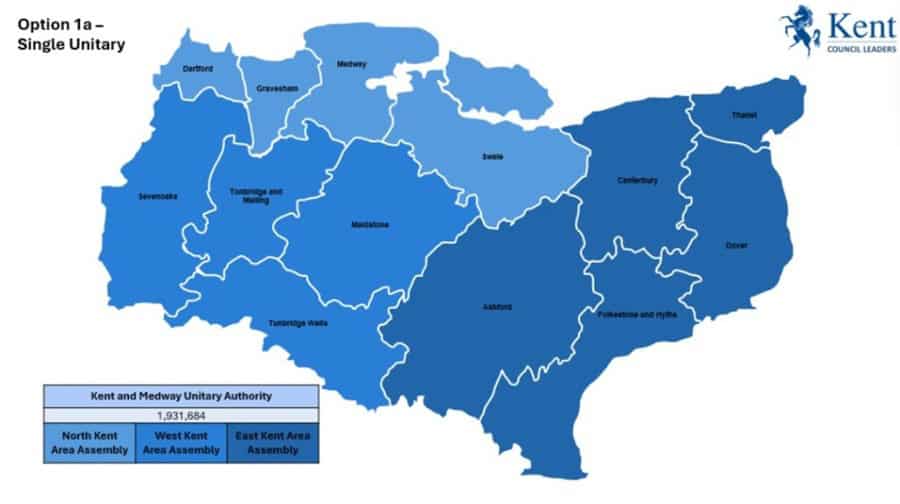
KCC announced its intention to explore the case for a single unitary council (picture below) covering Kent and Medway supplemented with three area committees covering the north, east and west of the county.
Throughout November, each individual council will use its own decision-making process to confirm its preferred model and associated business case.
Business cases then need to be submitted to the government by Friday 28 November.
In the new year, the government is expected to carry out public consultation with all Kent residents on the preferred options.
A decision by the government on the final structure of unitary councils is expected in the summer.
Meanwhile, the results of a public and stakeholder engagement exercise held to find out from people living, working and studying in Kent about what is important to them in reorganising councils has been published.
It found the public wants the new arrangements to focus on the quality of the services provided, ensure efficiency and value for money and to solve people’s problems quickly.
The public saw opportunities in simplifying local government structures, clarifying responsibilities and making the most of economies of scale to streamline operations, reduce bureaucracy and deliver better value.

This will end in tears! I don’t see whats wrong with the current set up, at least my District Councillor lives in my Ward!
Does your Councillor by living in your Ward guarantee top class service and experience? Your Councillor is selected by usually a very small group on people in each of the different party’s and not necessarily on merit.
Whatever option is chosen, this is a win-win for Thanet. All of our neighbouring Councils provide better services and value for money than TDC so our residents can only benefit from reorganisation. Having competent Councillors in a new Cabinet will be a refreshing change.
Just think, we might even get coastal toilets open all year round too like what happens in Dover and Canterbury Councils !
Bring it on.
100% agree! Those who think TDC are OK need to travel just a few miles outside the area to notice a real difference.
I agree with your first comment as neighbouring Councils do have more money to spend, will they spent more on Thanet, the answer may lie with the God of which ones you may or may not follow?s. However expecting to have competent Councillors in a new cabinet is wishful thinking at best>? If Margate does have it’s own Local Council it is almost certain the same faces that are on TDC will be there>?
Same faces ? I doubt it. Labour are heading for a total wipeout the next time the voters get their say. They’ve turned into a banter party.
I am afraid there is a lot wrong with the current system. District councils were installed because the rural lobby wanted more of a say.It got that more of a say and what we ended up with is TDC and areas of deprivation.Had investment been made 30/40 years ago, the ingrained level of deprivation might have been averted.Unitary councils are not new,they were proposed in 1968/9, but there was a vociferous campaign by Rural District Councils in particular about loss of identity and this is where we ended up.
Unitary councils are not a solution in themselves they are a starting point.
As expected, the various political parties have punted their own preference, but I don’t think they can rely on voters docilely voting the way they want.The Reform version is the worst, not because it has come from them, but because it is yet more unwanted centralisation. KCC have not done East Kent any favours,in the last 40 years, by shutting down everything to the east of Ashford and installing the remains in West Kent. Investment in East Kent by KCC, has been top down, minimal ,and quite, quite useless. Reform might have had a better case, had they started off rather the better than they have.The constant internal rows,put people off.
As for the rest, the 3 council scheme works best, because East Kent is going to be the weakest of the 3, because of deprivation and social care, so making it smaller in a 4 or 5 council scheme makes no economic sense.
All 4/5 schemes rely on existing borders,which is unnecessary. The middle districts Ashford and Swale, could be broken up, as Faversham belongs with the east, but Ashford probably belongs with the west. If we did that the NHS boundaries could be made co-terminus, and the nonsense of patients being transported miles away from Thanet etc, all the way to Ashford could stop. It doesn’t make any sense, as how on earth can a stroke patient be treated successfully if takes an hour to get them to the Wm Harvey for treatment. All that verbiage coming from certain parts of the medical elite about HASU’s can be thrown in the bin.
As I said Unitary councils are the start, once that is done and done quickly, the NHS,Fire, Police, Transport, and further education can be folded in, so they all work together. Who knows, perhaps in the fullness of time even NOMS can be made to work properly.
4d and 5a don’t “rely on existing borders”. They both include multiple district boundary changes.
I am fully in favour of unitaries and always have been, but before people get too excited about the performance of neighbouring councils, have a look at the debt they are carrying. A share of that is heading your way.
Change for the sake of change, is not good, this will not end well for a multitude of reasons.
You’re happy with TDC compared to other nearby councils?
No, but a unitary authority proposal is like throwing the baby out with the bath water, it simply needs Thanet to have an independent body come in, investigate and offer proposal road map for improvement and if that doesn’t work, incorporate itinto Canterbury as an area, in the same way herne bay and whitstable were many years ago. A unitary authority will offer less efficiency in costs and operationally, that is a fact. There are better ways, lest not forgetc15 years of devolution and tory cuts have caused this black hole. Unitary authority will not fix this, but better governance from each district will. If anything it should go the other way and abolish KCC, and allow each area to run itself from every aspect.