

By Local Democracy Reporter Daniel Esson
Kent’s recycling rates have been examined, just months before sweeping new national rules will overhaul how bins are collected.
From March, councils will have to provide standardised collections of glass, metal, plastic, paper, card, and food waste from every household in England as part of the government’s plan to drive up recycling rates.
The aim is to ensure “consistency” across the country – meaning the number and type of bins outside people’s homes will soon look much the same wherever they live.
The government has set an ambitious target for 65% of household waste to be recycled by 2035.
Kent’s performance
But new figures obtained by the Local Democracy Reporting Service reveal that Kent’s overall performance still has a long way to go.
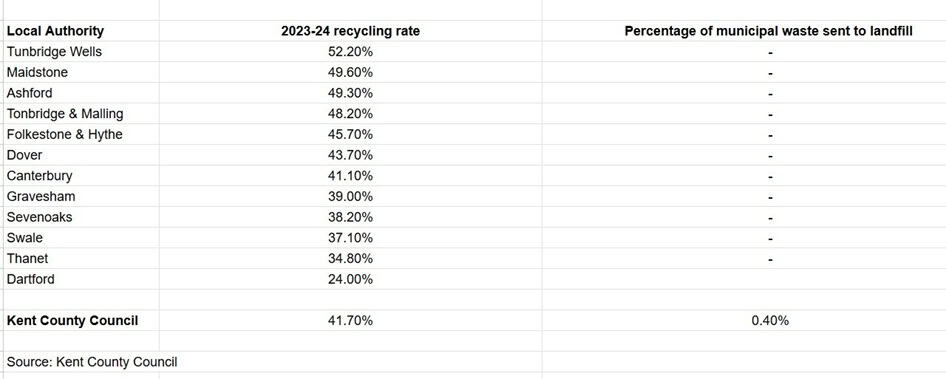
According to verified data for the 2023-24 financial year, our councils recycled, reused, or composted 41.7% of household waste, with just 0.4% going to landfill. The rest is sent for “energy recovery”, meaning it is burned to generate electricity for the National Grid.
Some argue local authorities should be “doing more” for the sake of the environment – but others believe we may have already reached “peak recycling”.
Across the county, Tunbridge Wells Borough Council (TWBC) came out on top – while Dartford was the worst performer, recycling less than half as much.
The former recycles more than 52% of its waste, the highest rate in Kent.
At the other end of the table, Dartford Borough Council (DBC) has consistently recorded the lowest rate in Kent, remaining in the mid-20s percentages since 2017.
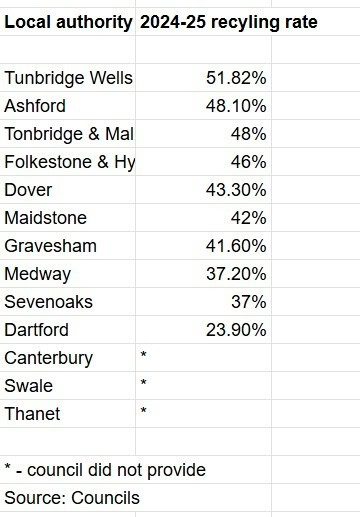
Provisional stats for 2024-25, not yet verified by the government, show little change.
Rates for Thanet
For Thanet, the 2023-24 figures show a recycling rate of 34.80%. Although the council did not respond to the LDRS for this year’s figures, in July TDC said the rate was 35%.
Talking about the upcoming changes, TDC said approved changes on the isle would affect approximately 27,000 properties by March 2026. The remaining households already receive collections that are in line with the new rules and will see no changes.
In July TDC agreed that properties currently having a weekly refuse collection (black bins or seagull proof bags) would switch to alternate weekly refuse and recycling collections, bringing them in line with the rest of Thanet.
A new weekly food waste collection will also be introduced for residential properties that don’t already have one. In areas where residents currently use seagull proof bags, the introduction of lockable food waste caddies should reduce instances of animals ripping open rubbish bags.
Thanet’s recycling rate is one of the lowest in Kent and significantly lower than the national average of 44% – 45%.
The roll out of the approved changes began in August with communal properties affected, and will be followed by the remaining affected properties seeing simpler recycling from January 2026. All affected properties would have new collection regimes in place by April 2026.
The cost of rolling out the scheme is £241,000, funded via the existing Inter Authority Agreement payment from Kent County Council.
In total, there are 76,922 properties in Thanet that receive a waste and recycling service.
Kent landfill
Over the years, KCC has reduced the amount of waste sent to landfill from 21% in 2012/13 to just 0.4% today.
The county council’s waste disposal strategy says: “Our ambition is to deliver a high-quality household waste disposal service, whilst remaining cost-effective for the people of Kent, with an emphasis on waste reduction, reuse, recycling and achieving zero landfill.”
The government’s standardisation of bins across the country also aims to “maximise environmental benefits”.
From March, the new default requirement for most households will be four bins, with one of each of the following containers: residual (non-recyclable) waste; food waste; paper and card; all other dry recyclable materials (plastic, metal and glass).
These may be various container types, including bags, bins or stackable boxes.
Food waste will have to be collected weekly, and from 2027, councils will also have to collect plastic films such as carrier bags and food wrappers, which currently can only be recycled at supermarkets.
Additional reporting Kathy Bailes

If we’ve learnt anything about the TDC waste and recycling management over the years it’s that this change will be a complete mess and appallingly managed locally. And why didn’t TDC submit their recycling figures for the last year ?
I never heard who was responsible for £1.25 million over spend on waste services! Someone’s head should have rolled but it’s TDC, not hing will happen!
The data raises questions for me. Of the “waste” sent for recycling how much is recycled? For example all that plastic, does it end up in India or China being burnt or in landfill?
The food and garden “waste”, why isn’t all of it composted with the result being sold to gardeners and farmer?
While collection is important Government should be looking at reducing all the stuff households put in their bins. Though this would reduce recycling totals it would be better for the planet.
Reduce – Reuse – Recycle should be the strategy.
It’s high time that vendors sold produce wrapped in stuff that was either compostela or recyclable at home.
I’m quite frustrated gazing at labels on packaging saying “consult your Local Authority” or “Not currently recycleable”
The part I’m not very happy about is that us folk with seagull bags have them because our properties have been identified as those without outside space for a wheelie bin. I.e. flats and houses with no garden, alleyway or drive to keep a bin on. So now we have to keep 2 weeks worth of refuse inside our kitchens – how is this doing to work? I’m absolutely dreading it. We’ll be getting e.coli and salmonella from the waste in our own homes. As a family of four our seagull bag is full every week and that’s with doing all our recycling properly. Yuk!
Yup and if you put your black sack out early the foxes get in and spread rubbish everywhere
This may not help you but I have a few neighbours with the seagull bags who use my bins, we’re “bin buddies”.
Liz try putting some food waste down the loo! Much food waste can be dispose of tbis way, and crush your tins. If you can’t do this manually, its possble to buy a tin crusher.
Peak recycling is when all waste is reused, not some arbitrary figure based on the opinions of parts of industry that prefer to persist with the throwaway society because the shareholders might not like it.
If only the “sweeping changes” actually included sweeping Thanet’s streets.
Nearly all of our food waste goes straight onto the compost bin (we never waste animal products, only the occasional fuit and veg). As for other recycling, we have a two large communal bins – one for paper & card, the other for plastic, metal and glass. If they’re capable of sorting the latter, why can’t everyone just have two types of recycling bins?