

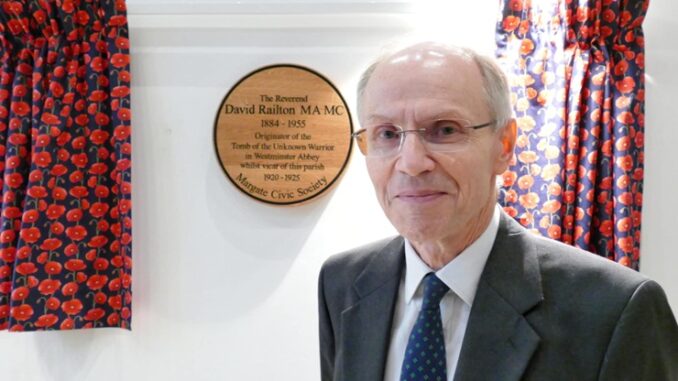
A plaque has been unveiled at St John’s Church in Margate to remember a former vicar who was the driving force behind the creation of Tomb of the Unknown Warrior at Westminster Abbey.
The Reverend David Railton MC, who was vicar of St John’s from 1920 to 1925, was responsible for the interment of the Unknown Warrior in Westminster Abbey in the presence of HM King George V on November 11. 1920.
Following his upbringing in Margate, including education at Stanley House School in Cliftonville, David Railton attended Keble College, Oxford.
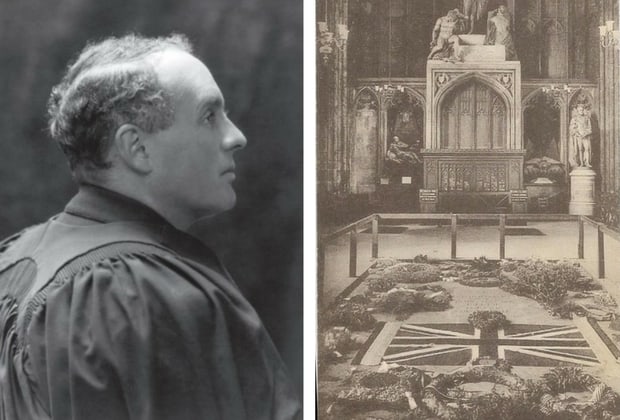
In the First World War, he served as an Army Chaplain to the 2nd Battalion of the Hon. Artillery Company on the Western Front.
Unlike many chaplains who has stayed away from the frontline, Rev Railton had gone into the battlefields, the trenches, the hospitals.
Along with the soldiers he had come under sniper fire and artillery shells, he carried stretchers with the dead and spent four sickening days collecting bodies and dog tags in the bloody aftermath of the Somme in 1916.
He spent his service trying to identify the dead, comforting traumatised soldiers and writing to the bereaved families.
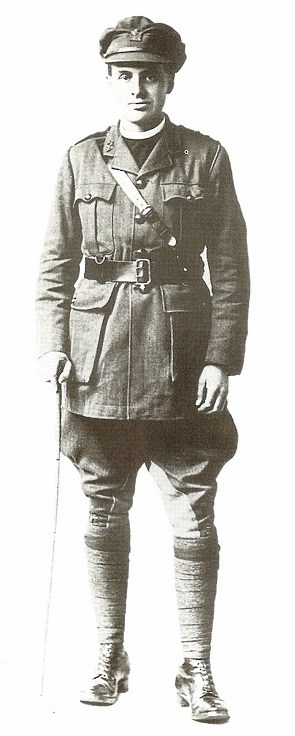
He was later awarded the Military Cross for his part in the rescue of an officer and two men in the conflict.
During this time he saw a grave in northern France with a pencilled inscription An Unknown Soldier of the Black Watch. This gave him the idea for a national memorial.
He returned from the conflict with mustard gas damage to his eyes, the long-lasting effects of Post Traumatic Stress Disorder and a burning desire that the unidentified men who died on the battlefields be recognised and remembered.
In 1920, while serving his parishioners in Margate, Rev Railton wandered the streets of the town at night, affected by insomnia and the thoughts of those still laying in unnamed graves.
That year he wrote to the Dean of Westminster with his suggestion of burying an unknown soldier at Westminster Abbey.
He also suggested that instead of a new flag they use one at the ceremony that had seen service – his own bloodied flag that had draped the bodies of men as they were taken off the battlefields.

The Dean successfully persuaded the government to adopt the Revd Railton’s suggestion and so instructions were given to bring back a body of a British soldier who it would be impossible to identify from each of four areas: the Aisne, the Somme, Arras and Ypres.
One of those bodies was selected by Brigadier-General L J Wyatt DSO to be conveyed to England and the remaining three were reinterred.
Although reference is made to a British soldier, it is possible the body could be that of a sailor or airman, hence he is always referred to as the Unknown Warrior rather than as the Unknown Soldier.

The unnamed warrior was placed in a coffin and put aboard a destroyer bound for Dover and then on to London.
Millions lined the route of the procession as the unnamed soldier was taken to Westminster Abbey on Armistice Day 1920. The Padre’s flag was draped upon his coffin as the warrior was taken for burial at the west end of the nave.


The flag was later hung from a pillar at the Abbey where it stayed until the Queen’s Coronation in 1953. It was then moved to St George’s Chapel, by the Abbey’s Great West Door, where it remains to this day.
Rev Railton never spoke or wrote about the occasion and many did not know he was the man behind the historic and moving service to the country’s ‘ghost battalions.’
He was awarded his Military Cross and Mentioned in Dispatches for his exemplary conduct during the war.
He served as Vicar of Margate from 1920 until 1925 and subsequently several Church posts throughout the country prior to his retirement in 1945. He died at the age of 70 in 1955.

To mark Rev Railton’s contribution, St John’s Church held the unveiling on Sunday (September 14).
A model replica of the tomb, knitted and crocheted poppies and church artefacts were also on display.
A special Choral Evensong was held and the unveiling of the plaque was carried out by Reverend David Railton MC’s grandson David Railton KC.
Other guests included Mr Railton KC’s children, Sir Roger Gale MP, Margate Mayor Katie Pope, Father Dennis, Pamela Pople of Margate Civic Society, veterans, serving personnel, cadets, scouts and more.
The event was organised with Margate Civic Society which, in 2020, installed a Blue Plaque at Rev Railton’s former home at 42 Gordon Road.

Quiet service and quality .