

The danger to wildlife posed by overhead powerlines and pylons has been highlighted by Save Minster Marshes campaigners after a swan was killed after hitting a powerline on Friday (March 14).
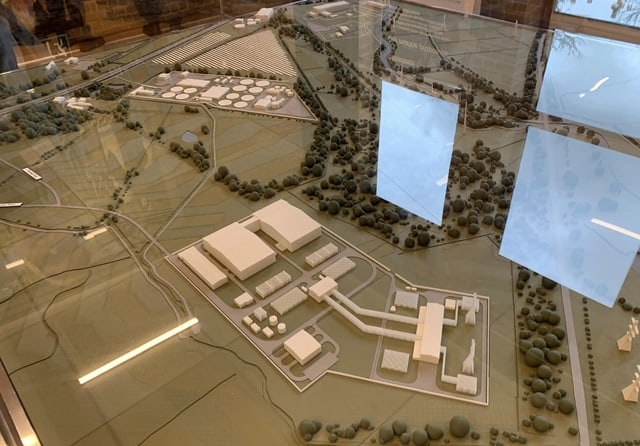
The mute swan hit the lines at Minster Marshes, an important wetland habitat where National Grid plan to build a converter station, substation, and 18-26 new powerlines strung between 15 new pylons for their Sea Link pipeline.
It is one of the 17 separate projects National Grid is putting forward for government approval to upgrade the UK’s electricity grid.
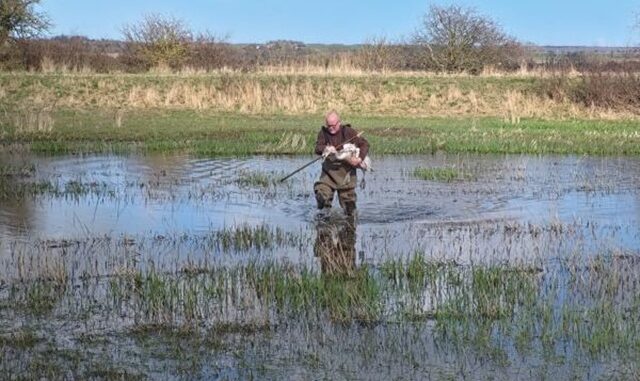
George Cooper, who works on the marshes, found the injured swan in a field. Despite racing to the vet with the bird, it sadly died en-route due to catastrophic blood loss.
George says one of the swan’s wings had been almost entirely ripped off in the collision. This death follows an incident in 2003 when an entire flock of 179 swans were killed at the marshes after collision with some of the 50 existing powerlines which cross the River Stour. In 2018 National Grid pledged to investigate after two swans hit pylons at the marshes and died.

George, who has been working on Minster marshes for more than 20 years and founded the Save Minster Marshes campaign to fight National Grid’s proposal, said: “Powerlines crossing a river will always be a risk to birds because they use rivers as a navigational aid.
“Loads of birds fly along the course of the River Stour from the coast to the marshes and beyond to Stodmarsh Nature Reserve. The reality is that we’ll never know how many birds are killed because most birds get predated before we find their bodies.”
Swans are particularly vulnerable to pylon powerlines, especially when they are strung across marshland and rivers. The RSPB says: ‘If pylons are erected in wetlands, they can pose a danger to certain birds, such as swans and geese. This is partly because they don’t have good forward-facing vision and so they may not see pylons when they’re flying.’
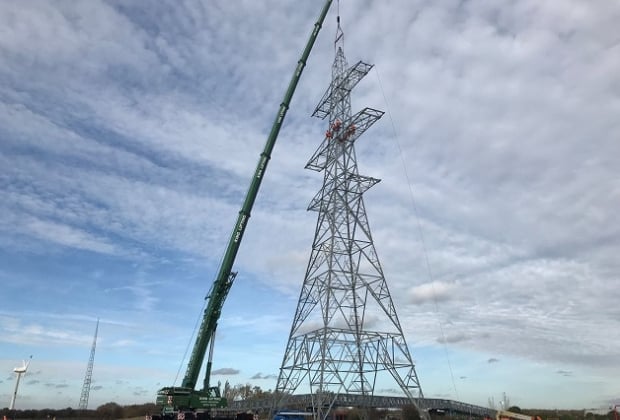
National Grid’s planned new pylons for the Sea Link project in Kent will cross the River Stour at two different points, adding between 18 and 26 new powerlines at a different height to the existing ones on the marshes,.
The site is a major bird migration route within a two mile stretch of the waterway.

National Grid is proposing the Sea Link project makes landfall in Pegwell Bay which is a National Nature Reserve and a Site of Special Scientific Interest. Internationally, it’s a designated UNESCO Ramsar wetland and an EU Special Protection Area – one of only 44 sites with the designation in the UK.
Minster marshes, where National Grid wants to build its infrastructure, is linked to Pegwell Bay.
A National Grid spokesperson said: “We have stringent processes in place for the protection of birds in the planning, construction and post-construction phases of every new infrastructure project.
“This includes surveys to inform an environmental assessment which is examined by statutory consultees including Natural England and the RSPB, as well as Kent Wildlife Trust, the Planning Inspectorate and the Secretary of State.”
National Grid says it recognises concerns about the addition of new pylons crossing River Stour and says the proposal is to install 10 new, permanent pylons, and up to six temporary ones, which would be removed at the end of construction. It is also planned to remove two existing pylons and make small changes to five existing ones.
National Grid add that the Sea Link project will deliver at least a 10% biodiversity net gain.
The Sea Link project is currently in the pre-application phase. It is anticipated that National Grid will be submitting its proposals to the Planning Inspectorate imminently.

As a gamekeeper, can anyone confirm what he ‘gamekeeps’? Does he release birds for shooting?
@Questioner, where does it say he’s a “gamekeeper”
It doesn’t in this article but on any number of other articles with him mentioned it does say so. Check any Minster Marshes article.
The birds will have to look where they are flying then. 🙄
We need electricity.
Power lines on cables are far cheaper, and easier to maintain, than buried cables.
But the deaths of over a hundred birds is not acceptable.
Once upon a time, power and telephone companies used to put visual markers on cables near where birds flew. Something like this must be done.
Or else move the converter station and its paraphernalia to some nearby derelict site, such as Manston.
“something must be done…”
What and how, in a legal manner?
“I dunno…stick it somewhere already owned by another company, soon to be back in use as an airport”
I don’t think there’s much chance of Manston ever being an airport.
But, 3ven if it were to be so, there is heaps of room up there to accommodate a bit of electrical kit.
100% move the proposed development away from this protected nature reserve. National Grid couldn’t care less about the natural environment, they only care about their shareholders.
you’re aware uk pension funds are invested in companies like the national grid, correct? Said staff of national grid, who’d be reliant on pensions in later life, who have family reliant on them now. Why, logically, would they only care about their shareholders and do you have an unequivocal source that states your opinion, is factually correct?
We’re not on this earth for long, so why worry about a world that won’t matter to you when you’re dead?
I’m not sacrificing my life for future generations that don’t care.
” The reality is that we’ll never know how many birds are killed because most birds get predated before we find their bodies.”
Or the objective reality is, it doesn’t happen as often as he claims and he’s being hyperbolic because he has a vested interest in ensuring that expansion and human evolution doesn’t happen.