


By archaeologist Steve Tomlinson
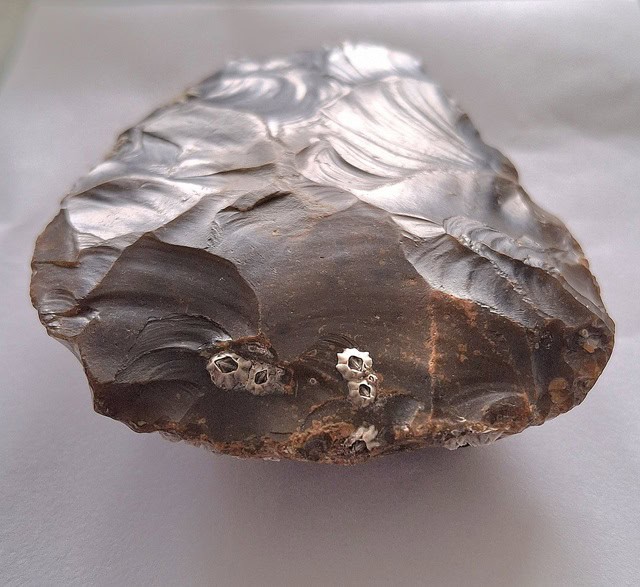
A Lower Palaeolithic hand axe, 8cm in height and 6.5cm across, has been found on the beach in Margate by archaeologist Steve Tomlinson.
Its recovery from this area is very rare and interesting, as information suggests that it may be the first hand axe ever recorded from this particular location. It is of a type known as an Acheulian hand axe and it is likely to date within the Lower Palaeolithic period, broadly between 615,000 BC and 240,000 BC, most likely after around 500,000 BC.
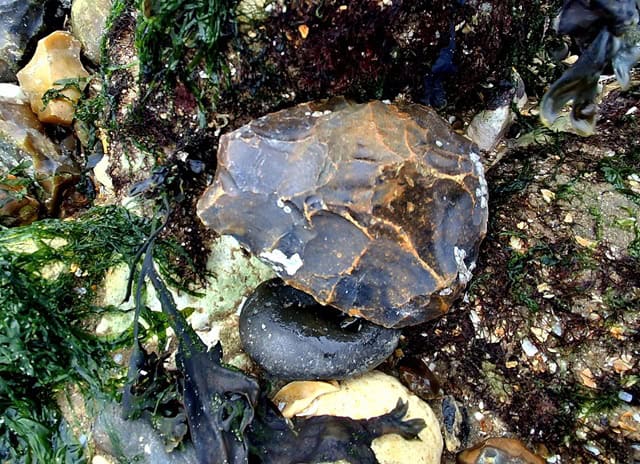
It was probably created (knapped from natural flint) and used during one of the three main phases of activity where evidence of hand axe dominated assemblages have been recognised in Britain so far:
- The Cromerian Interglacial, 500,000 to 450,000 BC.
- The Hoxnian Interglacial, 412,000 to 362,000 BC.
- The Purfleet Interglacial and subsequent cold stage, 320,000 to 240,000 BC.
The Palaeolithic period in Britain currently dates between around 968,000 BC and 9,200 BC (at the end of the last Ice Age). It is divided into three main periods: the Lower, Middle and Upper Palaeolithic. The Lower Palaeolithic (Old Stone Age) was marked by warm interglacial and cold glacial phases, the latter being a time when extensive ice sheets covered much of Britain and northern Europe, though they never reached as far south as Kent. The climate would have varied significantly during those periods.

In the summer, temperatures could be similar or sometimes warmer than present times. When the ice sheets advanced however, the area of what is now the county of Kent would have experienced freezing tundra-like environments, which typically forced the small populations of humans who occasionally lived here to move south-eastwards into southern Europe.
Acheulian hand axes were typically bifacial tools, meaning that they were flaked on both sides. They were created for various tasks, such as cutting, scraping and butchering. The shapes of hand axes vary, some were ovate, some were teardrop-shaped, and others were pointed.

The Margate hand axe is likely to have been one of the latter, though the tip on this example appears to be broken.
In general, hand axes are very rarely recovered in Thanet. This may in part be a consequence of the remodelling of much of our chalk landscape during the later glacial periods, which resulted in the Lower Palaeolithic flintwork that we find today initially being redeposited into later natural features, such as hollows, ditch-like channels and ice wedges filled with silts, sands and brickearth, or incorporated within the coombe rock that infills chalk valleys. Subsequent processes of natural erosion, or disturbance by human activity, can redeposit these artefacts again, perhaps several times.

During the Lower Palaeolithic, a time when the area of modern Britain was often connected to the continent, the landscape of Thanet would have been quite different to that of today, with forests and open grasslands providing rich resources for the hunter-gatherers who used tools such as this hand axe.
Periodically, as sea levels rose during the warmer phases Britain may occasionally have been islanded, a greater proximity to the coast would also have offered access to marine resources, such as fish and shellfish.
The area likely attracted early human groups due to its abundant resources, though these populations were primarily nomadic, moving in response to seasonal changes and the availability of food.
In Kent, and specifically in areas like Thanet, evidence of Acheulian hand axes contributes to our understanding of human prehistory. Archaeological finds in this region help to illuminate how early populations adapted to their environments, utilised available resources and developed their tool-making techniques.
Acheulian hand axes are a key component of Lower Palaeolithic archaeology, reflecting both the technological innovations and the cultural practices of early human societies.

Though the archaeological evidence of this period from Thanet, Margate and the beach itself is extremely limited, it is a valuable part of the much larger narrative of early human life that occurred within southeastern England during the Palaeolithic.
Thanks go to Paul Hart for his help in the production of this article

It’s magical seeing every groove on these flint artefacts and knowing that someone like you or I made that mark thousands of years ago.
What a keen eye to spot that amongst all the other flints. Well done 👏
Paul Hart is a great archaeologist.
Nice report and write up thanks. Interesting stuff.