


By Local Democracy Reporter Simon Finlay
Plans to shut fire stations and cut jobs across Kent have been overwhelmingly rejected by councillors.
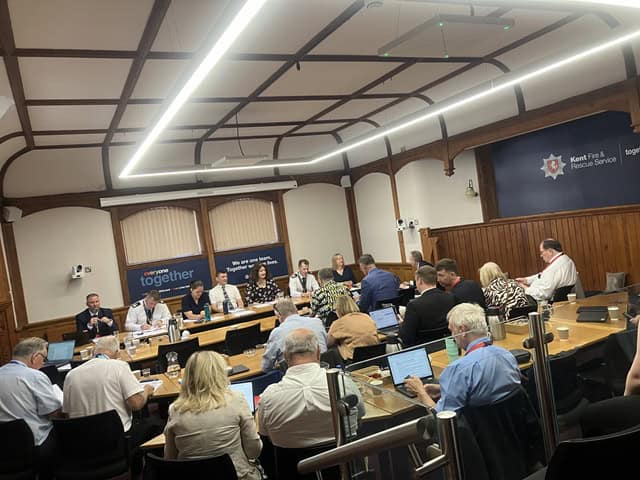
Members of the governing body, the Kent and Medway Fire and Rescue Authority (KMFRA), threw out proposals to radically shake up the way the service is run by 17 votes to two, with one abstention.
Now Kent Fire and Rescue Service (KFRS) senior leadership, who described the outcome as “disappointing”, will have to go back to the drawing board.
The Fire Brigades Union, which was fiercely opposed to the plans, said the result was “fantastic news” for its members and for the safety of Kent residents.
The service has faced a £1.3m funding shortfall and the changes would have seen more resources ploughed into day-time cover when demand is highest.
The authority, which is made up mainly of Medway Council members and Kent county councillors, had deferred the decision from June to study a 400-page document and allow a working group to test other options. The authority members met at the service headquarters in Maidstone this morning.
The KFRS senior leadership team proposed to shut four standalone, part-time on-call fire stations at Wye, Chilham, Westerham and Cliffe, followed by a 12-month review to assess public impact and demand. Grain station had been saved after a data review.
KFRS wanted to remove the on-call fire engine from four of the combined wholetime and on-call fire stations – Herne Bay, Deal, Faversham and Tunbridge Wells. There were also plans to change shift patterns.
KMFRA were asked to vote today on whether to send the plans out to public consultation.
Many of the members expressed concerns that the level of house building in Kent may create further demand on the service and increase response times because of the county’s clogged roads, although the service said it was not a major concern.
Reform UK county councillor Sarah Emberson said: “What we have done is listened to the concerns of our residents and while we acknowledge financial prudence, closing or mothballing fire stations is putting people’s lives at risk and that is not something we are prepared to do.
“I question whether house building in Kent will not have any discernible impact on response times. We all know about getting stuck in traffic and we are seeing more and more cars on the roads. I had a wildfire in one of my villages last night and it is a huge concern for my residents.”

KFRS chief executive Ann Millington said: “It’s disappointing, of course. But we will always keep people safe, although it will be harder to do that now. We need to go away and have a think about what we do next.
“We still have to find the money and we have to spend the next two or three years trying to find ways of meeting those challenges that we face.”
Mrs Millington conceded that “potentially” cuts may have to be made in other parts of the service.
Mrs Millington rejected Labour member Alister Brady’s suggestion the funding shortfall could be through dipping into reserves, as all the cash was already earmarked for new appliances and equipment.

Danny Barrett, the FBU’s secretary in Kent, said he hoped that new Prime Minister Andy Burnham would have sympathy for fire fighters. He told the authority members that he had had a meeting with a government minister but he felt his concerns “fell on deaf ears”.
Mr Barrett said he hopes to be able to have further negotiations in future with KRFS chiefs.
Tim Green, the FBU chair in Kent, said: “The result today is fantastic news and it is the right one. It proves that the position of the union was correct to promote the message that cuts cost lives and that fire station closures are dangerous.
“We had 300 wildfires in Kent in July, we have been deployed to Suffolk to help out there – that’s the reality of the work we do today in today’s climate.
“We have shown that solidarity is power and that we have reflected the views of the public.”

Dear Ms Millington I am sorry to hear that you are disappointed that your little scheme to “reform” the fire service came to nought, but nothing was lost because you said at the outset that it wasn’t about saving money, so that is ok then.
You might of heard about the little matter of the West Sussex fire brigade turning up 18 minutes after receiving a call, and how some flats caught fire and were probably destroyed, when they might have been saved. Fortunately, there was no loss of life, but some residents had no fire insurance, and even if they did, claiming can be problematic.
West Sussex did what you were proposing and now like those buildings, their policy has turned to ashes.
I am sure the cllrs at that meeting were spooked by the wild fires breaking out through the UK and Europe, so in retrospect may be it was not the best of ideas.
Best wishes,
George
Of course-all people like her care about is money. She gets 174k a year & probably gets a cut of the savings/bonus if she can close stations.
1. Grant planning consent to build more houses but cut down the number of fire personnel and appliances to deal with those catching fire.
2. Build more roads and parking spaces for more vehicles but cut down on the number of fire personnel and appliances to deal with those having accidents.
3. Acknowledge that we are undergoing climate change that leads to longer, hotter dry periods causing an increase in fires to fields and woodlands but cut down on the number of fire personnel and appliances to deal with such incidents.
Ann Millington and her cohorts are not living in the real world.
In the light of the well known and irrefutable facts why did they think it was appropriate to propose cuts in the service in the first instance ?
What is even more worrying is the fact that Ann Millington & Co. are ”disappointed” that their proposals were rejected.
The bottom line is that there will need to be an increase in Council Tax to pay for the services we all need and rely upon. Any increase will only be moderate because it will be off-set by the increased Council Tax revenue from all the newly built houses in any event.