

By Rory Kehoe
Apart from food poisoning, there doesn’t appear to be a likely link between Bratwurst, a hotel originally called the Bull Inn, and the deaths of two people. Yet there is and the events described below led directly to a stinging criticism of Germany by Thanet’s Coroner.
Some 250 years ago, the Bull on Ramsgate High Street was one of many inns offering B&B accommodation for perhaps only 1 shilling (5p) per night. Sounds cheap but it’s worth remembering that 1 shilling in the 1770s could also buy c.20 pints of beer and the average weekly wage was about 6 shillings. Around 1800, the Bull got a makeover and hoping to attract a better class of clientele, renamed itself the Bull & George Hotel.
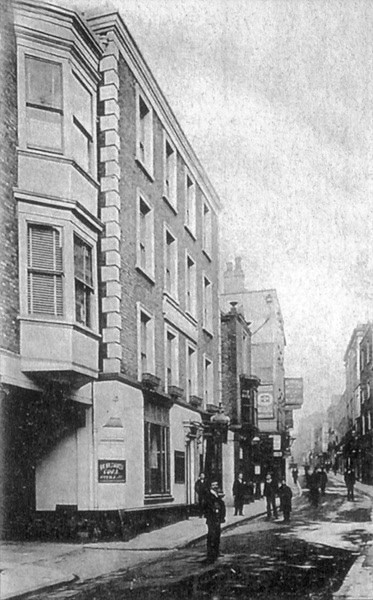
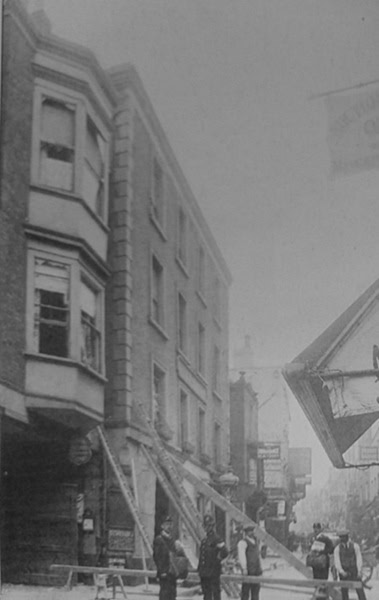
The 1905 photograph shows an imposing, solid-looking, Georgian building, built around its stagecoach courtyard. With over 100 years successful trading, the Bull & George was at the heart of Ramsgate life, so what (you may ask) could possibly have gone wrong and what has this to do with sausages?
The answer to this begins with a double murder in Sarajevo and four weeks later, the violation of Belgium’s neutrality by their famously sausage-loving neighbours, Germany. WW1 had just kicked off.
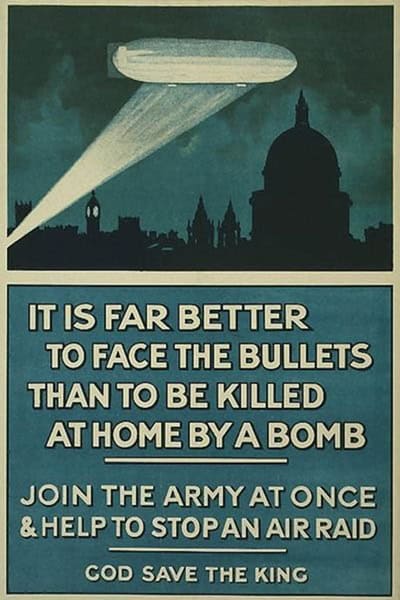
Nowadays, we take air travel for granted but in the years preceding WW1 aeroplanes were very basic and could only just about carry a pilot and navigator. In 1909, Louis Blériot made his epic 22-mile flight across the English Channel but in Germany, powered flight was moving in a different direction c/o Count Ferdinand von Zeppelin and his eponymous Hydrogen-filled airships. Commercial Zeppelin flights commenced in 1910 and it wasn’t lost on German Generals, that airships might make good weapons of war.
Within days of WW1 starting, Zeppelins were employed as bombers against Belgian troops defending Liège and French infantry in Alsace. Similar raids were carried out over the next few months but for a variety of technical reasons, Britain was beyond the effective range of Zeppelins. One reason was the amount of Hydrogen needed to lift a fully-laden airship. Simple solution? Yup, make airships larger, greatly increase the number of Hydrogen bags and the improved lift/weight ratio would allow Zeppelins to become a threat to Blighty.
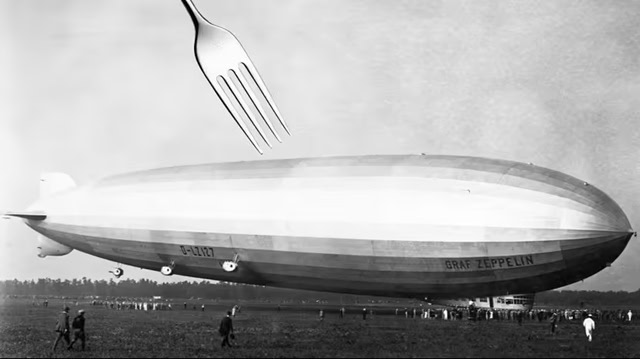
However, there was a flaw with this solution and one which cut to the very heart of what it is to be German: sausages! Specifically, sausage skin, made from cattle intestines and which, in those pre-plastic days, was the only lightweight, gas-proof material that Hydrogen bags could made from. Being on the horns of a dilemma, Germany had to choose between making larger airships, or keep making sausages. Zeppelin production won and in what might have been called a wurst case scenario, snorkers were strengest verboten! (sausages were strictly forbidden).
The first Zeppelin raids hit East Anglia in January 1915 and continued, on a sporadic basis, for the next 18 months. Initially, the Kaiser forbade bombing London, so provincial towns and ports bore the brunt of German raiding. Happily, Thanet’s luck held, thus avoiding the Zeppelins’ attention. All this was to change though, in the early hours of Monday 17th May.
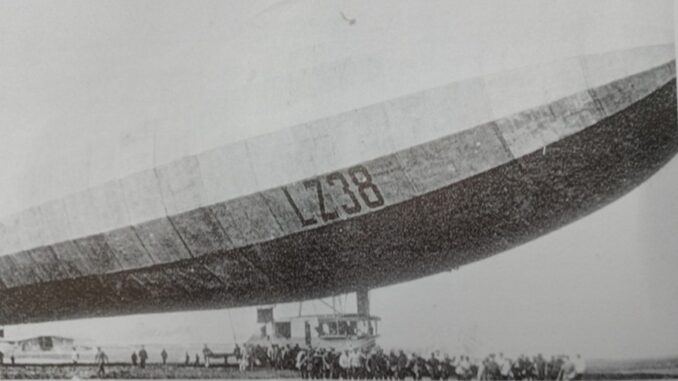
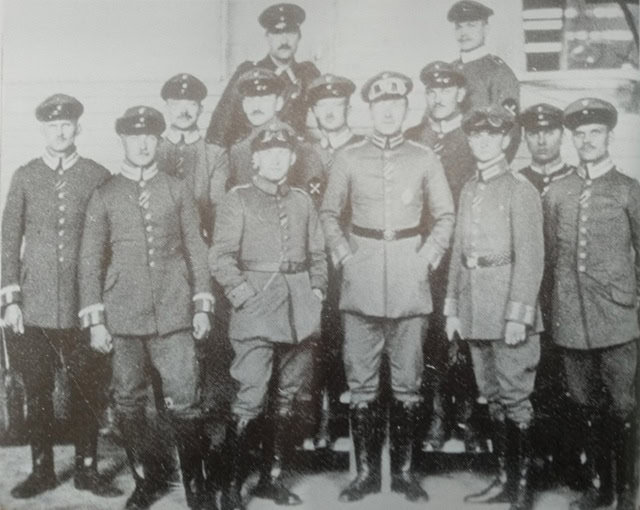
Zeppelin LZ38 had struggled with strong headwinds and failing to bomb Tilbury docks, turned around and flew along the north Kent coast, looking for suitable targets. Spotting Ramsgate’s Royal Harbour, Hauptmann Erich Linnarz (pictured with his crew) ordered bombs to be dropped, then headed for home, leaving behind a trail of death and destruction.
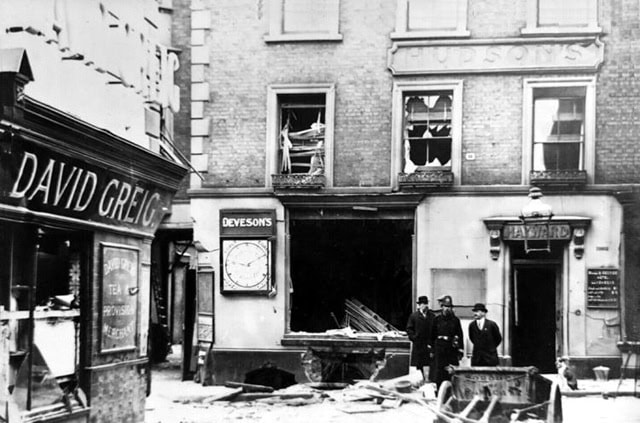
On the ground, the lower High Street and harbour area took a pounding but it was the Bull & George which suffered most, being substantially wrecked. Casualties were light but a waiter and two guests (John & Florence Smith) were taken to hospital where, sadly, the couple died from their injuries.
Inquests into the deaths were convened, with the jury returning verdicts of “death by enemy action.” However, the Coroner added his own damning narratives. John Smith’s death was recorded as “Wilful murder against the Kaiser” and Florence’s as “Death due to injuries received through an illegitimate and dastardly act of war.” Strong words!
Retribution was swift and on 7th June, Zeppelin LZ38 was destroyed in its Brussels hangar during a British air raid.
The wrecked Bull & George never re-opened and the site was cleared, making way for a new building, which housed Woolworth’s and afterwards, Poundland. Spare a thought on your next visit. .

Yes a good story, buy there is a twist. The idea of using sausage skins as gas bags for balloons and rigid airships was British!
Yes, we had perfected the process of using sausage skins which were joined together by nothing more than water to line gas bags.Of course you still had the problem of protecting the bags as they swayed within the duralamin frame of the airship, and the Germans paid great attention to this.We did pay back this piece of industrial espionage by copying german zeppelin designs The R34 the crossed the Atlantic in 1919, was a knock off of the P and R class Zeppelins.This was not always a good idea, as the R38 disaster was attributed to using the german height climber design and subjecting it to violent manoeuvres for it was unsuitable.
Hi. Thanks for your additional comments. Yes, the mid-19th century saw a variety of British, French and American airships, which were (to a degree) an extension of air balloon deveelopment. Largely indirigible, most of these have been termed “blimps” which is hardly a compliment. Von Zeppelin is generally credited with “inventing” the light-framed dirigible airship and certain did the most c.120/130 years ago to advance the technology. I didn’t know that using cattle inestines was a British idea! Another one in the series of things we invented, such as Lego, the internet and light bulbs, which we then failed to hang on to. Of course, the major problem with Zeppelins was that were, in effect, flying bombs. Just add a little tracer to your ammunition magazine and boom! The R38 disaster (for which read cock-up!) was almost an accident by design. It’s worth an article in its own right. Thanks again. Rory
Great, more interesting local history please.
Hi. Thanks for your kind words. I have several more articles in varying stages of production. Watch this space!
Rory
Linnarz survived the war and I think the second world war and wrote a book about his experience.The LZ38, a P class ship was an army airship and was destroyed on the ground in its hanger at Everes in Belgium.The P class ships were successful intruders until incendiary bullets like the Brock,Buckingham and Sparklets munitions were perfected. The air defences of Britain were rudimentary and the aircraft the LZ38 were pitted against were artillery spotters like the BE2C (The BE standing for Bleriot Experimental, and was designed by Geoffrey de Havilland).
Linnarz probably survived because the army withdrew its airships from the Western Front and deployed them on the Eastern Front where the opposition was less sophisticated.The Germany Navy persisted and paid the price, though it continued to build bigger and more sophisticated airships like the height climbers in a bid to beat the British defences. The bombers that were most successful were the Gothas and R class giants whose daylight raids caused outrage and led to the formation of the RAF in 1918.
Germany even went so far as to build a giant Triplane bomber to bombard America. A wheel of the Poll triplane still exists at the war museum and it is truly gigantic.
The LZ127 or Graf Zeppelin shown in the photograph, had a long career for an airship and was only broken up during the war, along with its successor the LZ 130 or Graf Zeppelin 2.
Hi George. Thank you for your further notes on Zeppelins and the WW1 bombing of Britain. It’s not a main area of research but I keep finding interesting snippets, so I tend to read on, learn and then write up short articles. There will be one on Gotha raids but it’ll probably be printed in the Canterbury press, as that’s where some of the bombs dropped and a shooting down took place.
I presume LZ38 was destroyed by the RNAS, rather than the RFC. Didn’t have the space/word count to go into more details, I’m afraid.
Lizzarz ended WW1 as a Major but I’ve not followed him beyond WW1. I know that several Zeppelin pilots retrained, joined the Luftwaffe and served in WW2 but what Lizzarz did, I have no idea.
I’ll look into the Poll triplane, as the idea of a WW1 raid on the USA amazes me. This is pre-Alcock & Brown and a bomber going to/from the States is staggering.
Thanks again for your comments. Every day’s a schoolday and responses such as yours really make my efforts more worthwhile.
Rory
Best article in a long, long time.
Thanks to the people as well who added interesting information in the comments.
A much nicer experience than the normal(?) hate speeches held here.
Hi. Thank you for your kind words. I have several more history-based articles in varying stages of production. Watch this space!
Rory
Thank you, Rory (and George). A really interesting read and I look forward to more of your articles
Hi Fleur,
Thank you for your kind words. I’ve just thanked George for his additional notes, which I also found very interesting and edifying.
I have several more articles in varyious stages of production. Watch this space!
Thanks again.
Rory
History gets distorted so just to put the record straight – the story has been well documentated before and you incorrectly state “a couple died” they were not a couple and not both named Smith. Much research was carried out on this and I spoke to Florence’s family, they did not know about the circumstances as to why she was in Ramsgate at the time but were glad the story had been put right. Below is a link to an updated precis of the story which I published some 20 years ago, with a short video posted in 2024.
https://www.facebook.com/search/top?q=buul%20and%20george%20ramsgate
Hello RHS.
Yes, I’d heard somewhere before that the two people who died may not have been an official (ie. a married) couple. Mr (some call him Captain) Smith was, as far as I know, using his real name, when he checked into the B&G and signed the register. Whether he signed in as Mr & Mrs Smith is open to conjecture but it appears that they were not exactly strangers. No-one would turn a hair these days but 110 years ago, even in time of war, such things as going away together for a few days were viewed somewhat differently. Given the seriousness of John Smith’s injuries, it’s hugely touching that he insisted on seeing Florence, in a separate hospital, before he died. So sad that she too died just over a day later. I have wondered before, if contemporary reports on the two deaths, naming “Mr & Mrs Smith” were made in order to spare relatives’ blushes. That John and Florence were innocent victims is beyond doubt and such was the anti-German backlash, from the Coroner the press and general public, that it may have been seen as weakening the case for indignation by admitting that John and Florence were not married.
“Yes, I’d heard somewhere before that the two people who died may not have been an official (ie. a married) couple” Then may I ask why you posted as they were husband and wife ? They were not a married couple her name was not Smith and her husband came to Ramsgate to identify her body. One look on deaths for that date confirms her name and marital status. Perhaps you could contact Dover-Pubs and correct the incorrect information there as well. Its disinformation that fuels future ambiguity – the truth gets lost ! I shan’t sue for $6 billion (Trump LOL) but I would like the facts to be correct & known including the Barmaid.
Hello again. Yes a fair point. Having referred to them as John and Florence Smith, I think anyone reading my article would assume they were Mr & Mrs, even though they were not married. It may have said Mr & Mrs John Smith in the register but a) that would have been necessary to obtain a room and b) we can’t prove this, as the register is not available, Destroyed in the raid? Thrown away when it became clear the B&G would never re-open? I have no idea. Smiliarly, I have been unable to view the actual Coroner’s report, so I don’t know his name, or if he dimplomatically fudged the issue of John and Florence’s marital status. Jury out on that one.
I would have like to have included the story of the barmaid and her incredible escape from almost certain death. However, I have to work to a wordcount and sadly, Kate Moffatt’s part in this tale had to be cut.
As a regular contributor to the Kent Pub History site, I’m in touch with the Editor regularly. I’d already made a note to amend the B&G listing and will ensure that it is made clear thet John and Florence were not man and wife. Irrespective of the nature of their relationship, I agree that it is better to have the facts straight. Site visitors may go on to draw their own conclusions but that is in the nature of historical interpretation. Thanks for your clarification.
The actual Coroner’s report can be found easily, in fact very much more easily accessible than 20-25 years ago when I researched the whole story of the bombing, the crew of/ and what happened to the Zeppelin, the coroner’s name etc. etc. Florence and John are buried in Ramsgate though not together and who says paperwork from the Bull & George does not exist? If the facts are revealed then end of story, no historical or any other interpretation are required.
Hi. Thanks for your additional comments. I did try an online search for the 1915 Coroner’s reports. No joy but I must confess, I didn’t spend a huge amount of time on this. I was in Kent Archives recently and asked there too. I’m sure Thanet/1915 can be accessed but the cataloguing is such, that it’d take some time to wade through and the lack of the Coroner’s name is a small detail in the great scheme of things. Yes, I was aware of JOhn and Florence’s last resting places but again, the word count didn’t allow for this detaols to make the article. When I did my original research on this story, the facts (as printed in the 1915 papers) were somewhat confusing. Eg. Mr/Captain Smith, a Mrs Smith who survived, a Mrs Florence Smith who did not, Florence Lamont, who also did not survive and even the number/type of bombs dropped. Probably down to reporters either rushing to get copy in and/or a paucity of facts being padded out to make a good story. Much the same as today! I agree with you about the register but if it survived the bombing, the fire, hose water and the clear up, then why would a hotel scheduled for demolition want to hang onto superfluous records? Playing devil’s advocate, even if Mr S had engaged Room 12 and Mrs L was in another room, a clandestine noctural meetng was still possible. They went through same hole and ended up toether in the cellar, which is open to various interpreatations. If J&F were strangers, just staying in the same unfortunate hotel, why did the gravely injured John make what must have been a painful visit to Florence’s bedside in a hospital several miles away? Again, open to several interpretations but it does suggest that John and Florence were a bit more than just-met acquaintances. Ending on a sure-footed positive, I have sent the Kent Pub History site Editor revisons to the B&G listing, which make it clear that J&F were not married. Thanks again. Rory
Not far if you know Ramsgate 1.2 miles General to the V.A.D. Hospital 5 minute taxi journey back then 2 mins. today. I do find it complexing when your article starts “Yet there is and the events described below led directly to a stinging criticism of Germany by Thanet’s Coroner” yet your above comment states you couldn’t or wouldn’t spend the time in finding the reports!
Anyway’s best I leave it there I tried being courteous in putting the facts right without putting too many noses out of joint but when what was written is justified because of time restraints and word counts then there isn’t much hope. What did you say “Probably down to reporters either rushing to get copy in and/or a paucity of facts being padded out to make a good story. Much the same as today!”
Hello again.
True, Ramsgate is not a huge place and a 1.2 mile taxi run wouldn’t have been a major trek but for Mr Smith’s injuries. I understand that he had to be carried to/from the cab and getting him in/out of the taxi must have been very uncomfortable for the poor chap. John Smith’s visit to Florence was, at the very least, an act of the greatest consideration and compassion. A gentleman to the last.
The coroner’s personal narratives, added to the jury’s verdicts, are widely quoted but never referenced to a specific point of reference, such as the National Archives, or Kent Archives. I don’t have the time available to chase down every option. I only included the Coroner’s wrods, as they give a flavour of the “anti-Hun” feelings of the time and the indignation people felt, as innocent civilians were being killed by German air raids and coastal town bombardments by the Kaiser’s warships.
I think that you have made your points courteously and in doing do have added to the story I set out to tell. Perhaps someone may feel inspired to drill deep, unearth more information and write a follow-up article? I’d have loved to have found images of John and Florence, which surely must exist. In 1915, the Ramsgate bombing was a major story and somewhere, deep in newspaper archives, family records, local libraries etc is much more source material. A worthy project for someone with the inclination, passion for history and time. I love history: it rarely disappoints!