

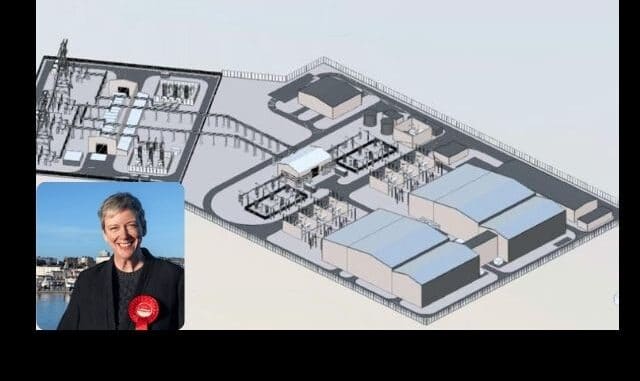
The deadline is fast approaching to register to submit views on National Grid’s plan for a 2 gigawatt (GW) high voltage direct current (HVDC) cable between Suffolk and the Minster Marshes
To bring the power from the subsea cables into and out of the electricity network there will be converter stations, substations and new underground and overhead electricity lines at both ends. This includes a 28-metre high, 90,000 square metre onshore converter station at Minster marshes in the Stour Valley.
The proposals have provoked huge opposition from groups including Save Minster Marshes and Kent Wildlife Trust.
Margate artist Tracey Emin also joined a demonstration in Margate against the plans earlier this month.
East Thanet MP Polly Billington has also voiced concerns.
She has registered as an interested party and made a submission to the Planning Inspectorate’s examination stage inquiry into the Sea Link plan.
In her submission, the MP has repeated her concern about the proposal’s impact on nature and the damage it could cause to Minster Marshes’ vibrant ecosystem and resident wildlife.
The MP is also encouraging others to register as an interested party and make their voices heard.

In her submission to National Grid, Polly said: “I am deeply concerned about the potential for this project to cause irreversible damage to nature in Pegwell Bay and Minster Marshes. The bay itself is home to Kent’s largest seal population, and the marshes and salt marsh provide a vital habitat for a variety of protected species, such as the golden plover, beavers, and water voles.
“This is a nationally important ecosystem that we should absolutely avoid causing permanent damage to.
“While it is important to build the infrastructure that will help us achieve clean energy, doing it at the expense of rare and irreplaceable natural habitats such as this is extremely damaging.
“We are in a nature and biodiversity crisis, the UK is in the bottom 10% for biodiversity levels, and we cannot afford to make this situation worse. Nature cannot come at the expense of National Grid’s bottom line.
“I have been inundated with concerns from constituents, both via email and on the doorstep, who are deeply worried about the impact of this project. They care deeply about the natural heritage of their local area, and they want reassurance that this will not be damaged – these reassurances have not been granted.”
The MP says previously work completed in the area in 2019 by National Grid, when the Nemo Link interconnector cables were installed, caused permanent damage to the salt marsh and chalk bed – damage that has never been repaired.
She added: “I and my constituents have no trust in National Grid to carry out the work and not cause similar damage again. Damage that must be avoided at all costs.”
“I strongly believe that National Grid needs to revise their plans for Sea Link and explore alternative landing sites where there would be less damage to nature. We have one chance to build the infrastructure of the future, it is vital that we build it in the right places.”
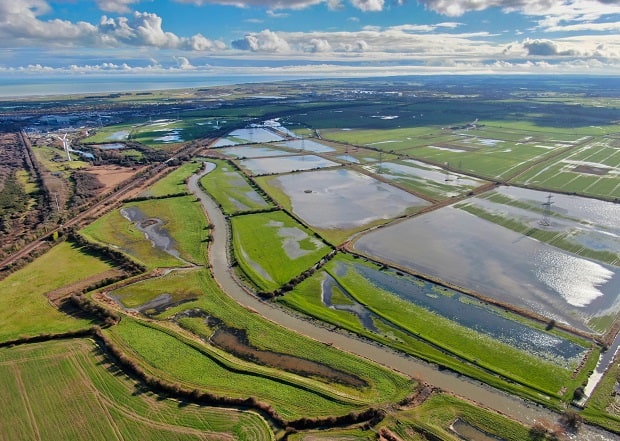
National Grid’s Sea Link project aims to increase the capacity of the electricity network, by laying 145km of undersea cables between Suffolk and Kent, and connecting them to a new converter station on Minster Marshes. Siemens Energy is carrying out construction of the infrastructure after being selected by National Grid as the preferred bidder.
Alternative routes were considered by National Grid before the Pegwell Bay route was approved.
A National Grid spokesperson said: “We carefully consider community views and environmental concerns in the development of our projects. We will be using trenchless technology to pass under the saltmarsh and will continue to work closely with environmental experts and local stakeholders to ensure that all necessary measures are in place to protect habitat and enhance biodiversity in the area.
“A landfall at Pegwell Bay was selected following a balanced appraisal of environmental, socio-economic and technical factors, alongside lengthy public consultation. Our proposals for Sea Link are the culmination of this extensive work. We are regulated by Ofgem, which aims to keep infrastructure costs as low as possible to deliver lower energy bills for homes and businesses across the country.”
Kent Wildlife Trust will be putting forward a case for nature and urging officials to look at other possibilities for the underwater cable.
Campaigners have created a step-by-step guide to assist people in navigating the system in a bid to help them engage with the process.
Documents outlining the Thanet end of the scheme say it will comprise of:
- A landfall point at Pegwell Bay.
- A Transition Joint Bay (TJB) – an underground, concrete box structure where the offshore cable connects to the onshore cable – connecting to cable the converter station.
- A 2 GW HVDC converter station (including a new permanent access off the A256), up to 28 m high plus external equipment (such as lightning protection, safety rails for maintenance works, ventilation equipment, aerials, and similar small scale operational plant) and a new substation at Minster Marshes.
- Removal of approximately 2.2 km of existing overhead line, and installation of two sections of new overhead line, together totalling approximately 3.5 km, each connecting from the substation near Minster and the existing Richborough to Canterbury overhead line.
Permanent access to Minster 400 kV substation and Minster Converter Station will be via a new access point off the A256, north of Jutes Lane. The site will have external lighting.
The converter station will comprise of a DC hall, converter transformers, valve hall, reactor hall, AC switchyard, control building, strategic spare parts building, LV electricity supply, fire deluge pump house, car parking, a permanent access road and landscaping.
The construction of the proposed converter stations would take approximately four years from first site access to reinstatement, excluding ongoing landscaping monitoring or maintenance
An indicative timeline says, subject to gaining development consent, construction works would be expected to start in 2026 and be completed by the end of 2031 with reinstatement potentially continuing into 2032.
National Grid’s development consent application for the scheme is now being examined by the Planning Inspectorate.
The full application is available to view on the dedicated Sea Link page of the Planning Inspectorate website.
Find the Rethink Sea Link campaign here
Find Save Minster Marshes here

The common sense thing to do is build it on the old derelict airport.
Stop believing the struck off solicitor and move forward.
Even if the airport was to start up again, Manston is a vast site, with plenty of space to swallow up the HVDC converted station. And it’s only a couple of km away from where it’s planned to bring the cable ashore.
Polly Billington who drives down the A299 to voice her concerns about all things Green but ignores all the TDC forgotten overflowing bins polluting our wildlife and countryside.All the dog poo bins,at the coastal edge left all weekend with excrement bags falling into the sea.The 60% of Thanets drains that are silted up instead of catching rainfall.The lack of roadsweeping which causes weedgrowth on industrial levels,which then has to be weed sprayed with toxic weedkiller.It goes on and on.
I just walked into Ramsgate and there is more strewn litter than London.It is disgusting.Nothing like putting tourists off.Billington is out of touch.
Dear me, not litter again. Its the bloody tourists and the locals chucking the litter, it doesn’t float down from the celestial plain to thwart the Davids and Rico’s of this world.
I find it very hard to accept that there is more strewn litter in Ramsgate than there is in London, considering how much larger than Ramsgate London is.