

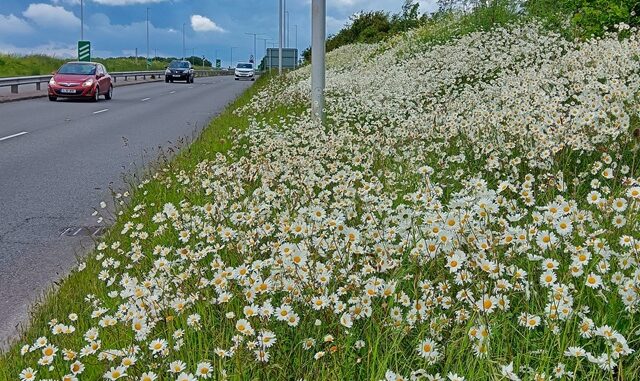
You may notice driving around Thanet this time of year that some of our verges are lined with giant daises.
Well, these are the humble oxeye daisy, with their bright white petals radiating around a sunny yellow centre. It’s a quintessential sight on roadside verges across the country in May/June.
These cheerfully simple wildflowers play a vital role in our ecosystem and bring a touch of simple beauty to our journeys. Verges full of flowers are not just great to look at but they are a vital nectar bar.

Their open, accessible flowers provide a rich source of nectar and pollen for a wide array of insects, including bees, hoverflies, and butterflies. These pollinators are crucial for the reproduction of many plants, not just wildflowers, and their presence indicates a healthy environment.
Beyond the insects, the seeds provide food for small birds, and the foliage offers shelter for various invertebrates. By keeping the mowers away and allowing these verges to flourish we create essential pockets of biodiversity in often-linear landscapes.
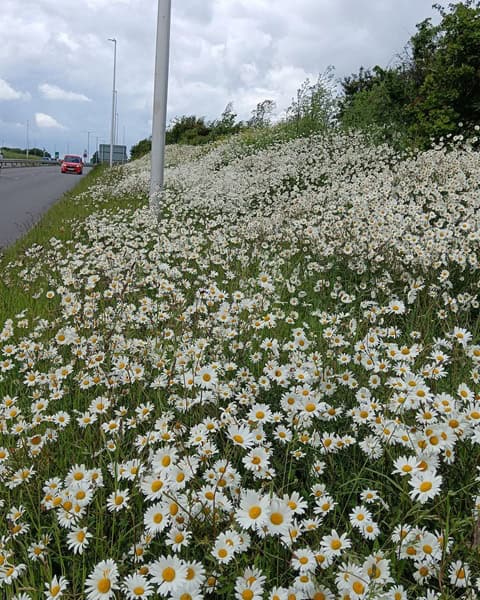
And for us? There’s a quiet joy in seeing swathes of these daisies nodding in the breeze, especially along the A299 by Thanet parkway. They evoke a sense of summer, natural beauty and the simple pleasures in life.
In our increasingly busy world, the sight of a roadside verge dotted with oxeye daisies offers a moment of calm, a visual breath of fresh air that brightens any journey and connects us to the natural world just beyond our car windows.
The charming name “oxeye daisy” is thought to have originated from the resemblance of its large, prominent flower head, with its central yellow disc and surrounding white petals, to the eye of an ox.
Thanet nature expert Nik Mitchell runs the Get Wild page on facebook
