

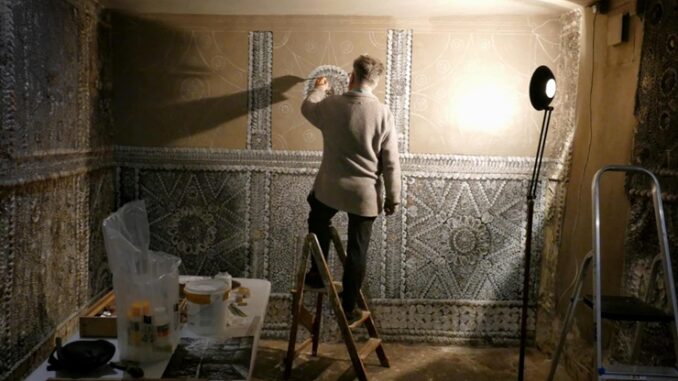
Work being undertaken at Margate’s Shell Grotto by town artist Paul Hazelton will return part of the site back to how it would have looked some 100 years ago.
Paul Hazelton, who is known for creating art and sculptures from materials such as dust and human hair, is recreating a full-scale mural on the Grotto’s East Wall in the Altar Chamber.
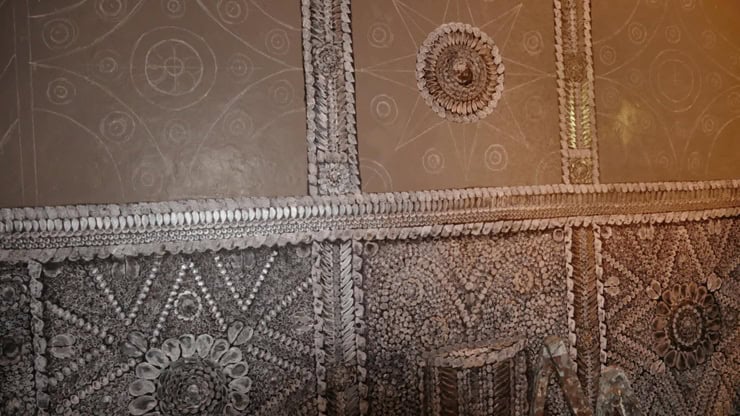
The original East Wall, mosaiced in shells, was destroyed in 1940 by a bomb that hit the cottage above. It was replaced with a plain, concrete wall, which has since either been left bare or partially covered by Grotto-themed imagery.
Paul is now creating a mural of the original East Wall, in situ in the Altar Chamber. Once finished it will, for the first time in almost 100 years, allow people to see the Altar Chamber ‘complete’, as it was originally intended.

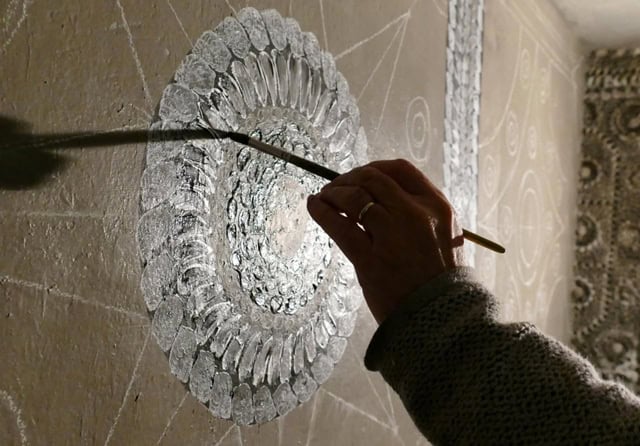
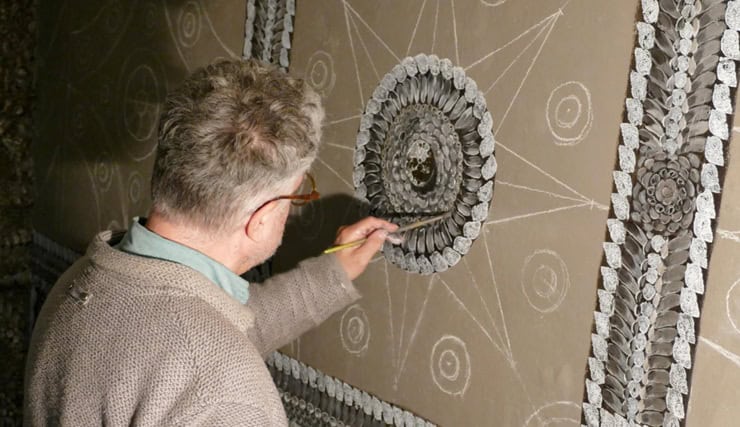
Paul has been using chalk and old photographs to plan the panels’ layouts and then painstakingly prints each individual shell with stamps and acrylic paint.
Once an impression has been made, he adds highlight and shadow to create a three-dimensional illusion.
Paul was previously Margate Caves artist in residence, His works have been included in many major international exhibitions, including Animals and Us, Turner Contemporary. In 2017 Paul’s work was shortlisted for the prestigious John Ruskin Prize.
The Shell Grotto was discovered by the Newlove family in 1835. It consists of 21 metres of winding passages decorated with 4.6 million shells. The walls are covered in images of gods and goddesses, trees of life and patterns of whelks, mussels and oysters. It terminates in a rectangular room, referred to as The Altar Chamber.
The most frequently used shells in the site are mussels, cockles, whelks, limpets, scallops and oysters. They are largely local. They could have been found in sufficient numbers from four possible bays: Walpole Bay in Cliftonville; Pegwell Bay, Cliffsend and Sandwich Bay.
In 1973 the Shell Grotto was given a Grade I Listing.
The Grotto was damaged during an air raid in the Second World War and it was this damage that prompted the first listing of buildings that were deemed to be of particular architectural merit by Historic England.
There are estimated to be less than 10,000 Grade I listed buildings in England and the Shell Grotto is probably one of the smallest!
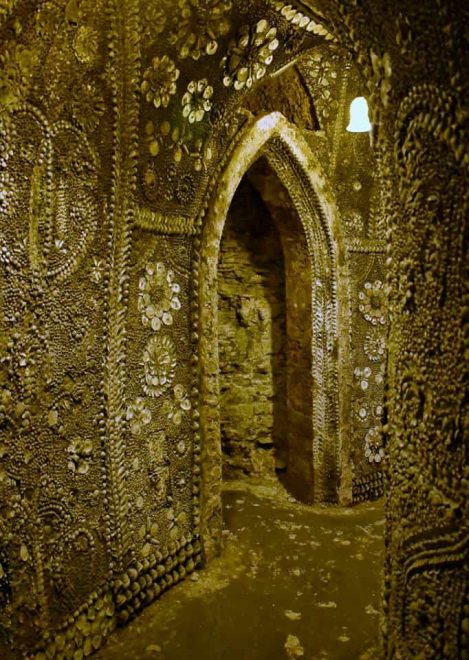
Some think it is an ancient Pagan grotto, others that it is simply an ornate Regency folly, although it lies under former farmland that was never part of an estate. Its true origins have never been discovered.
The Shell Grotto is in Grotto Hill, Margate.
Go to http://shellgrotto.co.uk/
Find out more about Paul at: https://paulhazelton.com/about/
