

By Local Democracy Reporter Daniel Esson
Council tax bills have surged for tens of thousands of Kent households over recent years.
As many residents are penalised for non-payment each year, we look at the consequences of not coughing up when the council comes knocking…
For many of us, stumping up the monthly compulsory charge to help pay for services is a simple, automatic process.
But residents failing to pay the household levy – by accident or choice – is a more common occurrence than you may think.
In fact, the colossal sum currently outstanding to our cash-strapped councils tallies up to a staggering £85 million.
To help plug the financial black hole, authorities have issued 193,000 liability orders since April 2021, according to data obtained by Freedom of Information requests.
They are formal legal demands for outstanding money through the courts whereby residents risk being hit with eye-watering legal costs.
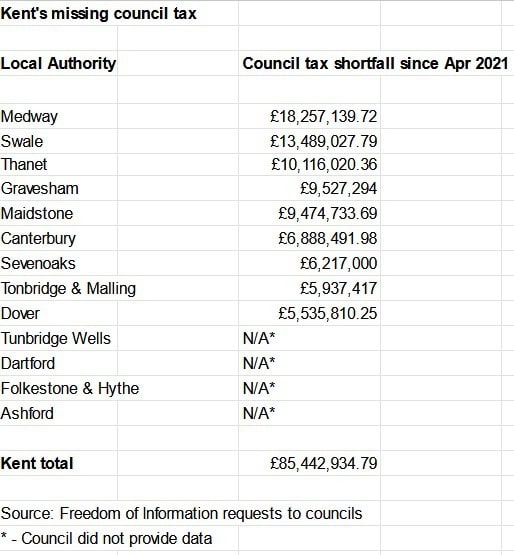
Owed more than £18 million, Medway council deployed bailiffs 26,000 times since April 2021, figures show.
The authority issued 46,000 liability orders in the duration, with the average amount owed at £1,400.
Thanet is owed just over £10 million and has deployed bailiffs almost 20,000 times since 2021 according to FOI data.
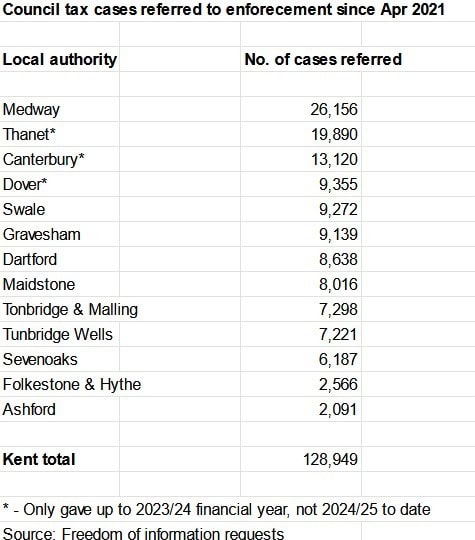
Comparatively, Swale hopes to claw back more than £13 million but deployed bailiffs on about 9,000 occasions and served 12,000 liability orders during the same period.
Canterbury, which has almost half the amount outstanding, called upon bailiffs on significantly more occasions – 13,000 in total – by April 2023.
Does anyone go to jail for it?
Non-payment of council tax, like most violations of tax law, is a civil matter, not criminal.
They do not usually result in jail sentences, however, there is no fixed rule on how local authorities deal with those who do not pay.
Government guidance tells local authorities to minimise the use of courts in council tax disputes – which is why hundreds of liability orders are often given approval simultaneously in court.
However, recent reports state from the start of 2017 to the end of 2022 more than 80 people may have been imprisoned nationally.
This only occurs in England, with Scotland, Wales and Northern Ireland not issuing orders to commit people to prison for non-payment.
Though they do seem to be in decline, with the New Statesman’s Freedom of Information request finding forty-four people were given jail sentences in 2017, and none in 2022.
From 2010-2023, up to 773 people could have been jailed across the country for not paying.
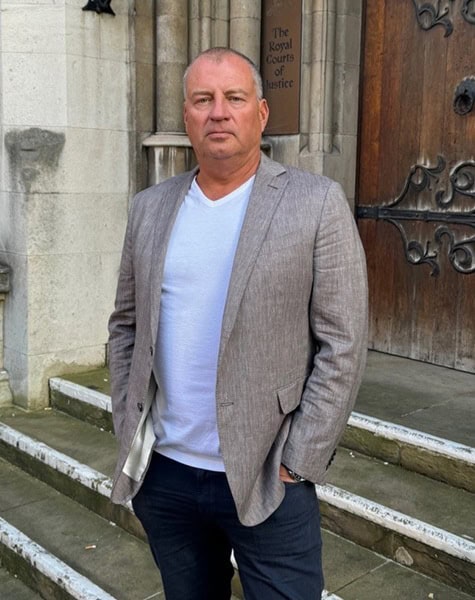
Lawyer and television presenter Chris Daw KC, who has represented clients in Kent’s criminal courts, started a Parliamentary petition in 2019 to officially end the use of imprisonment for non-payment of council tax.
It did not reach the 100,000 signature threshold for a Parliamentary debate, but the government did respond saying: “Committal to prison for non-payment of council tax can only occur where the court is satisfied that the debt is due to the wilful refusal or culpable neglect of the liable individual.”
Mr Daw told the Local Democracy Reporting Service: “Essentially I came to the conclusion that what we see in terms of council tax enforcement is an utter abomination.
“The vast majority of those affected are women, generally because they are left with debt from a partner who’s left and they can’t pay all the bills including council tax.
“We abolished debtors’ prisons in the 19th century and yet lo and behold 140 or so years later, we’re in a society which still sends people to prison because they can’t pay their debts, and that to me is fundamentally wrong.”
But despite almost 200,000 liability orders, nearly 130,000 cases referred to bailiffs in Kent in the last few years, not a single case has ended in a prison sentence in the county.
If not jail, what happens?
It is not just sternly-worded letters from the local authority which you receive by persistently not paying council tax.
Financial penalties can run into tens of thousands of pounds, especially if the case goes to court.

Speaking on Thanet District Council’s use of bailiffs, Cllr Rob Yates, cabinet member for corporate services, explained: “Council tax is a vital source of income for this local authority.
“The money received helps us to provide over 30 different public services including; waste and recycling collection, maintaining our awarded beaches and bays and the provision of homelessness support for some of our most vulnerable residents.
“We focus on supporting residents who fall into arrears with their council tax, rather than pushing for prosecution. Anyone who is unable to pay should contact us immediately for support.
“Pursuit of unpaid council tax can lead to us appointing bailiffs and goods to the value of the debt being seized.”
Home forcefully sold
In July, a resident who refused to pay had their home forcefully sold after racking up a debt of £36,000.
Gravesham council said after the recovered debt and legal costs from the proceeds of the sale of the Northfleet home the balance was handed back to the house’s former owners.
At the time, cabinet member Cllr Narinderjit Singh Thandi said: “Where it is clear that a council taxpayer can afford to pay but has chosen not to, then as demonstrated by this latest case, we will use all legal powers available to us to collect unpaid council tax.
“We rely on council tax to pay for the vast majority of services we provide.
“Like many local authorities around the country, we face budget challenges, and every penny counts.”
Orders to pay
When a liability order is issued, the legal costs incurred by the council in doing so can also be piled on top of the outstanding tax bill.
Local authorities can also ask an employer to deduct unpaid debts directly from the householder’s wages, apply to take money from benefits, appoint bailiffs to seize property, or take them to court personally.
It can also apply for a charging order which gives the local authority security for the debt as it is secured like a mortgage on a property and, in extreme cases, can force the sale of the property.
“There’s no crime involved in any of this – these are civil enforcement processes,” said Mr Daw.
“In my view it should only be in the most extreme cases of deliberate disobedience to court orders with no mitigating circumstances that anybody should be sent to prison in a civil case.”
“The end result of a financial debt should not be jail, it should be – in the worst case scenario – bankruptcy, not a prison cell.”

Whilst it’s somewhat incredible to see Thanet Council near the top of a league table for anything, I would much rather it wasn’t for most Council Tax owed. Meanwhile, mugs like us pay it on time every month and actually end up paying more because so many people can’t be bothered to pay.
It is hardly incredible that this money is outstanding when Thanet (and other Councils) decided to make their Recovery Officers redundant and change the recovery methods.
Use of bailiffs and prison may be considered draconian – but it is the only way to extract payment from those most reluctant to pay. That is why the legislation provides for sanctions. Furthermore, the lack or absence of ultimate sanction merely encourages others not to pay if serious consequences are unlikely or non-existent or simply not enforced.
Payment arrangements are always the first option for those in difficulty but there is always the 5% who merely play the avoidance game. Prison sentences were usually suspended in the first instance and only when the coercive force was seen to fail were they implemented.
It is hardly fair on those who pay diligently and on time every month that those who choose not to pay are able to buck the system – and yet those defaulters still expect the fire brigade to turn up if their house is on fire . . .
I’m not sure why this piece bangs on so much about being banged up.
The fact is that it Thanet there are, for whatever reason, people who between them owe TDC £10,000,000.
Maybe people in receipt of benefits, for example, should have their council tax taken out of their benefits, so there’s no chance of them falling into arrears.
Yes – that’s what the ”powers that be” thought. The debts could be collected by attachment to earnings or deduction from benefits rather than hauling debtors back before the Court.
It appears not to have worked.
Not good value though, bins not emptied at the slightest excuse, streets broken & filthy. Crime everywhere & not a copper in sight.
And failing to pay just makes a bad situation even worse.
Those who ”protest” by non-payment are really cutting their nose to spite their face.
Broken streets and police are the responsibility of KCC.
In more than 10 years, I’ve only had to report a missed bin collection a couple of times.
Chris T- your comment is an exaggeration of the facts.
The system and calculations around coming off and going on benefits could be a reason for arrears being built up often without the payer realising until the debt is significantly high enough to warrant attention and bailiffs?
The figures make nonsense anyway; what is the percentage of CT claimants and working households to total households in each district?
Chris T: maybe pay attention to what you chuck away. I know you’d rather not bother (like many others I know). Too bad for you.
If the residents of Thanet unite and refuse to pay the council tax untill all the uncollected money is paid, maybe the council might get a little more respect, or maybe the councillors should return their expenses, untill the unpaid tax is paid, as surely they do it because they want to put something into the community.