

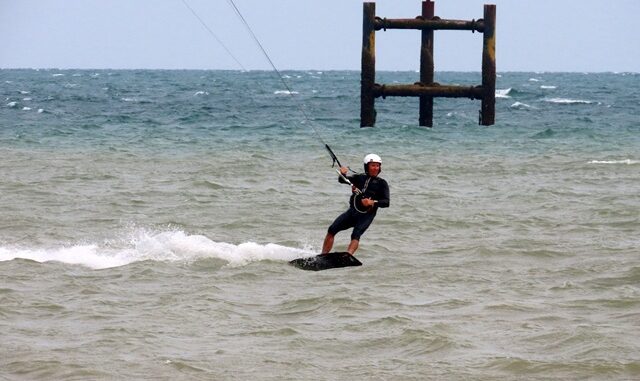
A Thanet kite surfer says he was lucky not to be injured – or worse- after his kite lines were cut by a suspected Indian Fighter Kite while he was out at sea.
Stacey Vass, from Margate, was about three-quarters of a mile from shore while kite-surfing off Ramsgate main sands last Thursday when his lines hit a long string attached to a small black kite.
Indian Fighter Kites are single-line flat kites where line tension is used for control and at least part of the line is glass or metal shard coated to cut down the line of others in fight matches.
The incident led to Stacey dropping backwards into the water and having to swim for some 25 minutes to reach shore.
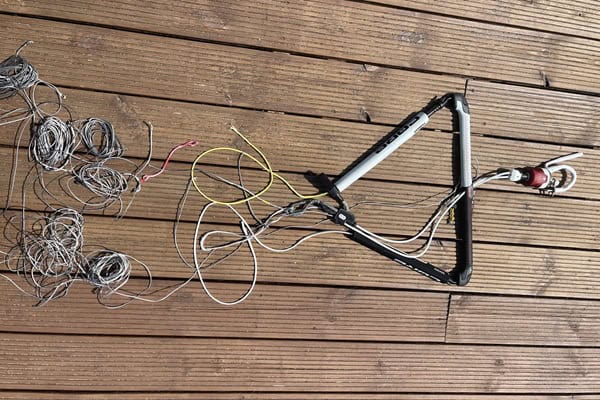
He said: “While sailing I was out about 1000m from shore when my kite lines hit a long string which was attached to a small black kite which was heading across the bay. Straight away it cut through all four of my kite lines causing me to drop on the water and my kite to fly away from me.
“Luckily I was able to swim back to shore in about 25 minutes, and my kite came into the beach safely at the end where Nero’s was where it was collected by a friend.
“As I was swimming in I could see the small black kite still flying, heading out to the north. It had kept flying because of the weight of the trailing line.
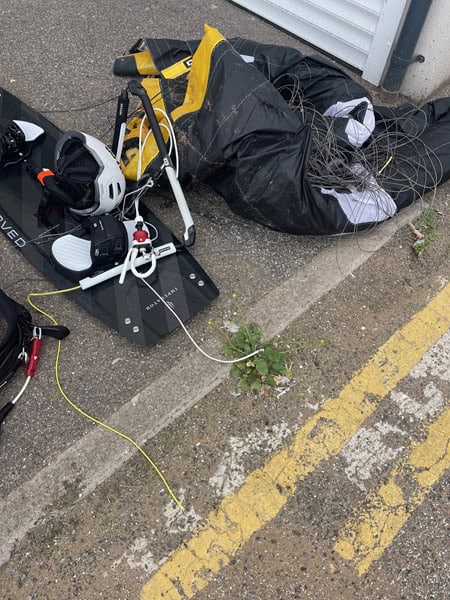
“Once back at home I talked to a couple of people and that’s when we discovered it’s a Indian fighter kite, the lines are covered in glass and small fragments of metal, the lines can be up to 80m long.
“My lines had a braking strain of 500kg each and it cut through them like butter, not even pulling me.
“It also cut about 70cm above my head, which could have very easily been my body.
“The kite could have very easily came ashore if the wing was 10 degrees more onshore and the line could then have run along a busy beach causing injury.”

Stacey, who has been kitesurfing for more than 20 years, says he wants people to be aware of the danger posed by the fighter kites.
The dad-of-one said: “They are banned in a lot of countries and have even caused deaths. When it comes down it means you have sharpened line in the water and then washing up on the beach where there are people and dogs that might get injured because they won’t even see it.”
The sharpened kite strings are a particular hazard for flying birds, as the strings easily cut through muscle and bone. Fighter kites are common in countries like India, Pakistan, Afghanistan and Bangladesh but not generally in the UK.
Stacey, who works for a kite company, has reported the incident to police and the coastguard.
A Kent Police spokesperson said: “Kent Police received a report of damage caused by a suspected unattended kite towards another kite which was being used in the water near Ramsgate beach during the afternoon of 7 August 2025. Local officers have been made aware.”

I’ve watched the Afghani team practising from Sandwich Bay, they are remarkably skilful and compete internationally. This is the first accident I’ve heard of in years of watching.
So presumably, if this was an Indian fighter kite that caused this, then it was a ‘losing kite’ that had been cut during a match, but rather than it being retrieved was just left to fly out to sea? Sounds like a sport that should only be played in a very controlled environment, not in public space or by the coast … I’d never heard of this before.
Well if it can kill a person or animal then needs to be banned.
✅ Agreed, Joe
https://timesofindia.indiatimes.com/india/15-dead-in-kite-flying-mishaps-across-gujarat/articleshow/117277096.cms
Is there no current regulation in the UK.
https://www.voanews.com/a/police-kite-fighting-string-responsible-for-india-festival-deaths/6931342.html
Cultural enrichment
What isn’t explained in the article was whether the kite strings were still attached to somebody controlling the kite. If, as intimated in the article, the kite was flying untethered and the line was loose, how
did it manage to sever three cables each of some 500kg breaking strain without becoming entangled in these lines if the fighting kite was free of any kite flier? I’ve read the links in the comments above about deaths associated with this sport in India but none explain how the kites could cut through quite this material so easily.
Happily, the kite surfer got back safely thanks to his being prepared.
This article is poorly written. I’m sure I’m not the only one who is confused as to what an ‘Indian Fighter Kite’ is? It is not adequately explained at all.
Third paragraph “Indian Fighter Kites are single-line flat kites where line tension is used for control and at least part of the line is glass or metal shard coated to cut down the line of others in fight matches.” Tells you precisely what a fighter kite is