

By John Horton
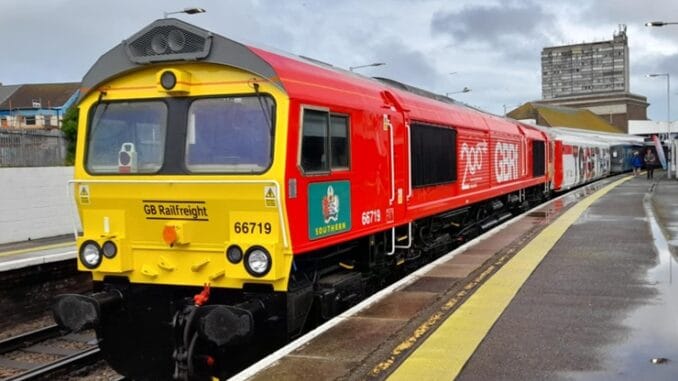
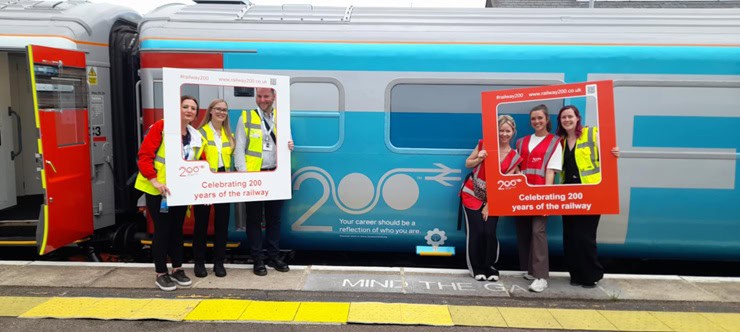
A special touring exhibition train made a stop in Margate this weekend as one of 60 destinations celebrating the 200th anniversary of the birth of the modern railway.
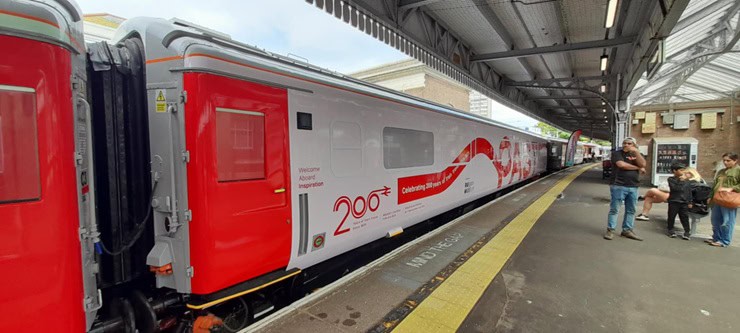
As part of the year long Rail 200 events, Inspiration is touring across Britain.
Two of the carriages have been specially produced in partnership with the National Railway Museum at York. The first carriage is dedicated to the past, with history tracing back to the ancient Greeks, and how travel has been transformed through the ages up to the modern day.
The second carriage is a wonder lab on wheels, with interactive experiences for everyone, whilst the third carriage focuses on the wide and varied careers available on today’s railways, some of which may surprise you, such as drone pilots, helicopter pilots, and ecologists. A fourth carriage is dedicated to agencies that help run the railways.
In collaboration with Rail 200 across Britain, Southeastern hosted Inspiration on July 20 – 21 at Margate on Platform 2.
Former train driver John Horton and family went along to explore the Inspiration train:
It would not be incorrect to say, that we’ve all made mistakes in the past, but that we learned a valuable life lesson for the future at the time. Yet every now and again we lack a certain something, in order to progress we need some extra, – “Inspiration”.
The event at Margate Station, was part of the celebration in 2025 of 200 years of the railways.
The very special train “Inspiration” is comprised of four host coaches and a generator car, with a locomotive at each end.

The exhibition started with a safety brief in a separate part of the station, in the former “parcels” area, where the blue tall wheeled cages used to be stored (remember those in the 70s and 80s?).
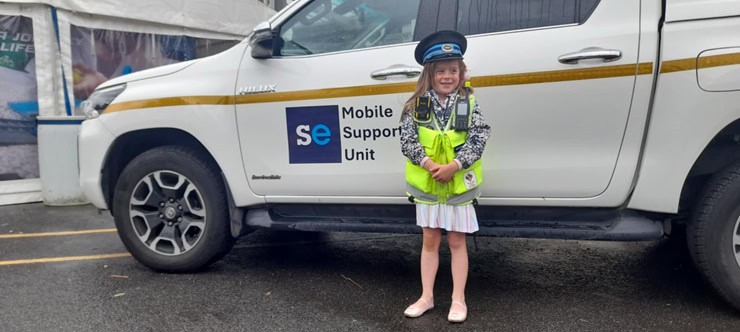
The brief was aimed at school children in year 6 to early stages of secondary education, years 7 and 8. Various myths were discussed and “busted” according to their accuracy, one such myth being:- if you lay down between the rails you are perfectly safe if a train should come along – actually wrong – “BUSTED” – the underneath of a train is extremely low, if it passed over you at speed it would more likely suck you up and you’d suffer life changing injuries, possibly losing your life.
Ticket holders were then shown to platform 2 where the train was stabled.


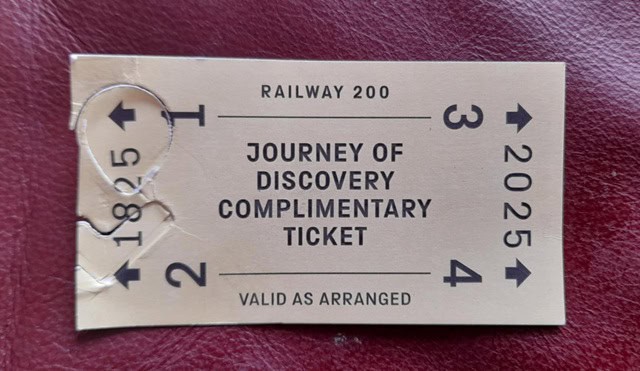
Coach 1 housed “The Past”, a visual display which told us about the birth of the railway, with the opening of the Stockton and Darlington Railway in 1825. As the years progressed, we learned about the birth of the Great Western Railway, the brain child of Isambard Kingdom Brunel, who was such an accomplished engineer and then the birth of “The Big Four”, the largest railway companies who in 1923 absorbed all the small branch and little known lines in their area – The London Midland and Scottish (LMS) The London and North Eastern Railway (LNER) The Great Western Railway (GWR) and finally The Southern Railway (SR). In the following years steam power developed, speeds increased and the world speed record was set by the LNER with Mallard, an A4 Pacific, which achieved a speed of 126mph on 3rd July 1938. That record still stands.
In 1948 the big four were disbanded and the railways nationalised. From January 1st of that year British Railways was born and steam was out. Coal was a dirty commodity, it was the blight of Britain, fossil fuel caused the great smog in London which killed hundreds, and more innovative means to power our trains was necessary, and so the end of the steam locomotive was announced and designs for a new electric railway or dieselisation were underway. The last steam train ran in Britain on 11th August 1968, “the Fifteen Guinea Special”- after that, steam was no more as a staple of railway travel.
1965 saw the launch of BR, followed by the division into sectors in 1982 and Network SouthEast was born on June 10th 1986. Finally, privatisation started in 1993.
Another interesting fact was how the railways instigated the standard time. Before the railways, clocks all told different times according to how far you were away from London, trains were being timetabled but the difference between cities varied. For instance, when it was 12 noon in London, it was 12:10 in Bristol and in Plymouth it was 12:18. This wouldn’t do, all clocks needed to tell the same time across the whole country, and thus the age of timetabling and time accuracy was born.
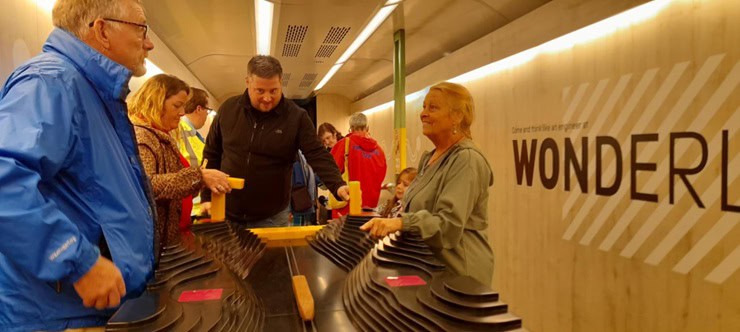
Coach 2 – housed “Wonderlab on Wheels”, here visual displays, which were highly interactive, showed how the railway works on innovative ideas. In a display of how wheels actually run on the rails, it was interesting to learn that only approx 25.4mm of actual surface metal on the tread on the wheel is actually in contact with the rail head, that’s a very small surface area indeed.
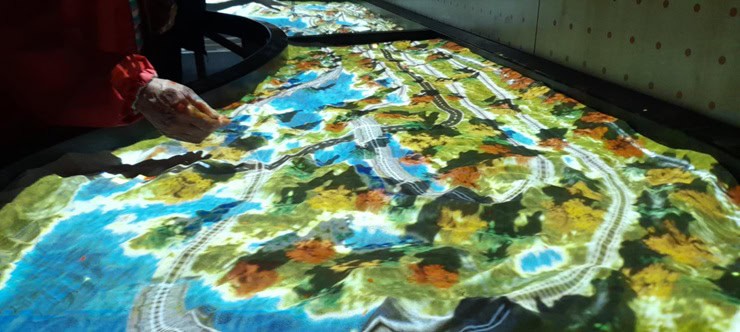
Another popular area was the holographic railway where a projected image upon a table was covered with kinetic sand and you could alter the terrain accordingly by simply moving the sand.
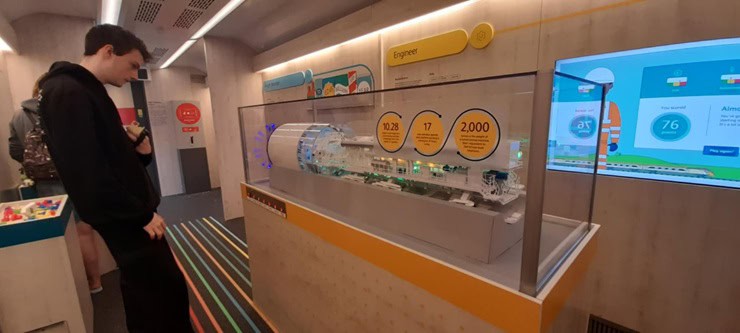
Coach 3 – “Your Railway Future” showed the various careers available on today’s railway, some of which I never imagined existed.
A working miniature model of a Tunnel Boring Machine (TBM) was fascinating to watch, with an easy to read explanation of how a TBM works, how it slides on hydraulic rams, carefully positioning concrete segments before moving forward as it digs out spoil with a huge rotating cutter head. There were various labelled buttons which you could operate and each corresponding part moved accordingly.
The railway certainly continues to progress, careers include those as an Ecologist or a Drone Operator. There was one massive drone on display, quite terrifying at first, but a vital part of helping run a safe railway today.
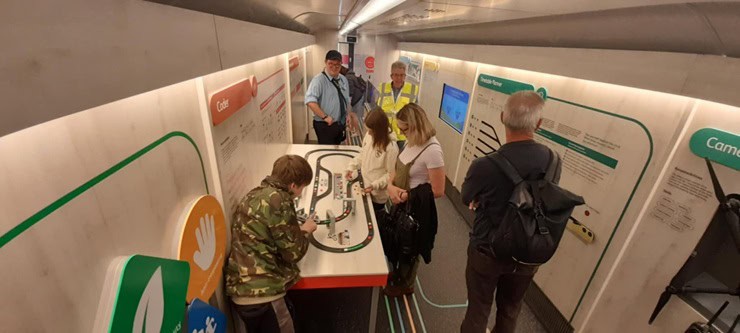
“Coders” – a model of a smart train- was in operation which you could speed up, slow down or bring to a stop, simply by placing transponders in the track, the signals being relayed directed to the model train which acted accordingly – truly fascinating. Positions such as Railway Teacher, Weather Analyst, and Timetable Planner were but a few to mention.
Coach 4 – “The Partner Zone”, which showed the various agencies which are currently involved in the running of today’s railway.
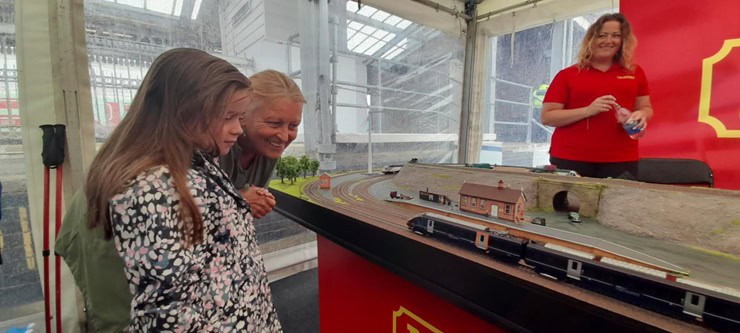
During our visit we met the Setterfield family and young Maisie Setterfield was keen to get active, which was exactly what the exhibition was all about.
It was a thoroughly enjoyable time and many things were learnt. The old saying of “every day’s a school day” certainly was true. Full of history, highly interesting whether you like railways or not, the “Inspiration” train is indeed truly inspiring and a journey that was too good to miss.
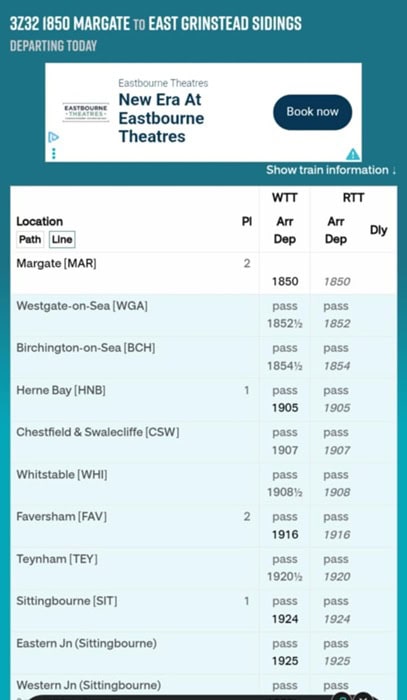
People can visit the train for free until 4pm today (July 21). It will then depart Margate this evening, at 18:50hrs, bound for East Grinstead, and a further stay on the Bluebell Railway at Horstead Keynes, times of the train passing through stations in Thanet up to Faversham are as follows, be sure to give them a wave:
https://railway200.co.uk/inspiration/
With thanks to Southeastern trains, Rail 200, GBRf and all the staff at Margate Station.

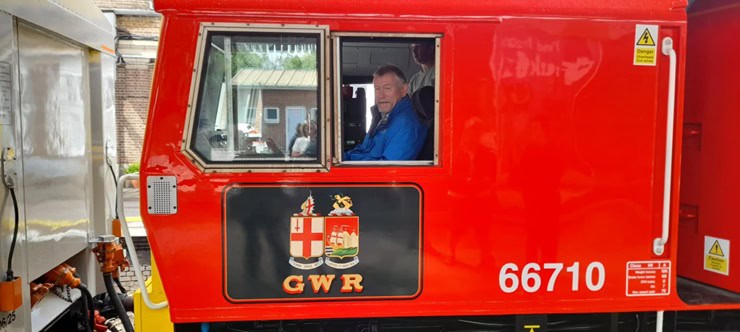
Sadly we couldn’t go on the first coach yesterday, it was closed due to a Aircon fault , it was all good fun and I got to climb into a cab of a class 66 loco with the driver explaining all the controls too .