

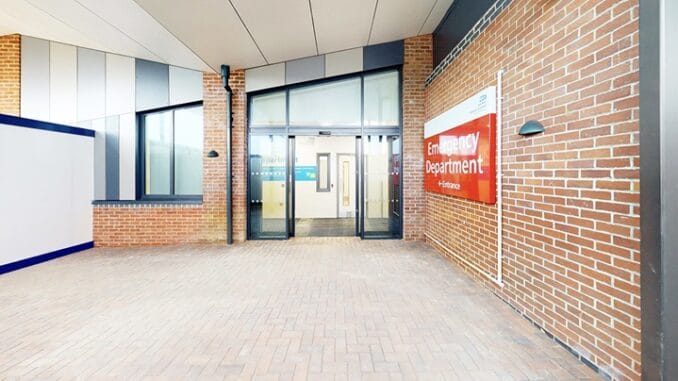
Urgent and emergency care at QEQM Hospital in Margate has been rated as Inadequate for safe care and a warning notice issued to East Kent Hospitals NHS Trust (EKHUFT) to make immediate improvements.
The warning followed an inspection in January by the Care Quality Commission (CQC),.
Medical care was upgraded from requires improvement to good, with ‘caring’ rated as Outstanding, following the same inspection.
The inspection was carried out at a time of ‘unprecedented levels of demand.’ A follow-up inspection of urgent and emergency care in May found the Trust had completed 61 of the 66 actions needed for improvement.
Ratings
Urgent and emergency services continue to be rated as requires improvement for being effective, caring, responsive and well-led, while its safe rating has declined to inadequate.
At a previous inspection of urgent and emergency care in 2023 inspectors identified breaches of regulations relating to safe care and treatment, dignity and respect and staffing. At this inspection, the service remained in breach of these regulations.
At the time of the assessment, four wards were affected by norovirus, with impacted patients isolated.
Medical care caring has been upgraded to outstanding. Responsive and well-led have improved to good. Effective has been re-rated as good and safe re-rated to requires improvement. During a 2023 inspection there were breaches relating to medicine management, infection prevention and control, the ward environment and staff training. At this assessment inspectors found improvements and no breaches of regulation.
EKHUFT, which runs QEQM and other east Kent hospitals including in Canterbury and Ashford, was issued the warning notice due to significant concerns about the safe care and treatment of people using the service. The notice requires the trust to focus on making immediate improvements in this area.
The overall rating for Queen Elizabeth the Queen Mother Hospital remains requires improvement.
‘Sustained pressure’

Amanda Williams, CQC deputy director of hospitals, secondary and specialist care for the South-East, said: “When we inspected urgent and emergency and medical care at Queen Elizabeth the Queen Mother Hospital, we found serious concerns about the safety and quality of care in the emergency department, alongside some notably positive experiences in medical care.
“In urgent and emergency care, the department was under serious and sustained pressure, and the systems meant to keep people safe weren’t holding up under that strain.
“We found overcrowding leading to people being cared for in corridors. Inconsistent monitoring of this corridor care meant some people’s deterioration could be missed, and at one point during our inspection, nobody was overseeing the main waiting room at all.
“We also saw one person who couldn’t be accommodated in the mental health lounge because of capacity and safety concerns who left the department to wait elsewhere and needed to be found by police.
“Staff in the emergency department were doing their best in really difficult circumstances, and many told us they felt part of a supportive team. But that commitment on the ground was not being matched by clear leadership and oversight.
“There was a disconnect between frontline staff and senior leaders, and this needs to be addressed urgently to make sure people receive safe and effective care when they arrive at the department.
“However, in medical care, good leadership was enabling staff the time to spend with people and treat them as individuals. People told us nurses and carers worked incredibly hard going out of their way for people living with dementia.
“Whether that was finding a former seamstress some towels to fold or getting hold of a crossword for someone who loved puzzles, staff treated people with real warmth.
“End of life care stood out, with themed side rooms and a memory tree for families to remember loved ones. One person told us doctors were fantastic and explained everything that was going to happen to them.
“We’ve told the trust where it needs to improve in urgent and emergency care and we’ll continue to monitor progress closely to make sure people are safe.”
Following the warning the Trust began reporting weekly to the CQC on its action plan and progress.
The CQC carried out another inspection of urgent and emergency care at the hospital on 6 and 7 May. The Trust has completed 61 of the 66 actions to improve and the CQC has stood down the weekly reporting on its progress.

Dr Des Holden, acting chief executive for East Kent Hospitals said: “We recognise that the care the CQC saw in the emergency department in early January was unacceptable for both patients and staff, and we have made significant changes to the emergency department since then, which we were able to demonstrate at the CQC’s later inspection in May.
“The hospital was under unprecedented levels of demand this winter, and since then our teams have worked incredibly hard to make sure it can safely manage significant pressures in the urgent and emergency care service by strengthening safety oversight, improving staffing and training, expanding virtual ward services, introducing digital nursing records and enhancing escalation processes across the hospital.
“This year, we have also been working as a whole-hospital team, alongside NHS England, NHS Kent and Medway, and with our partner organisations, to end corridor care in our hospitals. We now rarely care for a patient in a corridor and we are focused on elimination of all waits for patients outside a cubicle or bed space anywhere in the hospital.
“I want to thank staff for all the work they have done – and continue to do – to improve the service.
“I also want to recognise the work of the medical care teams, who were described by the CQC as delivering an ‘exceptionally high standard of compassionate, person-centred care’. They achieved an improved rating of ‘good’ for their service and an ‘outstanding’ rating for ‘caring’. It’s testament to these teams that they achieved this in the difficult circumstances of the challenging winter period.
“While we fully acknowledge the findings from the inspection carried out in January, it is important that patients, staff and the public recognise that today’s report on this inspection does not fully capture the significant progress made at the hospital since then.
“We understand, however, that there is more to do. We remain fully committed to building on that progress and providing safe, quality care for our local communities.”
The CQC rated urgent and emergency care as:
- ‘Inadequate’ for safe;
- ‘Requires improvement’ for effective;
- ‘Requires improvement’ for caring;
- ‘Requires improvement’ for responsive
- ‘Requires improvement’ for well-led.
In the emergency department, inspectors found:
- Staff levels meant people were waiting in the main waiting room without anyone checking on them for 40 minutes, even though some people had been waiting more than 72 hours for a hospital bed.
- Leaders didn’t ensure people were treated in appropriate areas. 28 people were being cared for in temporary areas not designed for ongoing care, while a further 50 people waited in the main waiting room at the same time.
- The service didn’t ensure people being cared for on trolleys in corridors had emergency call bells. This was taking away people’s ability to call for help if they became unwell. However, to provide reassurance and maintain oversight, staff were assigned to care for people in these areas.
- Staff didn’t have time to help support people with nutrition and hydration, skin integrity or personalised communications increasing the risk of avoidable harm.
- Staff in the mental health lounge checked on people every day and worked with outside mental health teams to keep them safe, even when the department was under pressure.
- Staff treated people and their families with kindness even when the department was extremely busy, and most people told inspectors they felt well looked after by staff despite long waits.
The CQC rated the medical care as:
- ‘Requires improvement’ for safe;
- ‘Good’ for effective;
- ‘Outstanding’ for caring;
- ‘Good’ for responsive
- ‘Good’ for well-led.
This means an overall rating of ‘good’ (upgraded from the previous rating of ‘requires improvement’).
In medical care, inspectors found:
- Staff created themed, comfortable rooms for people receiving end of life care, and set up a separate flat where relatives could stay overnight to be close to their loved ones.
- Staff helped people stay in touch with what mattered to them, including supporting someone who was a Jehovah’s Witness to join virtual meetings with their community.
- Staff did not always tell community carers about important changes when sending people home, such as new medication, skin damage that happened in hospital, or a greater need for personal care support.
- The level of pharmacy support left three people on St Margaret’s Ward without a proper check of their medicines for more than five days after they were admitted.
- Staff did not always record whether someone had capacity to make decisions about their own care, even when they had assessed that someone could not.
The report will be published on CQC’s website in the coming days.

Seems to me the staff are damned if they do and damned if they don’t, l had occasion to go to AE recently perhaps I was lucky I don’t know but I had first class care from start to finish,could not fault anyone, happy staff, plenty of refreshments and information.However when you see the amount of housing increase its no wonder QEQM is struggling as these people have no doctors so where they supposed to go.The infrastructure around Thanet has been damaged beyond redemption too many people and cars here now so unless we get a much larger hospital to cope or many new surgeries I cant see the end to this chaos and dont forget its not just Thanet they look after its surrounding areas as well all the way to Deal
The August before last I had a Stroke,and was sent to the QEQM by ambulance, which resulted in 3 days of Hell! I paid into the National Health Service all my working life, and that is what I expect, a service! I can’t go into all the problems I experienced, just to say I had one hot meal in 3 days, consisting largely of carrots! I made a written complaint later, and received a fullsome apology by phone! I have had another Stroke since the first one, and refused to go into the QEQM when the ambulance arrived! The NHS is on its kness, and badly managed, much too much reliance appears to be left using Agency staff who do not have the same committment as normal staff.
so you had a stroke, refused care at qeqm and thus would’ve been transported an hour by road to WH Ashford, in which time, you could’ve done irreversible cognitive damage? Some people really do love to cut their nose off to spite their own faces I guess.
when i last visited the A&E at the QEQM hospital it was packed solid , and there are a certain element of people that are using it as a drop in centre , but to make matters worse they take their aunts , uncles , brothers ,sisters and grandparents with them , taking up all the seats and space , and as usual no on does anything about it !
oh look, real world’s being a xenophobe again.
I had the occasion to attend a&e about 4 years ago, late evening. Perhaps the inspectors should question every patient in there to see why they are there and then compare that to the staffs opinions.
There were people there because they had nothing else to do, some kicking off because they wanted treatment on the spot , but had already attended days before and were tryiing to skip the wait for the follow up appointment. Yes some had long waits and several of those got bored and went home.
Others used it as a community centre. One conversation was a lady complaining that having smoked 60 a dy for 40 years, she’d given up because she’d got so ill , but was now upset that the copd could’nt cured and proudly proclaimed she was in a&e 3 times or more a week.
I was there 8 hours , but had had an ecg and blood taken in the first half hour, so once assessed as not being a risk of immediate harm , had to wait my turn for the results.
On that night much of what was going on was closer to crowd control and maintaining the system rather than actually dealing with people. Quite why some who attended felt the need to bring their entire extended family with them is beyond me.The police bringing in 2 patients over time i was there just another thing that threw everything awry.
How are the hospital meant to cope with a society that largely doesn’t care about the pressures it piles onto it. Or do we just pour endless amounts of cash at a problem that won’t use it efficiently.