

Review by Dan Thompson
We’ve all engaged in an act of resistance at some point in our life. Whether it’s an international event, like the Stop The War marches that happened across the world in 2003, or something more local – for or against opening a new airport at Manston, say, or protesting outside the council offices to try to save Margate’s Winter Gardens. Resistance and protest are, perhaps, defining characteristics of any sense of English-ness. Protests have shaped the way we live today.
Resistance is a new book by artist Steve McQueen, published ahead of the forthcoming exhibition of the same name at Turner Contemporary (or, maybe, just ‘Turner’ – if the publishing imprint is a preview of a new branding). The book, like the exhibition, is a collection of photographs which document protests, marches, and other acts of resistance between 1903-2003. That’s a century of massive change, and we are reminded in Gary Younge’s introduction that every gain made, from the right for all men and women to vote, to gay rights, to equality for disabled people, has been hard fought;
“The progressive mantra that a better world is possible is true … but a worse world is also possible, and there are people actively working towards that too.”
This book, of course, can’t include every protest, and tends to focus on the ones people thought were significant enough to document at the time (and those dates are deliberate, framing protest in the era when photography relied on film). There are Suffragettes before the First World War alongside road protestors in the 1990s, Indian women strikers at the Grunwick factory next to striking miners (all from the north – missing the Kent mines might be an oversight!), Greenham women and Gay Liberation activists.
It’s an incredible document, and a reminder that politics is a perpetual process led by ordinary people, not something that happens every four years that is best left to the alumni of Eton, Harrow, and Dulwich College, who have their own interests to defend. It’s real people, living lives in different ways, who understand the problems and can see the solutions.
In Resistance, that struggle is brought to life in a series of essays by the people who were involved – Sam Needleman remembers fighting British fascists on Cable Street in 1936 for example, Kate Evans recalls being a road protestor in the 1990s, and Rebecca Eleanor-Johnson writes about dancing on the Cruise Missile silos at Greenham Airbase. A series of essays by Emma Lewis, Paul Gilroy, Kate Hudson and other put those personal moments in a wider context.
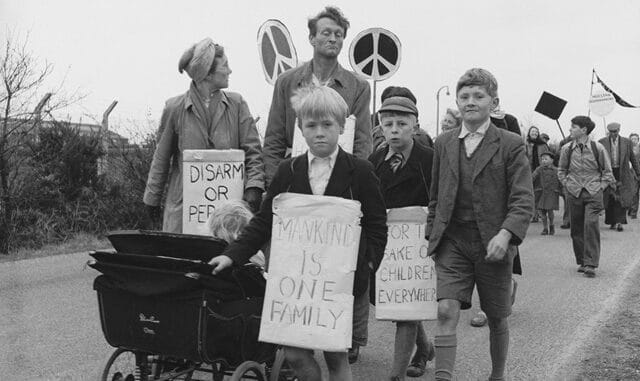
And this is a book accompanying an exhibition, so those memories sit alongside incredible photos, of people whose stories we might never know – who are the schoolboys on the Aldermaston March, or the lesbians kissing at Hyde Park rally in 1971, or the young Asian man with a ‘Brick Lane Against The Nazis’ badge? And how were their lives shaped or changed by this moment of protest?
Because while protest, acts of resistance, campaigning for a better (or worse) world, have big impacts and change society, they also change us. And that’s when this book works best, when it’s personal – because then it becomes not just a document of protest past, but a reminder that it’s up to us to make a difference. We can imagine ourselves in the faces in the struggles here, and that’s important.
Resistance by Steve McQueen is published by Monument Books and Turner, and is available from all good bookshops including The Margate Bookshop.
Resistance- How protest shaped Britain and photography shaped protest – opens at Turner on 22 February until 1 June.
The exhibition by Steve McQueen is curated in collaboration with Clarrie Wallis. It will explore how acts of resistance have shaped life in the UK and the powerful role of photography in documenting and driving change.

I’m really looking forward to the exhibition but Dan’s opening comment is well off the mark, that we’ve all taken part in an act of resistance, and he’s referring to a political act if some kind.
My experience has been that very many people don’t resist what they don’t
like or agree with. And this is part of the reason our society and our world is in such a mess.
On the personal level many people don’t resist what is going to make their lives worse, changes in welfare and health provision, education, unfairness at work, etc.
What I hope is that the exhibition encourages people to take action be it small and personal or political and international.
poor research by this man i feel , i doubt if he even knew there were coal mines in kent ?
Looks interesting, but surely this belongs in a museum rather than an art gallery?