

Elke Heckel is a retired midwife who relocated to Ramsgate nearly seven years ago from Hackney.
During the pandemic she signed up to an online writing group and, as a result, had some of her work published in the anthology “Words from a distance”.
After the pandemic Elke joined the Ramsgate Multiverse, a group of Ramsgate poets and writers who meet once a month for public readings.
She said: “Pegwell Bay and the Old Hovercraft Port are my favourite places to walk and watch nature through the seasons. It reminds me of the Marshes in East London and sadly also of a time when the 2012 Olympics erased human communities and wildlife.”
National Grid plans to use the old hoverport site for its Sea Link project and will need to secure it through a compulsory purchase order.
Campaigners say if this goes ahead there will be years disturbance of this special place and it will be inaccessible for humans who find solace there.
To find out more visit https://www.minstermarshes.com
The deadline to object is 19th January 2026.
There is nothing there
On the face of it it’s an abandoned brownfield site: old tarmac on spoils from Chislet colliery; a footbridge to nowhere; parking lots still marked out for the ghosts of cars waiting to board the hovercraft. Crossing the channel from here to France was a fast but bumpy, noisy and smelly ride, I am told.
Who had the audacity back in 1969 to think it was ok to build this next to the chalk cliffs at Pegwell Bay captured by William Dyce in his famous painting from 1885? It is now a dedicated internationally important nature reserve where wintering birds roost and feed in great numbers.

Can you hear them? The call of the curlews and redshanks. A flock of oystercatchers flying in from the East greeted by nattering Brent geese. At dusk we watch the spectacle of hundreds of red listed lapwings descending on the nearby shore of the garage pool.
Tell them – there is nothing there!
Look closer and you see how nature’s rogues have cracked open the tarmac: pampas grass, escaped from swingers suburban front gardens, wafts its soft manes, some blonde some almost auburn protected by their sharp serrated blades. Butterfly bushes everywhere: in the winter the seed heads like brown squirrel tails. In the summer their purple flowers smell like honey, mingling with the sweet smell of a bumper crop of ripe blackberries.

On the remnants of a mini roundabout a huge yellow broom embraces a gigantic buddleja and towers dramatically above us. Nature providing a splendid example of no maintenance public planting. Opposite a feathery pink tamarisk, famous for sending roots deep in search of water and sustenance, gently waves its slender branches in the breeze. Next to it a sea buckthorn is laden with an abundance of tart orange berries. It is renowned for its healing properties: skin, heart, eyes, digestion to name just a few.

Should we consume what nature has to offers here, nourished by nothing but tarmac, spoil, dirt and sand accumulated over the last four decades? Best not. And best not disturb the ground to prevent contamination of seabed and marine life.
But I urge you to go, tread softly and discover for yourself. You might find orchids, samphire, purslane, golden birch, honeysuckle, dog rose and old man’s beard.

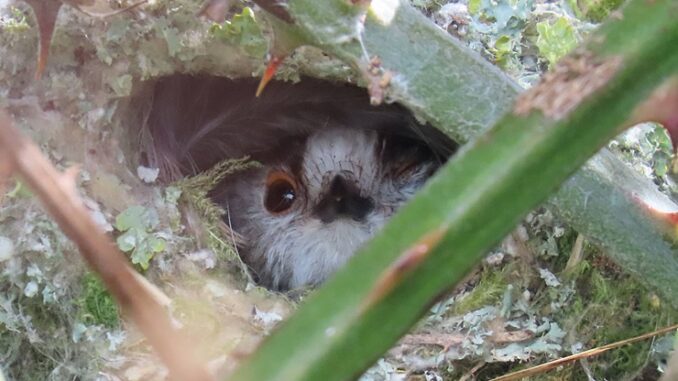
And know, somewhere in the scrubland a long tailed tit is building a nest with moss, lichen, feather down and spiderwebs.
There is so much there.
Don’t destroy it.

the rich and powerful always get thier way in the end , and no doubt this will happen here sadly
There is always an argument for Not In My Back Yard, but we need to look at the big picture.
We need to decarbonise at a pace, wind, wave,and solar are 3 means to do that.
The site was industrialised and before the governors, I suspect there were long tailed tit’s, and all manner of flora and fauna living there.
We also expected the poor to deliver energy to us, in the form of mines and power stations in the past.
Why do you think there are dinky little villages in the weald and the cotswolds? Because they dodged the developers bullet.
If there is a way of minimising environmental damage, it should be done, but someone somewhere is going to get the pylons and the energy infrastructure and it is not reasonable that places like Sheppey or Dartford cop all the negative bits of today’s world.
If Elke wants to give up electric light, the Internet and any care over global warming, and if that is the opinion of the majority in Thanet, then don’t do it, but otherwise, we have to accept some negatives to achieve an overall positive.
Nature is resilient and my guess after the disturbance, nature will return, but I am not David Attenborough, so I accept I may be wrong.
Elke knows that there are much better places to come ashore with this power, George, as would you if you read all the documentation and attended the hearings.
This is a brilliant piece of work, written by someone who has English as a second language. I’m in awe.
In the process of “Decarbonisation” do we decimate our wildlife.
Pegwell Bay is a SSSI ( Site of special scientific Interest, it is also a RAMSAR site.
This site is a feeding ground for many ‘Red Listed ‘ birds.
Then we move onto Minster Marshes, this area will equally decimated. In the name of decarbonization, is it worth ,
The answer has to be a resounding NO.
Romanticism does not exist in a place. It exists in the mind of the romantic. Hackney was once, like all of London, marsh. Where does Elke think electricity comes from? I’ve seen the hoverport come and go. Along with Richborough power station. Just get on and build the infrastructure. It’s going to happen. It needs to happen. Then Nature can get on and repopulate around it as it has done continuously. The sooner it’s done, the sooner the wailing and gnashing of teeth will stop. The sooner that the subsequent generations of wildlife can take hold.
Ugliness does not exist in a place. It exists in the mind of the ugly.
Beauty does not exist in a place. It exists in the mind of the beautiful.
Brutality does not exist in a place. it exists in the mind of the brutal.
Etc etc.
To people calling NIMBYism – there are more suitable brownfield sites that like to see used . They’re not on Sheppey) . I’d like another site used because the National Grid are planning to build an enormous energy converter on a swamp next to the old hover port. A swamp. Tonnes of building aggregate poured into a wetland. No one knows how far it is down to bedrock under the marsh. An energy converter is a good idea. Ruining a wetland for no reason is not. Right thing. Wrong place.
The problem with the term nimby is not just that it’s lazy; the misuse of the word allows developers’ myths to go unchallenged.The environmental damage, local disruption, concerns over planning transparency and cost-effectiveness are well documented and valid.
Well done Elke for highlighting the seriousness of this poorly thought through project.
I am afraid I agree with Harry on this one, which must be a first, but in my view climate change projects overreacted all.
So where else does this go, and if so, won’t there be similar complaints from those objectors?
As for swamps and impossibility, George Stephenson built a railway across Chat moss in 1829, and as far as I know tge line still.operates,so in engineering terms no issue.
I do object when projects lije tge nearby surf lagoon at Betteshanger was projected, because that could be built anywhere and rare lizard orchids were at risk, and to date it hasn’t been built due to economics and the impossibility of moving orchids around at will.