

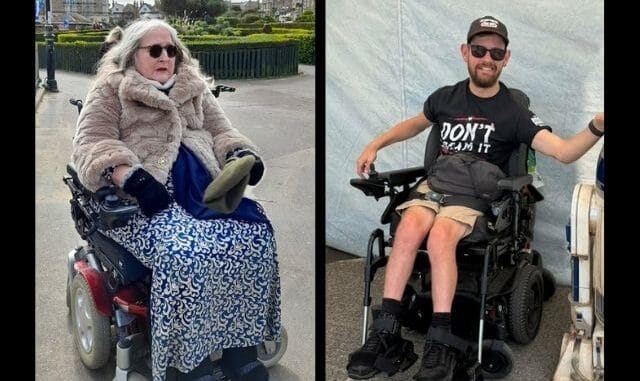
Like many disabled people, without wheels my life would be much less interesting.
I can walk a bit with sticks but my mobility scooter gives me better access to normal life, shops, the park, my local swimming pool, restaurants – those without steps anyhow – and I can scoot to see friends without needing someone with me to pick me up if I fall over.
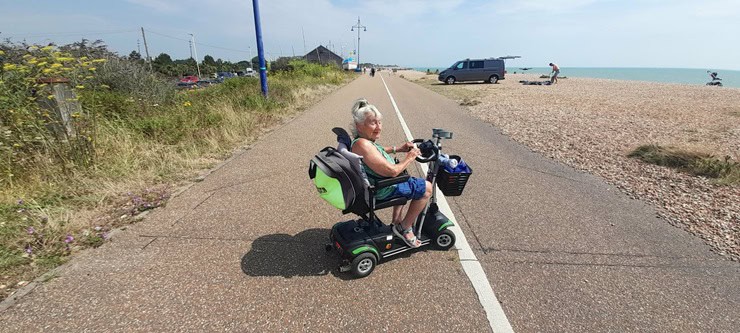
But some of my disabled community are totally dependent on wheels for every aspect of their lives, and without their powered wheelchair they can do nothing.
A powered wheelchair has a heavy battery and is controlled by a kind of joystick on one of the arm rests. They vary tremendously in price, but your starting point is over £1000 and if they are customised to your needs they can go up to more than £15,000.
Nell, whose daughter was very disabled and had to use a specially adapted wheelchair (which gave her independence) says that being without the chair was impossible.
“I used to seriously fear any kind of breakdown. Powered chairs have very heavy batteries. Usually this means plenty of power and distance. But they’re difficult to manage if you have to disconnect or move the chair without power.
“They are large of course which can increase frustration about access. Wide doors are essential, the turning circle is often large meaning it can be disruptive to others in public places.”
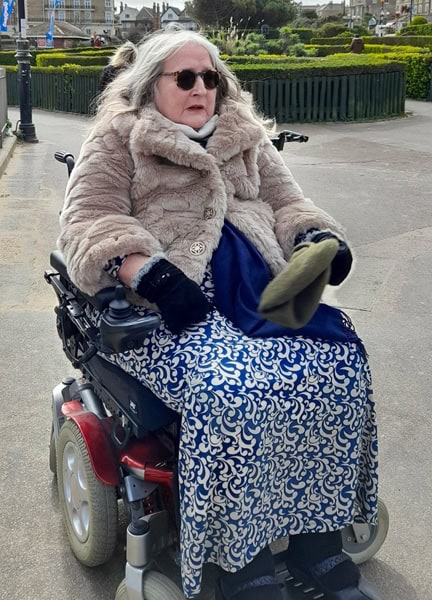
Jackie uses a powered chair because she has MS, and she uses it for everything. She’s got a spare one in case of breakdown. She can’t use her legs at all so getting in and out of the wheelchair takes a lot of technology. Her house is specially adapted and her husband – an engineering genius in my eyes – understands how everything works.
She can be seen whizzing around town on her way to her hairdresser (who has a ramp) or the beach (via the lift) with her granddaughter. She’s intrepid – but the dangers are everywhere. Slipping to the edge of the seat, or even out of it, when she’s out and about is hazardous: “People will try to help but that can be very dangerous if they pull you about in the wrong way. It’s undignified and embarrassing.”
Jackie needs a hoist at home to get her from chair to bed or to the toilet. Or up off the floor if the worst happens.
“In hospital it’s even more complicated as they are not really geared up to wheelchair users. They send me home as fast as possible!
“But what does upset me sometimes is hotels like The Yarrow in Broadstairs where disabled visitors have to go round the back and use a lift just to get to the main entrance. It could all be easier!”
But here’s what we all imagine is the worst situation for wheel users: it’s a heatwave and the powered wheelchair you depend on breaks down. This happened to my friend Aidan a few weeks ago.
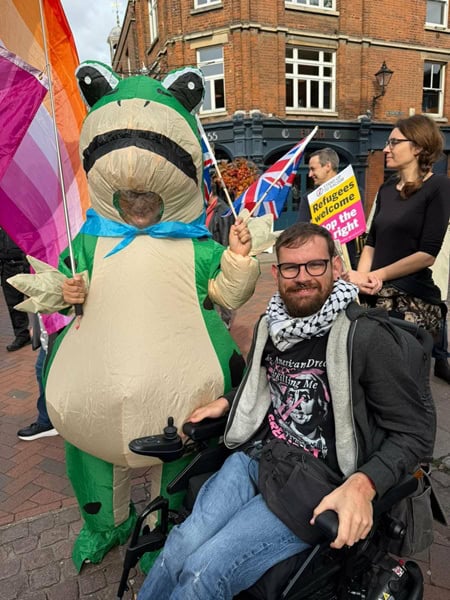
Aidan has been disabled since birth with cerebral palsy and relies on a powered wheel chair for everything. He’s currently studying for a Masters level degree in astronomy and aims to do a PhD in astrophysics next year. He studies at home but leads an independent life with the help of equipment currently provided by a wheelchair provider in Kent.
“(They) come and assess your needs, take measurements and offer a narrow range choice of powered chairs to choose from.” He explained.
As a student Aidan has no funds to buy his own equipment so, unlike Jackie, has no spare wheelchairs in case of breakdowns.
When his chair failed a few weeks ago it became an emergency. The provider collected his chair and promised it back in two weeks. They needed to order a new part and fit it in their workshop.
Aidan asked if he could have a replacement while the chair was gone and he was told they “don’t offer that service.” Not even for hire.
But a wheelchair is not like a busted toaster – you can do without toast for ever if need be – but a powered wheelchair is a vital part of your daily living if your legs don’t work and you can’t propel yourself in a manual wheel chair.
It was a heatwave, Aidan had exams (online) and no means of going out, no means of getting to shops or even out in the fresh air.
Being pushed in a wheelchair means you have to have people free to do it – and strong enough! Everyone needs as much independence as possible.
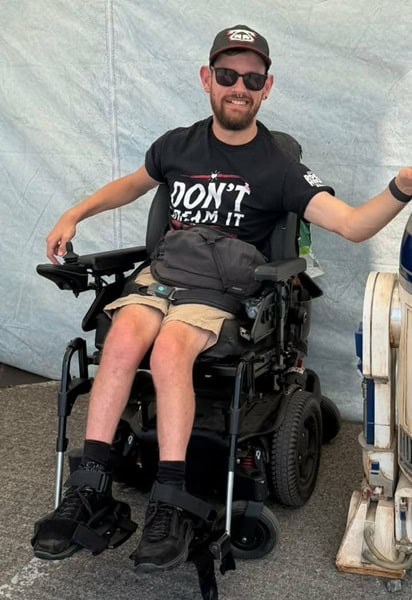
“I want to take part in everyday life. My independence is a fragile and sacred thing that should never be taken away. Without my power chair I feel dehumanised, with it I feel like a whole person again!”
Aiden needed to wait three weeks for his chair to be returned.
What he wants for the future is very simple: “I want the wheelchair service to provide a temporary replacement and to stock parts so that they don’t have to wait for parts to be delivered.”
But don’t we want more than that? We want these talented young people, and all the disabled community, to be able to work and participate fully in human life.
Technology can be a wonderful thing but when people depend on it don’t we have to make sure it’s easy to get hold of – and works?
