

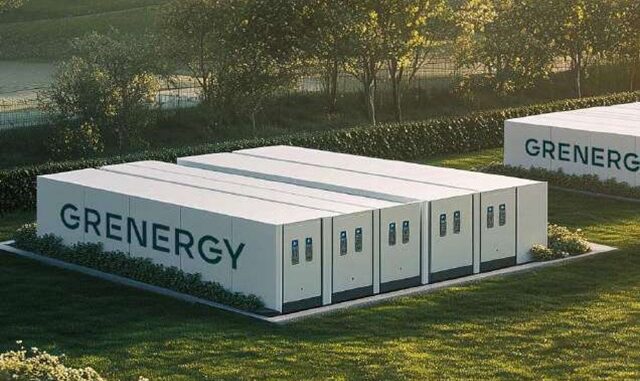
Plans for a battery energy storage system [BESS] on agricultural land at Ebbsfleet Lane in Ramsgate, will be discussed by councillors next week.
Villages councillor Abi Smith has called in the application made by Grenergy Renewables UK Limited over concerns about public safety, environmental sustainability and safe disposal of chemicals in the case of fire.
The 1.8 hectares agricultural site has been earmarked for 45 battery containers, 9 power station units, 3 auxiliary transformers, a monitoring room/warehouse, Distribution Network Operator (DNO) building, switchgear building, 2 water tanks, perimeter fencing, CCTV and lighting columns.
Grenergy, which is based in Spain, says the development “provides essential energy infrastructure to support the growth of renewable energy generation in the UK by increasing the capacity that is available to store energy.”
What is BESS
BESS is a device that collects energy from the grid and then discharges that energy at a later time to provide electricity or other grid services when needed.
Excess energy can be stored and released during peak demand or when an energy source is not generating. By importing excess energy from the grid and storing it, batteries can capture energy that would otherwise be lost.
Grenergy says discussions with National Grid identified capacity available for a connection into existing underground apparatus connecting to Richborough Substation.
Construction of the battery storage facility will take approximately six months with the majority of the construction deliveries arriving within the first three months and energisation testing taking place in the remaining time.
During the operational phase the BESS will be unmanned and operated remotely. A network of maintenance personnel will be trained to ensure the BESS operates effectively and inspections carried out as required.
At the end of the proposed 35-year operational period, the BESS and all equipment will be decommissioned, dismantled and removed. The land will be reinstated.
Clean Power Plan
In its application Grenergy highlights The Clean Power 2030 Action Plan setting out how the government will work with the clean power sector, including industry, trade unions, investors, policy makers and others to achieve its clean power goal by 2030.
The Action Plan says successful delivery will require rapid deployment of new clean energy capacity across the whole of the UK, with energy investment estimated at £40 billion on average per year between now and 2030. The company adds that a significant proportion of the increase will need to be facilitated by grid-scale battery facilities.
The application says the BESS would be in the same area as an existing solar farm and anaerobic digestion plant and close to Richborough Energy Park.
Explosion and fire concerns
Minster Parish Council has lodged an objection and raises “potentially many inherent hazardous risks that have not been fully researched or investigated by both the authorities and the battery storage industry.”
The objection highlights the possibility of “explosion” and the lack of information about potential consequences in the event of an accident/incident with the BESS.
The parish council adds: “There are major concerns regarding run-off from a site due to any fire-fighting materials or cooling fluids used in the event of any battery storage unit fire. Not only should run-off risks be revisited but also percolation of those same materials into the ground (and beyond).”
It also raises concerns that a thermal event may burn for 8 hours or more, adding: “ In objections for BESS systems elsewhere in the country, an explosion of a 4-unit BESS in Liverpool in 2020 has been used as an example of the dangers they hold for the unsuspecting.
“Some aspects to note from this incident are: Being remotely managed and operated led to delays in instigating switch off and electrical safety measures. Although an automatic fire alarm system was present and actuated due to the ignition of flammable gases inside the BESS unit, it did not prevent the fire or the ‘significant blast event’ (explosion).
“The use of a conventional inert “clean-agent” fire suppression system which blankets the thermal runaway event prevented combustion but allowed major quantities of flammables to build up. When finally mixed with air and ignited this creates a major explosion.
“The explosion occurred prior to the arrival of responding fire crews. This was fortuitous since the explosion potential is a significant risk to emergency responders that has caused life altering injury to firefighters at incidents on international BESS sites, such as Arizona and Beijing.
“Once water was applied, the resulting run-off contained Hydrofluoric Acid (HF)1 – a highly toxic substance which can dissolve concrete and whose fumes can be fatal to life.”
Grenergy says two water tanks are proposed within the BESS compound to supply up to 500 litres per minute for a duration of two hours. All BESS equipment will comply with the relevant fire safety standards. Five battery units are not placed within 10m of vegetation.
Council recommendation to approve
Thanet council planning officers recommend approval of the plans.
In a report to councillors, the officer says: “Increasing the amount of energy from renewable and low carbon technologies will help to make sure the UK has a secure energy supply, reduce greenhouse gas emissions to slow down climate change and stimulate investment in new jobs and businesses.
“Planning has an important role in the delivery of new renewable and low carbon energy infrastructure in locations where the local environmental impact is acceptable. It also sets out that electricity storage can enable us to use energy more flexibly and de-carbonise our energy system cost-effectively – for example, by helping to balance the system at lower cost, maximising the usable output from intermittent low carbon generation (e.g. solar and wind), and deferring or avoiding the need for costly network upgrades and new generation capacity.
“The proposed development would provide infrastructure to support and increase the capacity for the supply and storage of low carbon and renewable related energy.”
Grenergy has been operating in the UK since 2020. It says the Ebbsfleet project will have a 49.9MW capacity, save 985,000 tonnes of carbon and power 166,000 homes per hour.
The application will be discussed at a planning meeting on January 14.
