

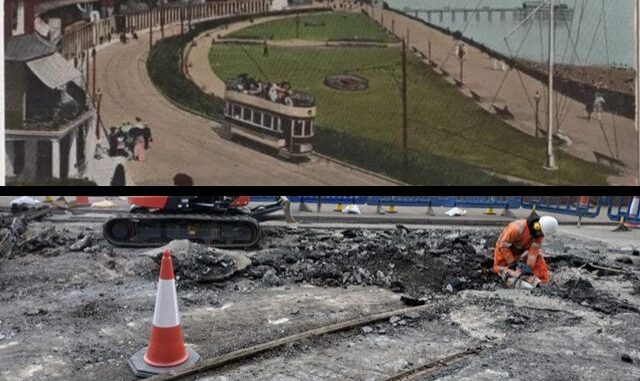
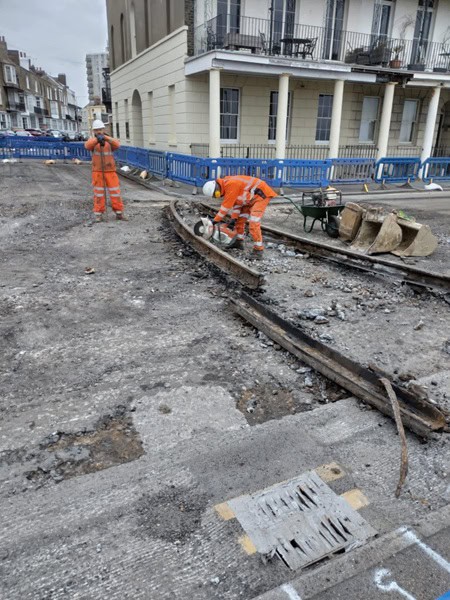
Tram rails that were discovered under the road surfacing at Wellington Crescent in Ramsgate in February have now been removed.
The ‘ghost’ rails are the remains of an electric tram service that had 11 miles of track linking Ramsgate, Margate and Broadstairs.
The Isle of Thanet Electric Tramways and Lighting Company opened its service in 1901 and ran until 1937.
It was one of the few inter-urban tramways in Britain.
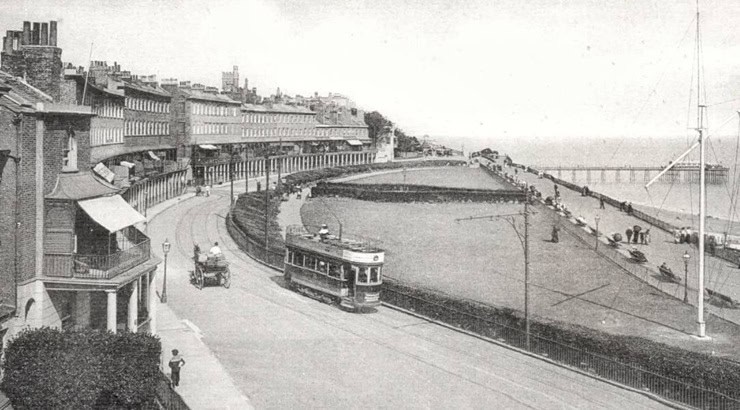
The route ran from Canterbury Road, Margate, via Cliftonville, High Street Broadstairs, Dumpton Park Drive, to a terminus at Ramsgate Town railway station.
The main depot for the tramway was at the foot of Northdown Hill.
Electric power was supplied by Thanet power station adjacent to the tram depot. A smaller depot was located at the terminus in Westbrook.
The initial livery was maroon and cream.
On 27 May 1905 car 47 failed to take a bend and came off the tracks into a grocer’s shop in Bellevue Road, seriously injuring the driver, conductor and the grocer’s 7-year-old daughter.
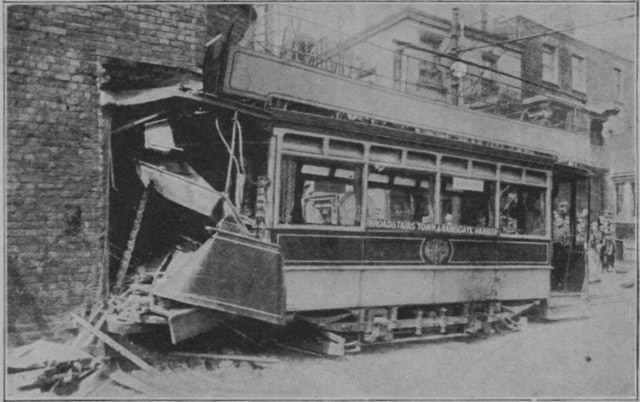
On 3 August 1905, car 41, during a routine descent of Madeira Walk suddenly careered out of control, jumping the tracks, causing it to crash straight through the railings. It then dropped over the 30 feet cliff edge. Only a few passengers were travelling on car 41 that day and they came out of the ordeal unscathed, but the driver, who was new to the job, suffered some injury.
The tramway service closed on 27 March 1937 but the company continued to supply electrical power to the district for domestic and commercial consumption.
In February this year, the rails were discovered during junction works for Stagecoach. However, road resurfacing after those works left a distortion on the surface and work has now had to take place to correct that.
Kent Highways has paid to remove the rails which, it is understood, will be rehomed.
Works are expected to be completed tomorrow (May 8).

A spokesperson from Kent County Council (KCC) said: “The tram lines on Wellington Crescent in Ramsgate were discovered following recent resurfacing works as part of our Wellington Crescent bus scheme. The lines were shallow within the road surface which would have made the new road surface wear out faster.
“Due to other road closures in the area, we had to return to the site to remove the lines during the daytime to ensure that works could be completed safely.
“We have been working closely with Ramsgate Town Council during the works. At their request, we have delivered parts of the tram lines for them to use in a local heritage attraction in the future.”
The attraction receiving the tram lines is understood to be Ramsgate Tunnels.
For more tramway history and photos visit: http://www.tramwaybadgesandbuttons.com/page148/styled-79/page242/page242.html

Almost seems like a backward step in this new electric age we are supposed to be in 😕 Would be amazing to have a dedicated tramline that ran from Ramsgate to Margate 🚊
Would certainly be better than The Loop!
I like the Loop
Loopite!
“Lord Trumpton”- so do I.
It was built at a time when local govt did things.Built to a gauge of 3ft 6 ins,like Dover’s earlier network, it was a successful form of transport,but alas the all conquering bus took over, as councils looked upon tramways as no longer viable.
Local electricity stations and tramways often were linked together.The formation of the Central Electricity Board and the national grid in 1926,was also a factor, as small local power stations were inefficient.
To some extent the loop mimics the old tramway,but if Kent ever does adopt electric buses, and that’s a big if, now fossilised Reform are in charge,perhaps the foresight of a previous generation will come to pass in a different format
I do hope that some section of the track is preserved and that the bean counters aren’t allowed to sell it all for scrap.
Along the pavement outside Canterbury East station, they’ve re-purposed an old tram track (or it could be a railway track) as highly durable pavement edging.
Railway rails I suspect Peter,as Canterbury never had a tramway.
Dover has/did have rails used as kerbing on the steep climb from Buckland to the Buckland estate.As the Buckland tram shed is located at the bottom of the hill nearby,I have always taken those rails to be tramway related.
Both tram networks deceased within a few years of each other in the mid 1930’s, and East Kent now Stagecoach, was the beneficiary.
The Dover transport museum has exhibits of the Dover tramway which was very similar to Thanet’s.
Perhaps those pining for the good old days are right,because public transport in East Kent is not improving and I doubt whether it will improve in the next few years.
BETTER-STILL BRING BACK THE TRAMWAY.