


By Local Democracy Reporter Simon Finlay
Reform UK at Kent County Council (KCC) has passed its budget after a mammoth eight hour meeting yesterday (February 12).
It went through by 48 votes to 26, with one abstention, to applause, whistles and a standing ovation.
Residents’ council tax will be raised by 3.99%, which is 1% lower than the maximum the government sets without a referendum.
Deep concerns remain about the soaring costs of adult social care (ASC) and the provision of special educational needs and disabilities (SEND).
‘History’
KCC deputy leader and head of finance, Cllr Brian Collins, claimed the financial position of the council his party inherited from the Conservatives last May was “deeply concerning”.
Cllr Collins said: “We are all witnessing history. I am honoured and proud, I stand before this chamber and present the first budget of a Reform UK-led county council.
“This is not just a change of administration, it’s a change of direction.”
Long-term debt stood at more than £730m and Reform pledged to make reducing it a priority and aims to bring it down by a further £80m by the end of the financial year, he noted.
Cllr Collins said the cost of adult social care (ASC) stands at £787m, almost 50% of KCC’s annual £1.6bn budget.
The council says it is committed to “drill down” into how ASC is delivered and commissioned, and by the end of the year, the overspend should start to come down.
Cllr Collins added: “There is still a lot of work to do but the direction is right and the ship is turning slowly and firmly.”
Of the budget, he declared: “Some people call it risky, I call it bold.”
‘Challenging’

In his report to members, KCC chief finance officer Dave Shipton said setting a balanced budget has been “especially challenging” due to escalating costs exceeding funding from central government and local tax.
In his report, he said setting the council tax increase at 3.99% in 2026/27 “principally creates a long-term financial risk” as it is irreversible and loses £10.1m in revenue with a possible knock-on in future years.
The documents also warn that if the budget is not delivered, drawdowns on reserves could leave the council “financially insecure”.
It may also have consequences in accessing government Exceptional Financial Support (EFS), as the council would have been expected to take “all reasonable steps” to manage pressures.
If EFS is not available and the council’s reserves are inadequate, the “only option” would be a section 114 notice, effectively a bankruptcy declaration.
Mr Shipton said that although a total drawdown of reserves will be £29.8m, of which £16m comes from earmarked funds no longer required, there will be adequate reserves for 2026/27.
The budget risk register identifies at least £410 million of financial hazards across various directorates, with ASC the dominant pressure.
The register sees it as “single largest financial risk to the council” while demand rises faster than the money coming to pay for it, and efficiencies are reliant on changes in the way the service is commissioned and delivered.
The new Reform administration inherited overspends in ASC of £45m in 2024-25 and is going over by a forecasted £50m by the autumn of this year.
ASC has adopted a new strategy of reducing sector growth by limiting provider uplifts (fee increases set by providers) and limiting demand, but it comes with the “risks around provider sustainability, service capacity, and delivery of statutory duties”.
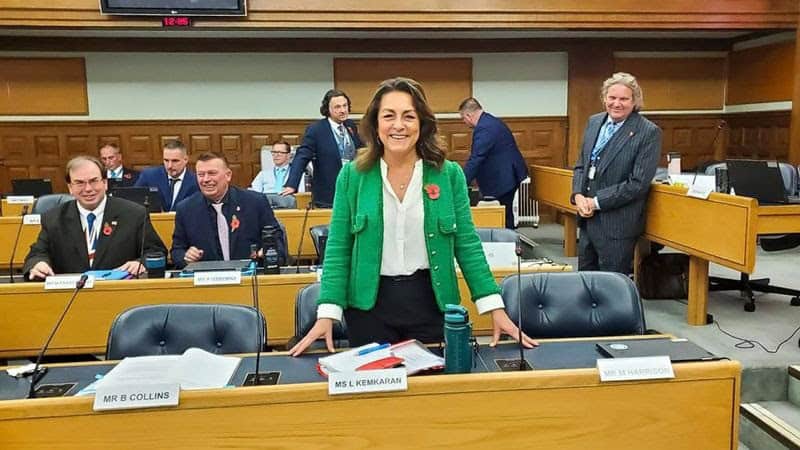
KCC leader Linden Kemkaran said the budget is built on the “simple principle” that the people of Kent remain “at the centre of every decision we make”.
She told the packed chamber: “Every pound we spend, every project we deliver and every efficiency we identify must be judged through the lens of what it means for our residents, our businesses and our communities.
“Families in particular are facing enormous pressures and they rightly expect us to manage public services with responsibility and honesty.
“At the same time, we must acknowledge the reality that much of the council’s spending is already committed through contracts, statutory duties and essential services.
“Change is happening but it will take time and must be done responsibly. The budget strikes a careful balance; it recognises our statutory obligations – those services we are legally required to provide – and it responds to the priorities our residents consistently raise with us.”
She said that she would have liked not to have raised the council tax at all or even reduced it but the council’s financial position prevented it.
Government funding and risks
While the council is also overspending in the high needs block (HNB) of the dedicated schools grant (DSG) and special educational needs and disability (SEND), the sector has been thrown a lifeline by the government’s £5bn rescue packages to fund around 90% of council deficits.
Although the government will take over the top-up funding of special needs in 2028, it was feared KCC or the authority which replaces it after local government reorganisation would face inheriting all or part of the deficit.
There are dozens of areas at risk of exposure in the budget and critics point to the council’s dwindling reserves becoming perilously low. Reserves have to sit at 5% of the overall budget.
The register warns: “Unbudgeted expenditure could weaken financial resilience and increase the risk of overspends or the need for emergency measures.”
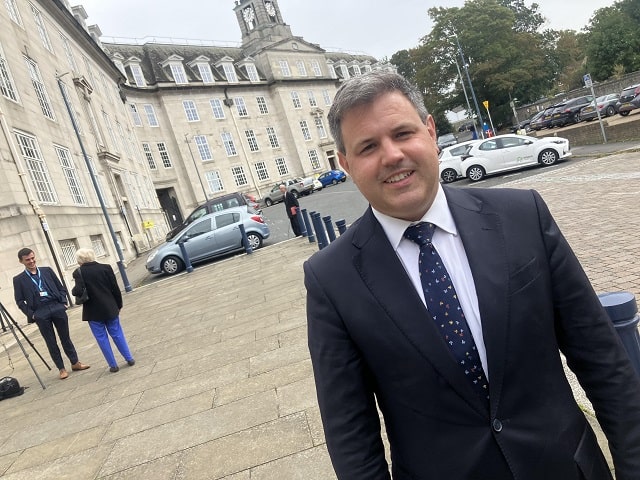
Opposition leader, Cllr Hook said: “This is a casino budget. It contains KCC’s highest ever exposure to financial risk – £410 million of immediate risk in this year (up 60% from last year) and what do we have to protect us against this tidal wave of risk? Reserves scraping the minimum 5% floor.
“They say it is ‘unlikely all the risks will hit us at the same time’ but with reserves this low, it doesn’t need all of them. Only some of them need to bite to be ruinous.
“There is a forecast of £36.5 million overspend for Reform’s first year in control. Which, outside of this budget, must be plugged from dwindling reserves.
“They are putting our risk levels on steroids, while burning the safety net of reserves.”
A series of opposition amendments were heavily defeated, including one from the Lib Dems for scrapping taxpayer-funded political assistants to save £140,000.
The Green Party said by “refusing” to make any uplift to fees for key nursing homes, Reform is risking NHS services and condemning the elderly to more corridor care through which people may die.
Labour co-leader Alister Brady said his party’s government gave KCC more than £50 million in extra cash this year and further increases over the next two years.
He said: “The government bailing you out – lifeline after lifeline. So, let’s stop pretending the government isn’t helping. Because the truth is simple: without this Labour government’s support, Kent County Council would be on the verge of bankruptcy after a year of indecision and chaos.”
Independent Cllr Maxine Fothergill said that the budget is “technically balanced” but has significant risks.
She added: “In the context of the statutory pressures outlined in the papers, it is entirely appropriate that all non-statutory expenditure is carefully scrutinised.”

Thats a lot of words i just cba to read, but didnt Reform promise not to raise council tax?
No they did not make a promise not to raise it.
google and videos of him saying it beg to differ….
no idea if i can post a link here so i wont try, use the internet, its all there
Always money for arts bilge that loses money-but none to do the essentials without screwing the residents.
As long as there is still plenty of our money left to put a constant supply of people that have never paid in to this economomy in to hotels with driving lessons and circus skills imcluded …..
I worked for the then Department of Social Security back in 1993, when Social Care was devolved from national to local authority control. It coincided with the ongoing progressive closures of local authority homes. As the private sector took over the fees that they charged inflated geometrically. Whilst contestants in the political arena happily spar with each other over budgets. Nobody asks the difficult questions regarding care provision.
The biggest question is: Why is there no statutory restriction on the amount of public money that an owner may take as profit, or charge whilst running a social care business? There needs to be a Royal Commission created to look into the financial aspects of the Social Care industry. We are all paying far too much for it.
It’s not just social care that has skyrocketed since privatisation came in but every other industry also that went with privatisation. Selling off everything was the worst mistake a government could make. Now our local council’s are doing the same with selling everything public off. Once all the china has gone and money is spent there is no income. It’s schoolboy economics !!
Mass deportations of the parasites =plenty of money saved simple
you have any idea how much it would cost to send them back, even if they could , which they have no legal way to do quickly now ? but yeah, tell me you are a flag shagger without actually saying it
But who would sit in the Royal Residences, House Of Commons & The House Of Lords if they were all deported?
Erm! I thought this article was about the KCC budget, not Harry’s dislike of benefits applicants (and now we know why as the are all hear down at the DHSS or whatever it’s called now), nor immigration (sigh!), but the promises made by Reform, and what they actually delivered.If you all recall they did indeed promise cuts in council tax based on a belief that there were serious amounts of unnecessary spending and corruption. They even suggested that contrast were ripping them off.Now DOLGE is dead duck and all they can mummur is about care charges, when care home staff are paid a pittance, and so called “self funders” are in fact footing the bill, by having all their assets requestioned to pay for their care.
Yes the Tories are guilty of leaving a rotten legacy, but then Reform sprang from the ranks of the Tory party, including Ms Kemkaran,so they should have known all about KCC and it’s manifold failings.
No George. Your cognitive dissonance is playing up again.
What I dislike is the amount of taxpayer money that goes to private social care providers that does not go to social care.
As for the privatised entities profiting from our new cultural enriches in a similar fashion… Pay a visit to the Company Check U.K. website, to check out the 3 main providers: Serco Limited, Mears Housing Management and Clearspring. Check out their financials and which other pies their directors have their fat little fingers in! A matter about which taxpayers of every hue should be concerned. As their contracts are for ten years!
They’ve raised taxes when they ran on a promise to lower taxes and the budget is flawed and has been destroyed by anyone with any intelligence and knowledge of the spending that’s needed.
The same fools defending these people.
The amount of taxes payers money it’ll cost to clear up the mess they make will be flabbergasting.
Britain wasn’t broken but Kent will be
Not Impressed – Labour Party have managed to virtually bankrupt us in 18 months by their lies, devious dealings and complete lack of any understanding of fiscal reality! As for their ethics and decision making, another sad chapter.
Would that be the labour party who where left a rather big mess by those wonderful Tories who didnt screw the country over for 14 years ? Now im not a fan of the current leadership at all, but seriously, do people forget the reason we are in a cost of living crisis, why the nhs and our other public services are struggling so much ?
2008, gold reserves sold at the bottom of the market, an unregulated banking sector and an independent Bank of England… Nothing to do with the Conservatives.
Really, ok, nothing to do with Covid, money spent, absolutely not the Tories in any way shape or form…
Well Harry, from the tone of your post, I thought you were all in favour of the private sector, but I stand corrected.
The seeds of KCC’S destruction were sown not last May when Reform took control, but over 40 years ago.All Reform are doing is bringing the end a lot closer than anticipated.
40 years ago KCC were as they are now the centre of reaction. They had grudgingly accepted the post war butskellism of keynsian economics and the welfare state,and owned quite a number of carehomes.In those days living longer,with dementia with baby boom levels of demand were unheard of.
Up pops Thatcher with her small state conservatism, and post industrial policymakers, and like the little reactive imps that they are KCC started to sell off all manner of care homes etc, and embraced out sourcing.
Come the banking crisis,Osborne and Cameron,covid,the rise in OAPs in the boomer cohort, and KCC are caught short big time.
They are not alone, but this explains much of why local govt is in a pickle.
George. It’s not about Capitalism and a free market against Socialism.
At the time of the 2008 global crash, when Brown had as the gold at the bottom of the market and then bailed out The City with taxpayer cash, a new phrase came into existence in the U.S.: “Croney Capitalism”. What we have us not a free market, but a rigged game that permits profit-driven monopolies. Where contracts are so long term and so secret that most government ministers are not even allowed access to them.
Whether it’s a state monopoly or a corporate monopoly, it is monopoly that is the problem.