

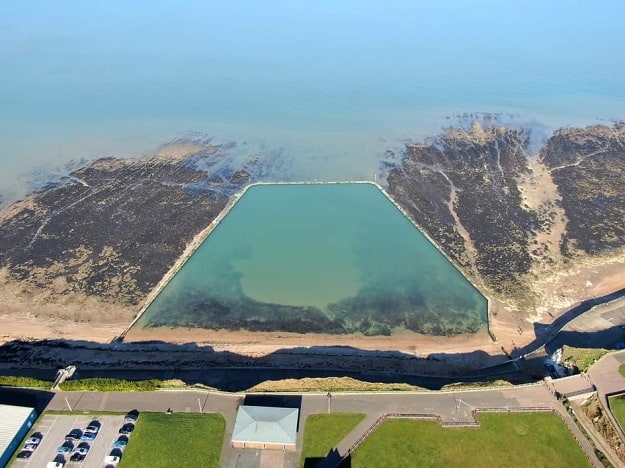
The tidal pool at Walpole Bay will be closed temporarily, between Monday 28 April and Friday 2 May, for maintenance and repairs.
During this time, people will not be able to enter the pool. Signs will be displayed in the surrounding area.
While the pool is closed, the water will be drained to allow routine maintenance to take place. Margate Town Deal funding will support further work being carried out, including repairs to the sluice gates and concrete steps and replacing the escape ladders. Surveys of the structure will also be carried out to inform future works.
The pool will reopen when the work is completed.
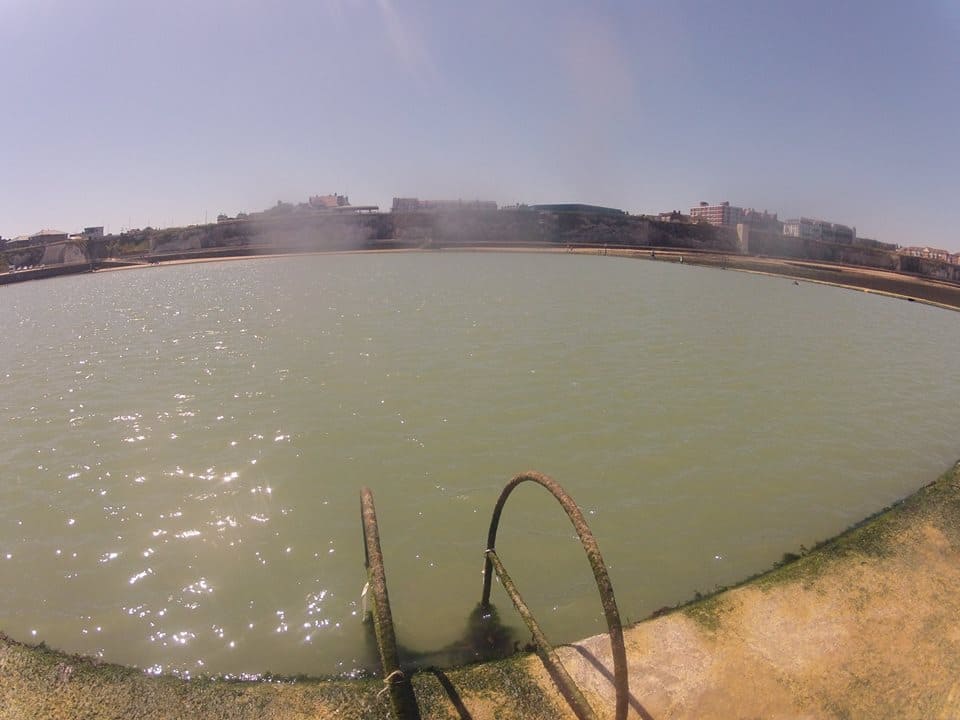
Walpole Bay Tidal Pool is listed at Grade II by Historic England. The pool covers four acres and is believed to be the biggest tidal pool in the UK. The pool is 6ft deep in places and is popular with sea swimmers and beach visitors.
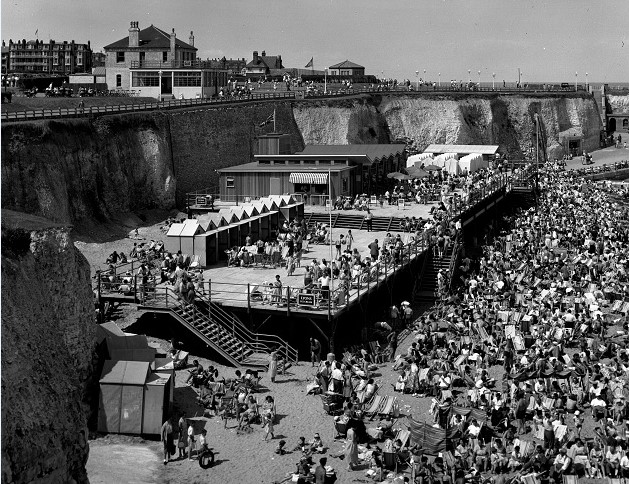
The pool was officially declared open at 3.30pm, June 25, 1937. It is one of two tidal pools constructed in Margate at the same date, the other nearby at Marine Terrace, on Margate Main Sands.
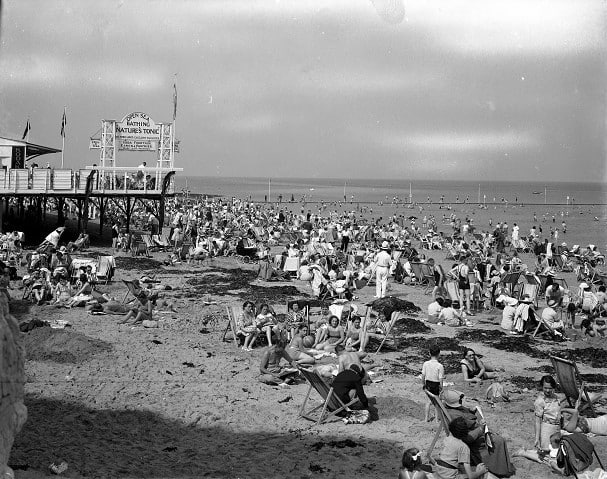
It was constructed to make it possible for large numbers of people to bathe in the sea at all states of the tides because the beaches at Margate and Cliftonville sloped gradually, and there was a considerable tidal range so that the low water mark could be as far as 300 yards from the promenade.
Design
The Walpole Bay Tidal Pool was designed by Mr. E. A. Borg, M.Inst.C.E., the late borough engineer of Margate. It was constructed with modifications by his successor Mr. W. L. Armstrong, B.Sc., Assoc.M. Inst.C.E using direct labour, at a cost of £7000. It covers an area of 4 acres and is 450ft long, 300ft wide at the seaward end and 550ft wide at the landward end. There are walls on three sides with the chalk beach used as a floor. It originally had two diving boards.
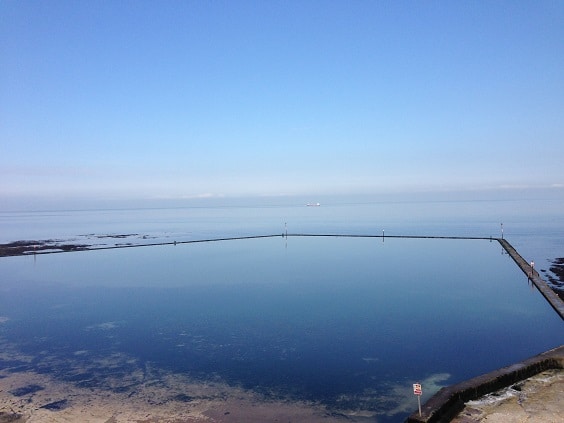
Walpole Bay Tidal Pool covers 4 acres, which is larger than the two largest listed seawater lidos, Penzance and Lymington. In shape it forms three sides of a rectangle, the seaward end and two sides, which increase in width towards the landward end where there is no wall, the beach acting as the fourth side.

The wall is two or three feet wide and ranges from two or three feet above the shore at the landward end to about seven feet deep at the seaward end. Its shape and scale can best be appreciated from the top of the cliffs.
Ambitious
This was an ambitious engineering feat. Each concrete block weighed about one ton in weight and had to be fixed into position by hand crane. The work was carried out by day and night to take advantage of every tide.
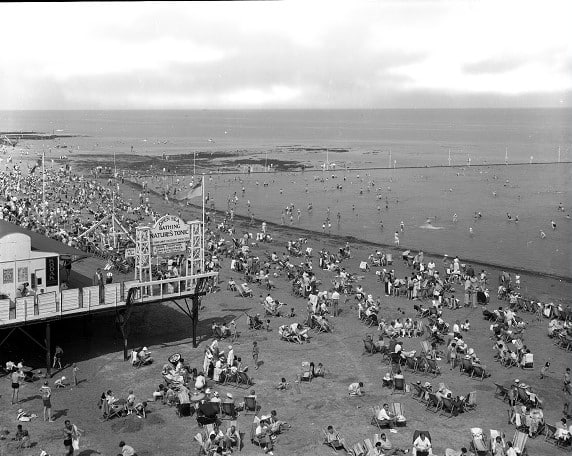
This was especially necessary in the case of the Walpole Bay pool, where it was never possible to work on the outer wall more than a few spring tides each month, as the neap tides never leave this position. The construction of the pool is simply the enclosure of the foreshore by two side walls and an end wall, and the natural beach has been utilised as the floor of the pool, the slope giving a graded deepening of the water to a maximum of about 6 ft. 6 in.
The walls are in all cases founded on solid chalk and built of interlocking concrete blocks. At intervals of 12 ft., old tram rails are concreted into the walls, running about 5 ft. deep into the chalk foundation and up to within 1 ft. of the top of the wall. An expansion joint is provided between each pair of rails that is about every six blocks in the top course, as it was considered that the bottom courses, being wholly submerged on one side, would not be affected by temperature variations as much as the top course.
Fresh springs
It is an interesting feature that in the case of Walpole Bay pool, there are copious pure fresh water springs arising from the beach within the confines of the walls and the pool is continuously overflowing by the supply of fresh clean water from the floor of the pool.
Overflows are fixed in the top course of blocks, each 2 ft. wide, 6 in. below the top of the wall, so that as the tide recedes the top water line is 6 in. below the top. Hand-ropes were fixed round the wall and there were a number of lifebelts; four flights of steps (one in each back corner and one on each side about halfway along the pool – these still exist), and two diving boards.
Three penstocks are fixed in the outer walls of sufficient size to empty either of the pools in about two hours. Concrete blocks were made in blockyards near the pools. These were conveyed by Fordson tractor and trailer to the site of the works, and fixed in position by cranes running on tracks laid inside the walls. The structure survives intact except for the loss of its two diving boards. However, a number of listed lidos no longer retain their diving boards.
Oliver Merrington’s website lists 24 tidal pools in the British Isles of which only 13 are in England. Few were built as large and survive as complete as the Walpole Bay Tidal Pool.
Unique
Margate is the only place in the list of 13 where two tidal pools were constructed. The Walpole Bay Tidal Pool is near a Grade II Listed 1935 Art Deco-style concrete lift which provided easy access from the top of the cliff to the foreshore for users of the tidal pool.

As a structure the Walpole Bay Tidal Pool has social historical interest as it provided an improvement to sea bathing at the period of the greatest popularity of the English seaside.
Frequent tests are taken of the water and indicate that the purity of the water is not the least inferior to that of the open sea.
Margate Town Deal at Walpole Bay
A number of projects are planned at Walpole Bay, as part of the £22.2m government funded Margate Town Deal. These include new beach facilities at promenade level at Walpole Bay including a café, toilets, showers and a bookable space that can be used flexibly by the local community and others. The designs for these are currently being reviewed.
Work also started this month to procure a contractor for the Skatepark. This process is expected to take around eight weeks.
An update on the Margate Town Deal projects will be presented to the council’s Cabinet in June/July 2025, which will include timescales for project delivery. It is anticipated that the new facilities at Walpole Bay will be open to the public by summer 2026.
Bob Porter, Director of Place at Thanet District Council, said: “Walpole Bay has become a focus for coastal activities for local people and visitors to Thanet. The beach facilities planned as part of the Margate Town Deal project are key to enhancing this.
“The tidal pool provides a free to use venue for sea swimmers, so it is vital that it is fully maintained. We understand that closing the pool for a short time will be inconvenient, but it is necessary for the work to go ahead.”

Watch this space planning permission granted for 100 homes, well they would if they could LOL
Admit U ❤️ Cliftonville!