

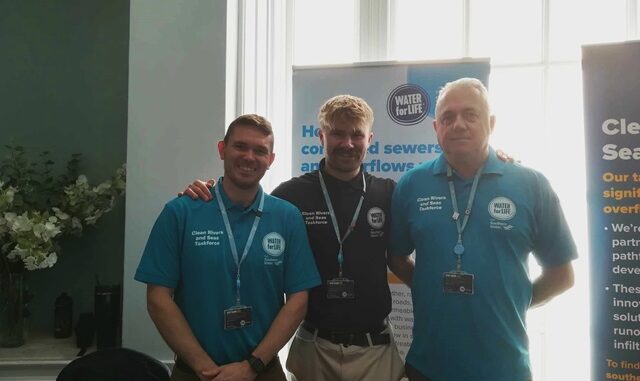
A Southern Water roadshow at Pierremont Hall in Broadstairs yesterday {November 28} shared plans for the company’s £10 billion investment across the region over the next five years – including £38m on sewer upgrade work at Broadstairs and £15m in Margate, Westbrook, Cliftonville and Birchington. A £24m upgrade has already been carried out in Ramsgate.
Work in Thanet includes £8m for improved resilience at Margate and Broadstairs pumping stations, £2m to replace mains in Margate.
Some £1.5m is planned for storm overflow reduction work with much of this taking place in Broadstairs from next year.
Works will be revealed in more detail once Ofwat issues a decision in December on the water firm’s five year business plan for the next price review period from 2025-2030.
Companies have been told to be ambitious in their plans to reduce pollution, while delivering value for money for bill payers.

Dr Nick Mills {pictured above}, from the Clean Rivers and Sea Task Force, says a £9m project at the Margate Pumping Station has already seen improvement.
The work included the installation of two new Archimedes Screws, replacing existing mechanisms which were almost 40 years old.
These help defy gravity by lifting the sewage from North Thanet from the sewer to the start of the treatment process.
However, as they’re often in action 24 hours a day, even the largest ones start to wear in time, which effects the efficiency of pumping stations, and mean they eventually require replacing.
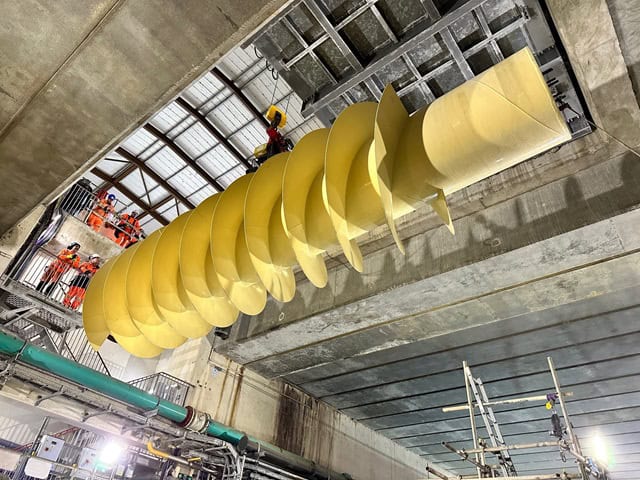
Dr Mills said: “There is improved reliability at Margate Pumping Station, a lot of work has been going on to improve the current operation.”
He says storm overflow reduction at Margate is beating government targets and attention will now turn to Broadstairs improvements.
John Penicud, managing director of our wastewater sites and operations, acknowledged that investing in an upgraded system would mean a rise in customers’ bills.
Southern Water says in real terms bills have actually been cut by 40% with the average cost in 2014 being £420pa and in 2024 £421pa.
But, Mr Penicud said, bills have to rise to make investment possible.
The rise, which is currently part of the business plan being considered by Ofwat, would mean wastewater only customers will see average bills increase by £85 per year (27%) between 2025 to 2030. Water only customers will see average bills increase by £145 per year (69%) between 2025 to 2030.
For those who pay monthly it means a rise by just under £9 per month from 2025 increasing to just over £19 per month by 2030 (costs before inflation).
At the roadshow, advisors were on hand to talk to anyone struggling with bills and to highlight Southern Water schemes which offer discounts from 45% to 90% off bills.

Mr Penicud {pictured above} said Southern Water owners Macquarie have invested £1.6 billion since 2021 and added that shareholders have not received a dividend since 2017.
He added: “We run sessions like these so people can get under the skin of what our plans mean for them and how we deliver investment to continue to improve the environment and reduce flooding and pollution
“A few people were understandably concerned about the prospect of future bill rises – but when they understand bills haven’t risen in a decade, it put the investment we have planned in context and received support.”
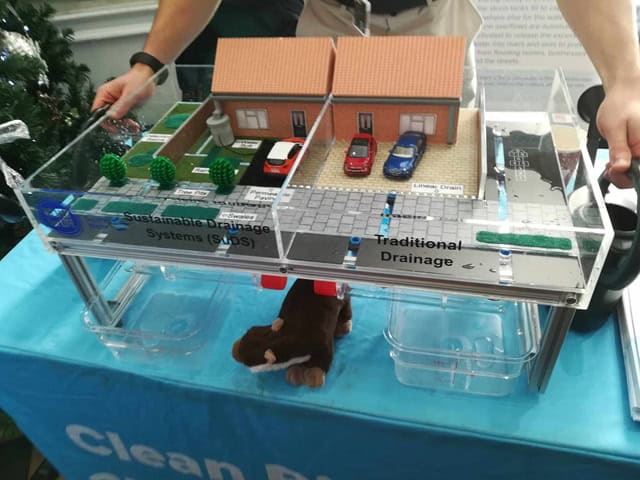
The Task Force team were also at the event with a model demonstrating how soakaways, permeable paving, rain gardens and planters can help to reduce storm overflows by slowing the flow of rainwater.
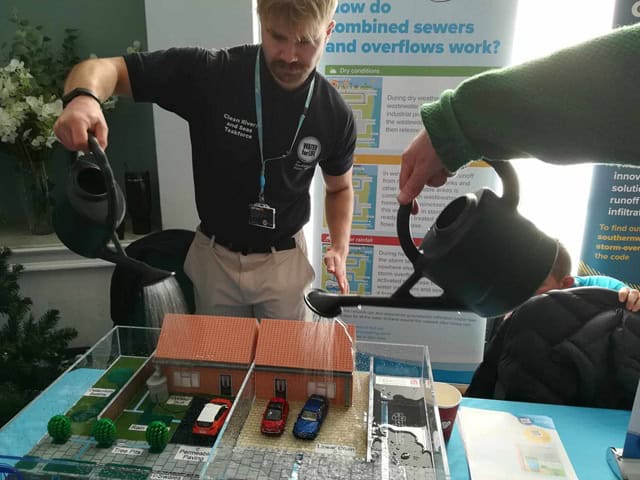
The model had two example homes, one using traditional drainage and the other using sustainable drainage systems {SUDS} and showed how SUDS reduced that flow of run-off.
The team has also been working with Broadstairs Town Team for the use of water butts and with schools to install special ‘water slowing’ solutions on their grounds – helping to protect the sewer network during and after heavy rainfall.
By slowing the flow of surface water from hard surfaces like classroom roofs and playgrounds, sewers are less likely to see huge jumps in volume in short time frames, which can go on to trigger overflow water entering the environment. The aim of water slowing is to protect schools and the wider community from flooding.


Schools that have had rain gardens installed include Dane Court in Broadstairs {pictured above} and Northdown Primary School in Margate.
Another SuDS scheme which will start in January will be the creation of tree pits and swales on 5000m of currently impermeable surfacing in Margate’s Gloucester Avenue. This will be funded by Southern Water and built and maintained by Kent County Council.

Storm overflow engagement officer Ben Murray said: “Permeable paving, water butts and tree pits are all part of the solution. They slow the flow of surface water that gets into the treatment works.”
The illegal connections team was also on hand at the roadshow to explain the painstaking detective work that stops wrongly connected loos and washing machines from dumping wastewater straight into streams and onto beaches.
Ashley Marshman, head of customer service, said: “We had a great day in Thanet – my team were really happy to be able to help so many people and it was great hearing from colleagues in other parts of the business how engaged people were in learning more about what we do.”
The Your Water Matters roadshow was attended by 161 residents and stakeholders.

Would not trust these as far as I could swim….not far!
All they are interested in doing is protecting their profits at the cost of their customers and the environment.
When they say they are going to invest £10B, what they mean is they will invest £10B of our money, and then charge interest on it.
PR exercise to reputationally manage the absolute corruption that goes on in the Southern Water boardroom.
Srsly, if you’ve ever worked PR, you can see this for what it is. A reputation management exercise. Nothing more, nothing less. They’re trying to paper over their reputation for being corrupt.
A bunch of criminals that should be behind bars-if any of us did this we would be locked up for years.
One of Britain’s biggest water companies was fined £90m ($126m) today for deliberate dumping of “billions of litres” of sewage into the North Sea over a 5 year period. But no Directors or other staff were implicated in the proceedings, and none were bound over to ensure that they would receive prison sentences if/when it happens again.
“These offences show a shocking and wholesale disregard for the environment, for precious and delicate ecosystems and coastlines, for human health, and for fisheries and other legitimate businesses that operate in the coastal waters,” said the judge.
The judge said the company had a history of criminal activity for its “previous and persistent pollution of the environment”. It had 168 previous offences and cautions but had ignored these and not altered its behaviour. “There is no evidence the company took any notice of the penalties imposed or the remarks of the courts. Its offending simply continued,” he said.
In 2019, three employees were convicted of obstructing the collection of data by the government-owned Environment Agency, which was investigating raw sewage spilled into rivers and on beaches in south-east England, but none spent a single day in jail.
The case between the environmental regulator and Southern Water, which the company tried to suppress, raised questions about the Southern Water’s corporate governance and why employees would obstruct the agency. Five staff members were convicted in 2018 of obstructing EA investigations between July 11 and 13, 2016 although two of the convictions were overturned on appeal. Several of the employees argued that they were acting under the instruction of the company solicitor not to give data to the regulator, even though the agency is dependent on information supplied by the water companies for its monitoring of sewage outflows.
The court documents cite a “lack of co-operation . . . and in some cases . . . conduct which was clearly calculated to frustrate the inspection”. In one example, a management scientist said she was instructed by a lawyer to refuse to allow the EA to take documents that would have provided data on sewage outflows from a waste water treatment works. In another example, a colleague was instructed by a superior “to remove the bagged diaries from the officers’ possession and lock them in his van”.
I find their comments patronising and lacking the ring of truth.I think it is disrespectful that these technocrats come here and expect the locals to be grateful that they have not made more of a mess than they have already.
The future for the water industry is to be nationalised or to be mutualised, and for Macquarie to be sent packing.
Idiotic company, not to be trusted in any way