

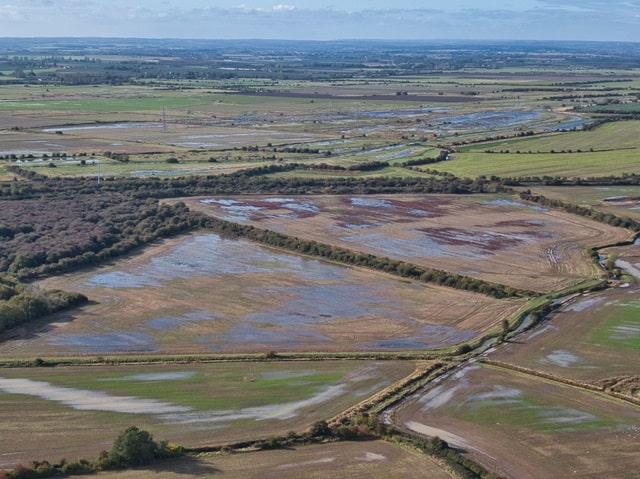
Advice has been given to bring forward the timeline for the controversial Sea Link project, which would include a 90,000 square metre onshore converter station at Minster marshes; a subsea electricity cable to Pegwell Bay and high voltage pylons over the land to the south of Minster.
The advice is contained in a report commissioned by the government from the National Energy System Operator (NESO) looking at how to supply Great Britain with clean power by 2030.
NESO is the nationalised energy system operator for the UK. Previously owned by National Grid plc, when it was known as National Grid ESO, it is now a public corporation after government bought all the shares for £630 million. As of October 1, it has responsibility for operating both the electricity and gas distribution systems.
In its 84-page Clean Power 2030 report, NESO advises the fast tracking of three projects that it says “have been identified as critical to delivering a network which supports the clean power pathways, but at present have delivery dates after 2030. Support is therefore needed to bring these projects forward for 2030 delivery.”
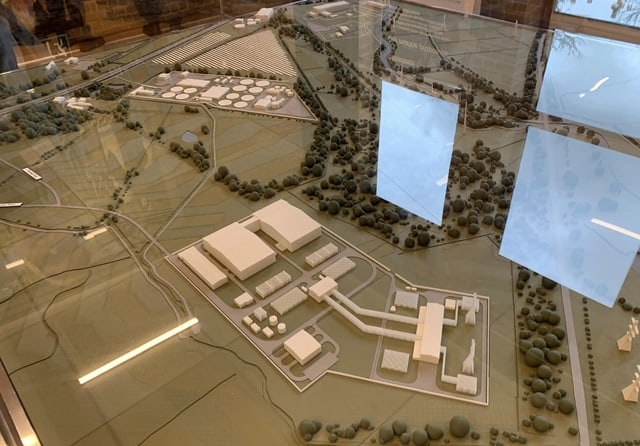
The projects are two in East Anglia for Norwich to Tilbury connections and National Grid’s Sea Link scheme between Suffolk and Kent.
NESO says the projects are “critical for connecting offshore wind in the North Sea and supporting the flow of clean power, “ adding: “ Our assessment suggests that without these projects, the clean power objective would not be achieved, leaving the clean power target short by around 1.6% in 2030 (assuming a typical weather year) and consumers could face extra constraint costs of around £4.2 billion in 2030.”
NESO, which also looked at eight other schemes, says: “Given that construction for many of the required projects needs to begin in the next 6-24 months to be in place by 2030, upcoming planning reforms will need to streamline and speed up processes.”
It is understood the advice is to speed up delivery dates by at least one year.
The Sea Link project needs to obtain a development consent order (DCO) via an application to the Planning Inspectorate.
The development consent being sought will include a number of other provisions, including those which authorise the compulsory acquisition of land, and the compulsory acquisition of rights in, on or over land, if necessary, to construct, operate and maintain the proposed project.
Currently the Secretary of State is expected to make a decision in 2025 with construction then taking place, if granted, between 2026 and 2030.
However, National Grid says there needs to be reform to put fast track plans in place.
A spokesperson for National Grid said: “We are supportive of the ambition, but making this a reality will require significant and immediate reforms on both connections and planning.”
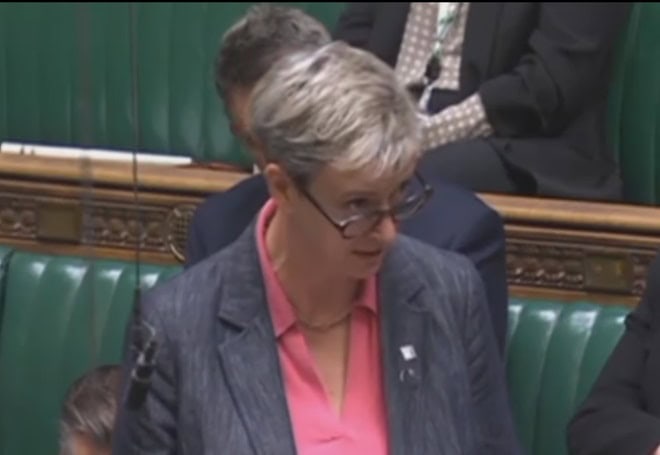
East Thanet MP Polly Billington has previously voiced her concerns about the Sea Link scheme, saying the potential damage to critical habitats and ecosystems means “an alternative route for the cables should be sought.”
In response to the NESO advice, the MP said: “I support the ambition to build the energy infrastructure we need to reach net zero and bolster our energy independence, but I do not accept that doing so means that we need to destroy our natural heritage in the process.
“My concern with the Sea Link project is that, in its present form, it will cause considerable damage to a protected nature reserve, which is why I have called on National Grid to rethink these proposals by choosing one of the alternative routes available.”
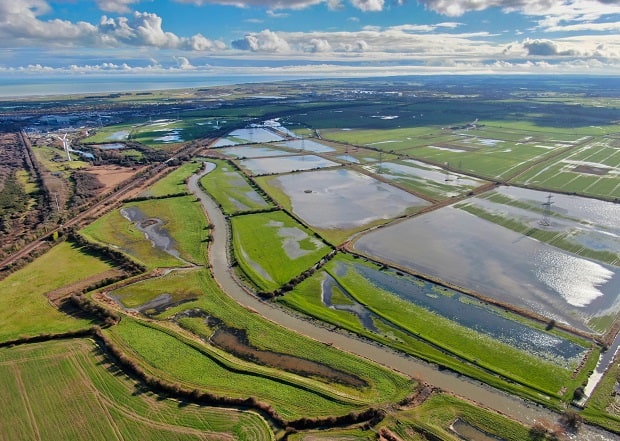
Polly Billington is a member of the Energy Security and Net Zero Committee. She, along with 60 other Labour MPs, recently endorsed the use of pylons in response to anti-pylon lobbying by Conservative and Green MPs who had written to NESO to ask for an “urgent review” into the pylon presumption and to explore the “potential cost competitiveness” of underground cables instead.
In response the Labour bloc wrote: “The cheapest and most pragmatic way to meet our energy needs is to reject the Conservative and Green MPs’ ideological and expensive presumption in favour of undergrounding of cables.”
The letter says underground cabling is significantly more expensive and will result in delays that would make consumers worse off.
It adds: “When clean power is produced here, transmitted here and consumed here, we will be far safer and have more control of our bills.”
Ms Billington said: “I remain supportive of using pylons where appropriate as they are not only cheaper to construct for billpayers, but also cause significantly less environmental damage than running cables underground.”
The Clean Power 2030 report will be considered by government.
The ambition is part of the government’s plan to be a clean energy superpower by 2030.
Government is currently setting up Great British Energy, a publicly-owned company headquartered in Scotland to invest in clean, home-grown energy. The Great British Energy Bill is currently passing through the House of Lords and will have its second reading on November 18.
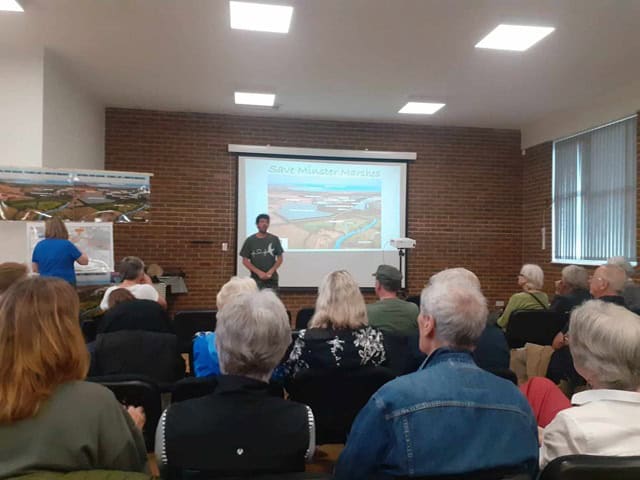
There is significant opposition to the Sea Link project with campaign group Save Minster Marshes fighting the plans and Kent Wildlife Trust heading up the Rethink Sea Link campaign.
Both MPs, Polly Billington for East Thanet and Sir Roger Gale, whose constituency includes West Thanet, have spoken out against the proposals.

Just use the manston airport. There clearly isn’t going to be an airport again as work hasn’t even started yet, and no sign of it starting anytime soon.
The silence is dealing from Fraundman. Not destroy the marshez when the huge brown field site sits derelict.
I agree. It makes perfect sense.
On the one hand, it will save the marshes and wetlands; on the other it will make use of the derelict Manston site.
And, since Manston is less than 2.5 miles from the proposes site, there would be little difficulty in relocating the equipment.
Mr X – you obviously have little knowledge regarding designing procedure before construction begins for large projects. You do not just open a box and begin operating immediately!
With Europe having no wind for a week now, bringing in this offshore energy has no impact on our electricity supply. For the amount of destruction and cost involved we need to think about how we can used improved technology for the grid rather than relying on old tech that is not up to requirements.
In the UK, wind power is producing 5.6 % of our needs at the moment.
But it is quite unusual for there to be so little wind in the UK.
What is not sustainable is that at the moment 53% of our electricity is being provided by burning fossil fuels.
But what would otherwise be providing that 53% on a cold , dull, windless day? We currently have roughly 35gw of installed capacity , if that is only currently producing 5.6% of our needs it would suggest we’d need roughly another 300gwvof capacity to fill the current fossil filled gap. Utter nonsense and totally unaffordable.
What’s totally unaffordable is the enormous destruction and upheaval caused by anthropogenic climate change.
We’ve all seen the pictures of hurricanes in the USA and torrential rain storms in Europe, and the loss of life and damage sustained as a result.
I agree that relying on wind and sun is a bit hit-and-miss, but, until nuclear fusion technology is available, we’ve got to make the best of it.
You’ve completely avoided the question so i’ll try again, what should be filling the 53% shortfall that currently renewables are incapable of filling?
As for your doom and gloom examples, the gloabalcpopulation was 1 billion in 1800 and around 2 billion in 1938 and estimated at 8.2 billion today. More people live in areas that before they wouldn’t have, ( on the coast, flood plains etc) what were comparable numbers of lives lost in the past from weather events?
How about reducing our consumption instead of boosting profits for the energy suppliers?
Some rather confused mixed messages from Ms.Billington, here supporting pylons because they are cheaper and best cost option for the consumer, but in another article says that the station being on the marshes was because it was the companies cheapest option and should be reconsidered.
Any chance of some signposts rather than flags?
Pylons don’t change the fields beneath them much, whereas the Sea Link project, if it were to be built next to the Minster marshes, certainly would make a lot of difference to the habitats adjoining the converter station.
My point was Ms. Billingtons arguments in respect of cost and that her opinion varies with the direction of travel she’s trying to garner, from official body thats on her side of the political fence then she supports it and says costs need to be kept down. When it’s to support the views of the ecologists she criticises the company behind the scheme for having chosen the least cost option.
You either wish to protect the consumer from higher prices or not.
As for pylons and impact, i’m sure most people would rather cables were underground if only because of the negative impact to the visual landscape, they’ll be seen by many of thousands of people every day, the converter station by relatively few.
My comment was actually a reply to “Death and Gravity. However, Ms Billington is quoted in the article- she is concerned about the damage the proposed station would cause to the nature reserve.
why not just put solar panels on all new builds
Exactly May – I have been saying the same thing for years. Introduce legislation to make solar panels compulsory on both residential and commercial new builds.
And let’s stop using prime agricultural land for solar farms.
Because it’s a relatively expensive way of producing energy, the national grid isn’t designed at street level to accept too much power and may need further grid upgrades to move energy from the sunny south to less sunny north. Will householders ne forced to maintain the systems? Will the grid ne forced to buy excess power? Or people be forced to have batteries?
Much better to insulate properties to a higher standard instead, reducing energy demand instead.
Quite agree regarding solar farms on farmland , but the whole time people are willing to pay so much for their energy and so little for their food , who can blame landowners for going for the land use that gives them the best return.
National Energy System Operator (NESO) only has one listed active person with significant control and that person is the Energy Secetary Ed Miliband !! so it would appear the Energy Secetary asked the think tank he owns to produce a report for him that returned a report that favours the plans he wants approving !! And Labour have the front to accuse the Tories of sleaze and corruption
Front not really , they’re just politicians and see no boundaries when it comes to getting answers they want in order to pursue their goals, Blair and his dodgy dossier is probably the ultimate ( known ) example. This government know they’ve only got levers of power asa result of a very odd set of circumstances and are very unlikely to get a second term , so will duck, dive, deceive and finnagle , every which way they can to force through their wildest dreams ( which will include altering the electoral system to try and wangle more years in power) going,to be a very,odd parliament.
Riveroak announced they would start work next year on reopening Manston Airport.
RSP bought the site in 2019.
Since then they have done absolutely nothing.
Notably the CAA application has stalled, and the tricky question of what to do about the MoD HRDF aerial remains mired in RSP’s apathy.
Far better to use some of the site for the converter station.
The CEO has been associated with a number of similar ventures; they all failed.
The cost to get the place going is quoted as anything between £300,000,000 and £800,000,000. Assuming you could find investors with that sort of money to invest in a project that both the PI and the government’s own experts said is unnecessary, have you any idea what sort of returns the investors would want?
Riveroak announce all sorts of things.You can believe in all sorts of things, such as believing fairies at the bottom of the garden, but that does mot Jean that there are fairies.
What happens when there is a blocking high pressure area in Europe and there is little wind or sunshine?
Well PV cells using perovosite are offering more efficient generation. Battery systems, using Li-on cells or by heating sand etc.Pumped storage or kinetic systems are other methods. Some base load nuclear,and of course a diminishing number of gas generating plants as a reserve.The UK also has 60% of tidal power potential in Europe, and the tides rise and fall adinfinitum probably till the end of the planet or until the moon detaches from earth’s orbit.
This can be done sensitively,and nature as long as it is not totally eradicated can adapt.
Where nature is almost eradicated is on a highly intensive agricultural areas.
The thing is, climate change is cutting a swathe through parts if the world and it’s the poorest and most disadvantaged people that suffer the most.
As i type gas is providing 14gw of supply and has been providing similar amounts on average for the last few days, the nations 17gw of installed solar capacity is providing 1.3gw and the 35gw of wind producing 5.5gw. Nuclear is pretty much at capacity. Biomass is flat out largely burning imported wood as fast as it can for around 3gw (very roughly this is around 800 tonnes of wood an hour) Interconnectors are importing french nuclear and norweigan hydro for another 3.5gw.
Then in the net zero world we need to replace much of the countries domestic gas use, as currently gas does much of the nations central heating)
None of the methods you suggest can replace this long term with the exception of nuclear, tidal is never going to provide much , our geograpghy doesn’t support tidal logoons to any great degree and the idea of using tidal turbines again falls apart when you take into account the variances between neap and spring tides and the way flows change over the course of the day.
Nuclear is the only real option but we sold off our expertise and are now reliant on foreign designs and build along with investment, though of course if we could halve our economic loss due to excess weight and obesity we could find the momey for a new nuclear facility each year ( though building them will no doubt take decades).
Throw in the eventual likley move to large scale electric cars and again we fall massively short of reliable generation.
Net zero is a quest over the span of another 50 years to be economically feasible, not a suicidal 6 year leap into the unknown based on short term thinking combined with overly generous contracts for energy that isn’t available on demand and which in our situation means we get pitiful generation for longer periods at the time of year we want it most.
It’s notable that the rest of the globe isn’t as keen to follow our example.
Is it climate change cutting a swathe through the world or more to do with populations having become so large in relation to available resources that when there’s even a small crunch the effects are disproportionately high.
And yet Polly has no view on Manston cargo hub. Far more environmentally destructive than this absurd project.
Well, no.
One will almost certainly go ahead.
The other almost certainly won’t.