

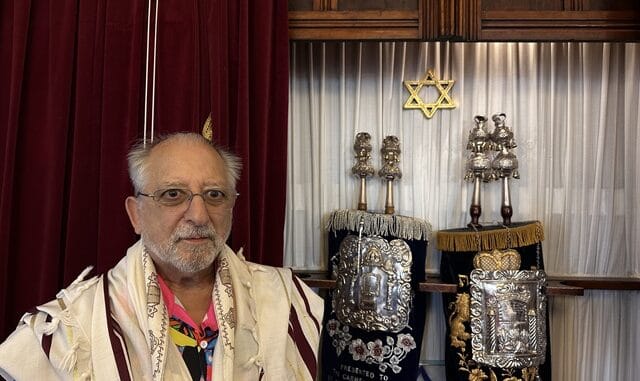
By Local Democracy Reporter Daniel Esson
Kent’s Jewish history runs far deeper than many might realise, from one of Britain’s most famous Jewish philanthropists to a once-thriving seaside congregation.
Today, only a handful of synagogues remain – but in Thanet, a small Jewish presence is quietly keeping the remarkable heritage alive.
The 2021 census found that only 2,050 people in Kent identified as Jewish. This would make them the smallest religious minority in Kent, dwarfed more than fourfold by the next smallest, Buddhists.
However, one corner of the county once hosted a vibrant Jewish culture. Strolling down Ramsgate’s Honeysuckle Road, you could be forgiven for not knowing that the synagogue and mausoleum of one of the most famous British Jews in history sits nearby.
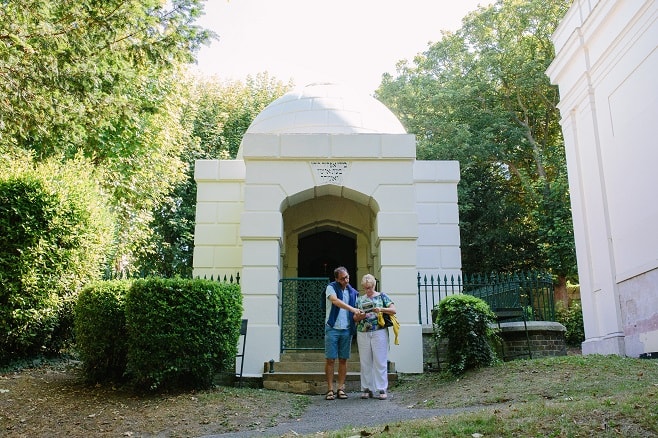
In the town, an avenue, a medical practice, a town council ward, a pub on Trinity Place, and some woodlands off Dumpton Park Drive all bear his name, but its Italian sound obscures the fact Sir Moses Montefiore was Jewish.
Born to an Italian Sephardi family, the banker and philanthropist bought his Ramsgate property in 1831, and spent much of his life there until he died at the age of 101.
Now, according to the census, Thanet has the second highest number of Jewish people in the county, at 268, behind Canterbury’s 310.
Insofar as there is Jewish life in Kent, though, Thanet is more or less the centre of it, and has been for a long time.
The ARK in Cliftonville, once a synagogue, has reopened as a cultural space, run by a charity of the same name.
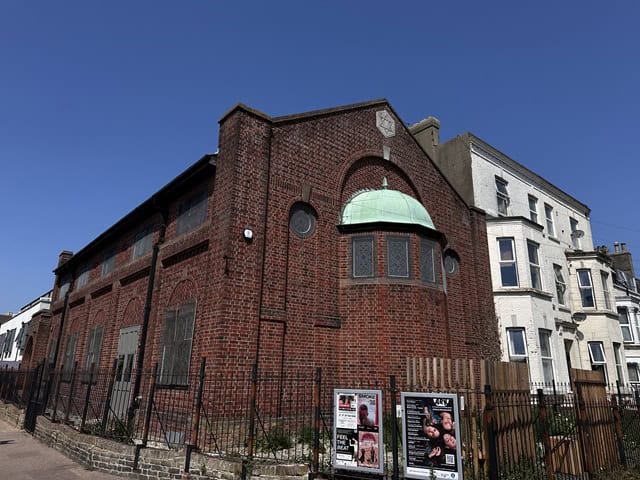
The redbrick building on the corner of Albion Road and Godwin Road at first glance could be mistaken for a church or the like, if not for the Star of David on the stained glass window, and faintly graven into a plaque near the roof.
“In 2020, the synagogue was put up for auction, since there weren’t sufficient people to make it workable as a place of worship,” explained Jan Ryan, CEO of ARK Margate.
“Some people were trying to buy it to convert it into a house. We thought that it would be a real pity to let that happen. It’s a building that was there for the community.
“It probably would have just been converted into flats.”
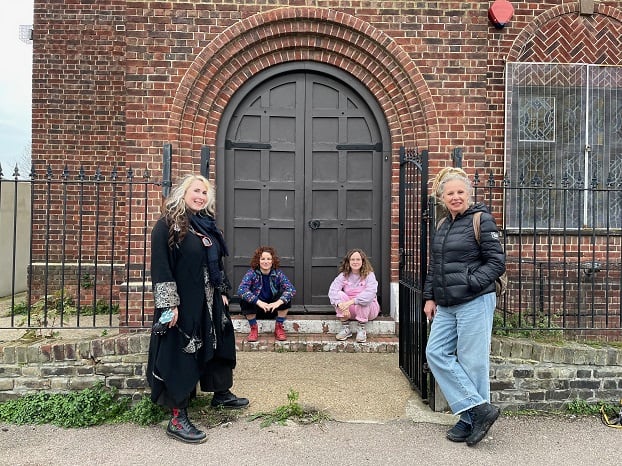
That year, along with three other women – Francesca Ter- Berg, Kate Gillespie, Lucy Lyons, all secular but of Jewish heritage – she launched a crowdfunder campaign to purchase the building, which after some generous support they did so for £300,000.
The building is now used as a community space for theatre, arts projects and music, and does work with many local asylum seekers and refugees.
With almost no congregants for some decades, the building is ‘deconsecrated’, but still hosts an ark – a colossal wooden structure which usually houses Torah scrolls, and has the Ten Commandments written on it in Hebrew.
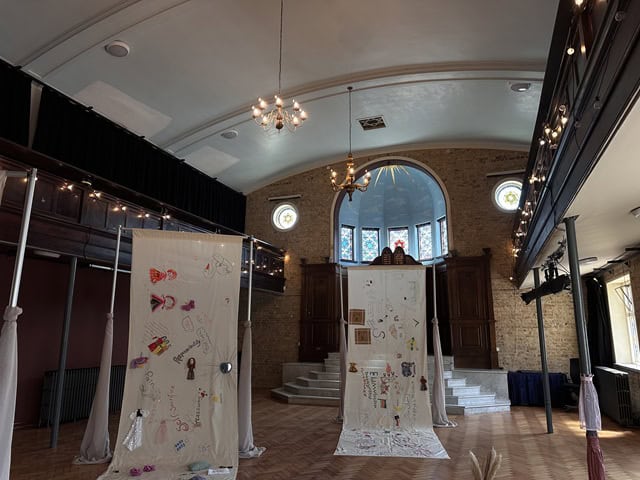
“We steer clear of all religious activity. For us it’s about culture and community,” says Ms Ryan.
“I think most religious communities have dwindled – people are less faith-based and spiritual than they used to be.”
“What’s been quite interesting at ARK, though, is that it attracts lots of people who are Jew-ish,” she added.
Judaism is, in most people’s understanding at least, not just a faith, but the culture and communities which have historically developed around it, forming an ethnoreligion.
As such, some use the term Jew-ish to mean those of Jewish cultural heritage or background who do not practice the religion, or are otherwise distant from Jewish communal life.
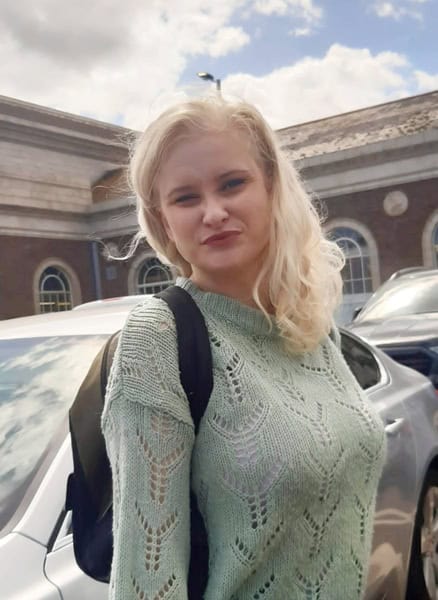
Katie Blythe, a local historian, explained that when it was running, the Margate synagogue “was very orthodox but in a very English way.”
In a small way, this local connection to Orthodox Judaism still exists – round the corner on Eastern Esplanade is the Unico Hotel, a kosher hotel which Ms Blythe says is owned by the Satmar, a Hasidic (ultra-orthodox) Jewish community.
Ms Blythe continued: “There’s always only ever been one Jewish community in Thanet, its focus just shifted depending on the time.
“I found something like 300 hotels and boarding houses that were Jewish in Thanet across the centuries, and about 200 of those were in Cliftonville,” such that some nicknamed it Kosher del Sol.
“Some had been only boarding houses for a season or two,” she added.
Ramsgate synagogue, on Margate Road, is one of only two working synagogues in the county, the other being in Chatham.
Canterbury’s King’s School owns the distinctive neo-Egyptian former synagogue (also deconsecrated) in the cathedral city.
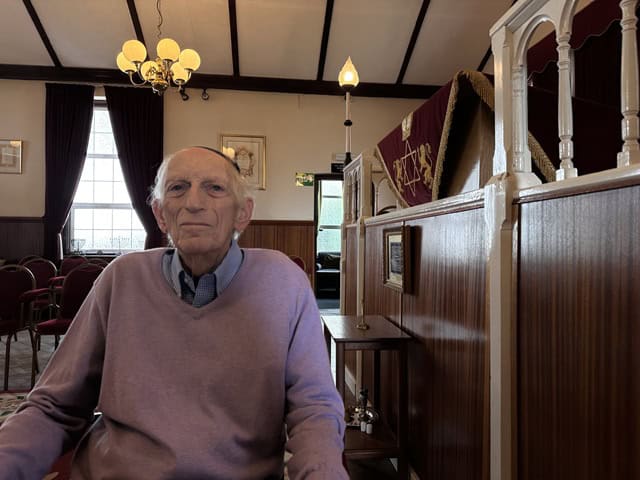
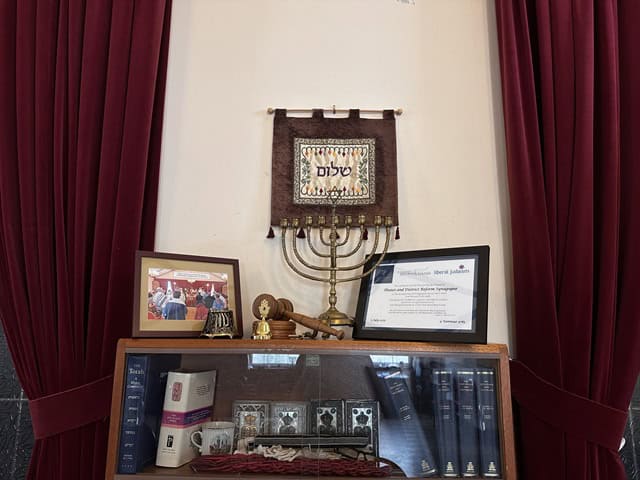
Godfrey Fischer, 87, was one of the founding members of Thanet and District Reform Synagogue in the 1980s after moving to Ramsgate.
“When we arrived, there was the established Orthodox community in Margate. And that was it.
“A group of people decided that they would like to form a progressive or reform community and they put an advertisement in the paper.”
From outside, the Margate road premises looks much like one of those small local Methodist or Baptist churches common in English towns, often converted into residential properties, but for the menorah wrought into the iron of the fence and Star of David above the door.
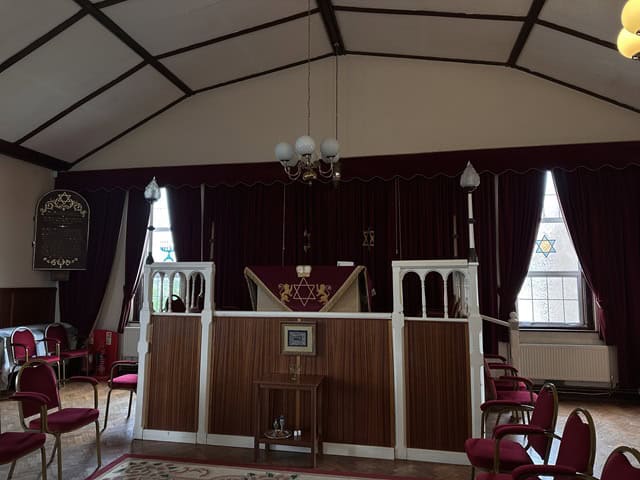
On the inside it looks the part, with the red and gold decor making up for the rather conventional architecture.
“I was brought up in an Orthodox community in London,” Mr Fischer continued.
“I prefer the progressive movement, I think it’s more to my liking and my feelings.”
In Orthodox practice, men and women are segregated during service, and conversions are not recognised. Ramsgate’s community is far more relaxed, and more than happy to have me sit in on a service.
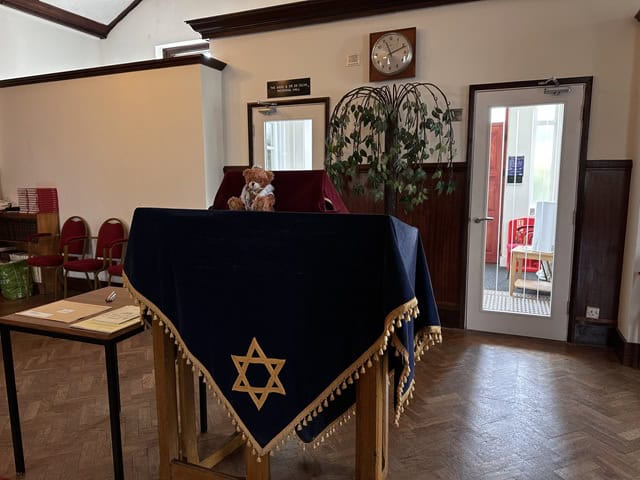
It feels quite similar to a Church of England service, with a booklet offering guidance on which song is next, which part is sung by a group and which by the Rabbi alone, except for the fact the document is read right-to-left, and is partially in Biblical Hebrew.
“I can read it, it’s Biblical Hebrew, but as a language, I don’t speak it,” Mr Fischer continues.
“But when you go to religion school, when you’re little, you learn all the letters, and then you learn how to read, so it stays with you.
“And so, it’s a good connection with the religion.
“But it’s also important, because not everybody understands the Hebrew, that there’s an element in English as well, so it’s more inclusive.”
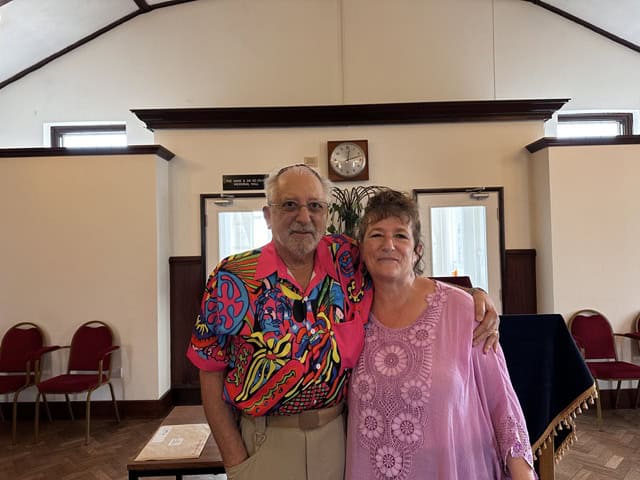
Cliff Cohen, who graduated as a Rabbi in the 1970s, says he “didn’t know there was a synagogue here” when he moved to Ramsgate in the 2000s to retire.
“It’s not a full-time job, it’s a small community; we’ve got 60-something members so the actual communal pastoral side of things is not onerous.
“But it does make me the Jewish chaplain to everything in East Kent: every hospital, every care home, every rehab centre.”
He says that the small size of the community means some of the divisions between British Jews have become more or less irrelevant.
“I would think most of the Jews in Thanet probably are Ashkenazi by descent, but when you’re out in the sticks like this, it actually does make a difference.
“The reality is we are the only functioning synagogue this side of Maidstone.
“So if you want to belong to a Jewish community, if you want to meet other Jews and make Jewish friends and so on, and you move into this area, we’re the place you have to come.”
In relative terms, the community has been growing significantly, he says.
“We have something like 14 or 15 youngsters in our cheder, we call it ‘Sunday School’, for want of a better word.
“Which, for a community of 60, 65 members, that’s a very high ratio.”
“When we came, I think our children were the only youngsters here, and other than our children, we were probably the youngest members.”
Despite the community growing, and coming from London, where the vast majority of Britain’s Jews are located, it’s still a small world: Rabbi Cohen was in a youth group with Jan Ryan of the ARK and met her again about 50 years later when she moved to Margate.
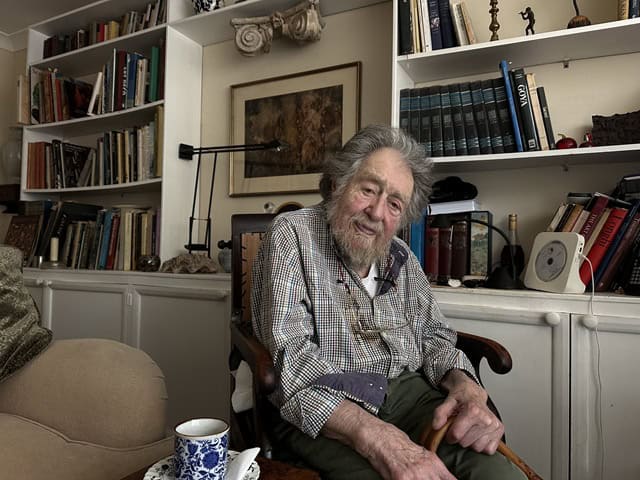
“When I came to Ramsgate, I didn’t know there were any Jews here, I didn’t come here because of that,” says Mark Negin, 94.
“I came because there was cheap housing in the town, which was full of interesting buildings.
“I’ve never regretted it for one minute.”
The former stage designer was born in London, and spent much of his working life in Canada when his family moved; he says, at the behest of his step-father, to flee from numerous fraud cases, some of which were even against Jewish charity organisations.
“From the time we left England—and that includes my time in Canada until I came to Ramsgate – I had no association with anything Jewish,” he says.
“I spent my whole working life with absolutely not a thing to do with Jews or Judaism in any conscious effort or way.”
Of all people, it was a Church of England priest at the pub who told him to visit the Ramsgate Synagogue.
“And so, under the instructions of my local parish priest, I got in touch and got to know Godfrey and several of the other people.”
He eventually took a historical interest in the life of Montefiore and his connection with Ramsgate and became a trustee of Montefiore’s mausoleum and synagogue.
“The trustee was getting very old, neglecting it, graffiti all over it, it wasn’t well maintained.
“They called me when the caretaker was resigning, retiring, she was reaching retirement age – and they wanted a replacement or someone to look after the Montefiore Synagogue.”
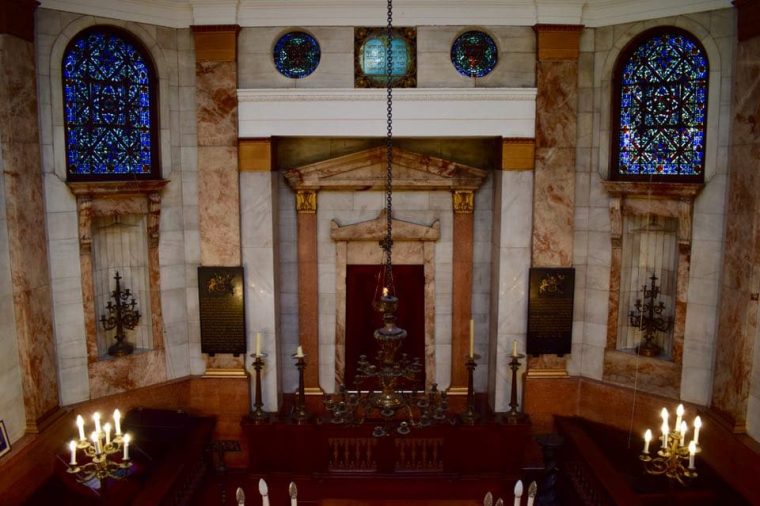
After taking on this mantle, he then became, in his words, “the token Jew of Ramsgate.”
“Which I find very funny, since I’d avoided having anything to do with Judaism for most of my life.”
“I suppose if there is a God, somehow or another the bugger has pushed me into this position.”
Despite being non-religious, he stresses “I feel extremely Anglo-Jewish,” more than specifically Jewish.
“I was born here. My first views of life spring from England.”
Rabbi Cohen says “I would say if you’d asked about the community maybe 15 years ago, when we’d been here for about five or six years, I would have said, ‘It’s a lovely community, but it’s very old and tired.’
“You know, the same people have been running it for 25 years, they’re all getting older, they can’t see a positive future for it, and there’s a kind of sadness.”
But, ever since the opening of Highspeed 1 and easier travel to and from the capital, “we’ve had a steady stream of people in their 30s and 40s, rather than—because it’s a seaside town—people coming to Ramsgate in their 80s to retire.”
“I would imagine we would always remain a small community, but that doesn’t matter as long as people are involved,” added Mr Fischer.
“We have services every, every week, we have a religion school, and various social functions.
“You never see every seat full in the building, but that doesn’t matter. It’s who comes along, and whether they feel they want to come along, and when they do, they feel they are welcome.”
Note: Conversion is recognised in Orthodox Judaism as long as it is carried out according to its own laws/teachings.

It was my proud Jewish heritage that attracted me to Thanet from London, 41 years ago.
Very interesting and positive article.
Good article
Interesting article shining a positive light for once on an often misunderstood and maligned minority within the wider community. Would be interesting to see other interviews focusing on individual religious or ethnic minorities in the area. Would help to dispel certain prejudices and promote peaceful cohabitation.