

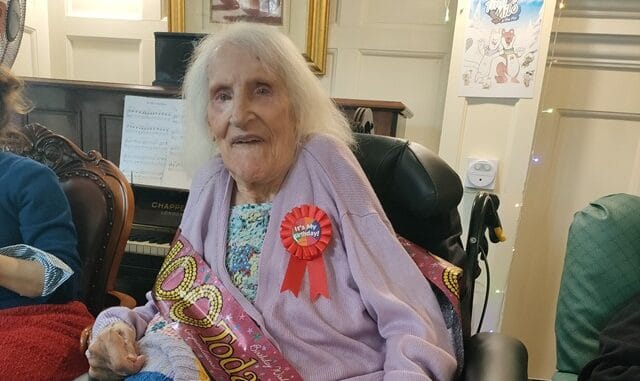
Shottendane Nursing Home resident Phyllis Jones is celebrating her 100th birthday today (February 11).
Phyllis was born on 11 February 1926 to Mr and Mrs S J Grange. Her father was the head gardener at Horwood House – now a luxury hotel in Milton Keynes- and her mother was the housekeeper.
Phyllis,, best known as Phyil spent several years in the Women’s Land Army in North Wales during and after the Second World War where she meet Eddie Jones, who was a Corporal in the Army.
The couple moved to London and were married in 1947. They had two sons and now four grandchildren.
Phyllis worked as a Civil Servant in London for more than 30 years, spending time in the Foreign Office, the MOD and finally Post Office Telecommunications which was privatised and is now known as British Telecom.
Phyllis lived in Broadstairs for the last 25 years, spending most of her time tending her vegetable plot and garden.
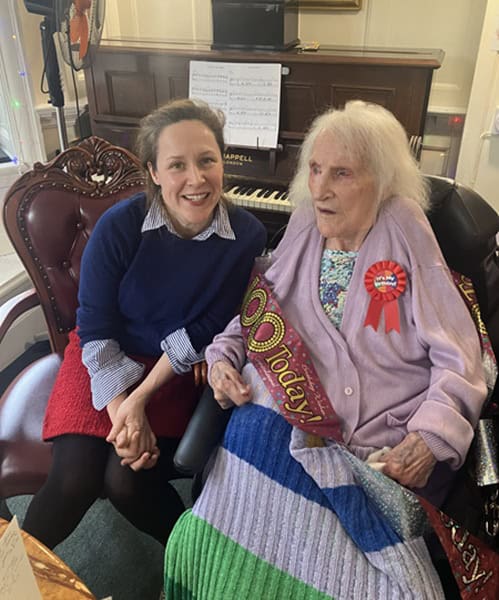
She is now living at Shottendane in Margate and is celebrating her birthday with staff, fellow residents and family.
In the year Phyllis was born
King George V was on the throne and the Prime Minister was Stanley Baldwin (Conservative)
26 January – Scottish inventor John Logie Baird demonstrates his pioneering mechanical television system (which he calls a “televisor”) at his London laboratory for members of the Royal Institution and a reporter from The Times.
9 February – Flooding of London suburbs.
February – K2 red telephone box introduced, chiefly in London area.
30 April – A state of emergency is proclaimed under the Emergency Powers Act 1920 on account of the “threat of cessation of work in Coal Mines”.
1 May – Coal miners’ lockout begins in Britain over planned pay reductions.
3 May – A general strike begins in support of the miners’ strike at midnight 3–4 May.
4 May – The BBC broadcasts five news bulletins a day as no newspapers are published due to the general strike.
12 May – The general strike ends at midnight 12–13 May without concessions to the strikers; coal miners remain on strike.
24 July – First greyhound racing track in Britain opens in Manchester.
6 August – American swimmer Gertrude Ederle becomes the first woman to swim the English Channel, from France to England.
7 August – The first British Grand Prix held at the Brooklands circuit near Weybridge.
29 November – Coal miners agree to end their national dispute and return to work. A majority of the Miners Federation have voted to continue the strike but with less than the required two-thirds majority.
2 December – The Prime Minister Stanley Baldwin ends the state of emergency that had been declared due to the miners’ strike.
7 December – The Council for the Preservation of Rural England, later the Campaign to Protect Rural England (CPRE), is founded by Patrick Abercrombie to limit urban sprawl and ribbon development.
15 December Electricity (Supply) Act creates the Central Electricity Board to set up the National Grid.

Happy Birthday.