

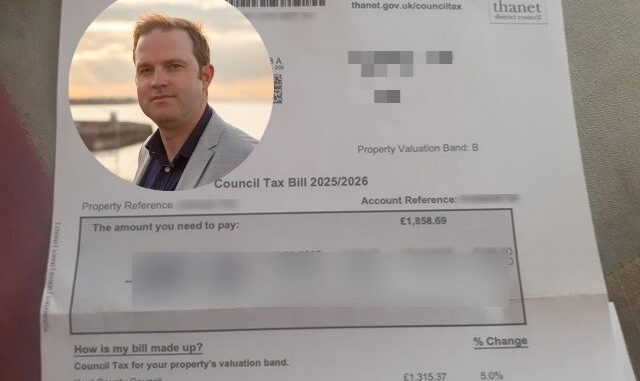
Thanet council is proposing changes to its council tax support scheme which will result in some 6000 of the isle’s poorest households no longer having to make payments.
The current support scheme has a maximum award of a 90% reduction in the Council Tax charge but the proposed scheme would increase this to 100%.
The 100% support was abolished in 2013 by then Chancellor George Osborne. At that time the Council Tax Benefit (CTB) system was axed and replaced by Council Tax Support (CTS) which shifted the responsibility to local authorities while at the same time cutting 10% of the funding to administer the scheme.
There are currently some 12,000 recipients of Council Tax Support in Thanet.
Thanet council says the support scheme needs overhauling to be more efficient and this will also provide the opportunity to reintroduce the full amount of support.
In a report to councillors it says TDC already has one of the most generous support schemes in Kent, but moving to a 100% CTS scheme will see the council join 130 others in England and be the first in Kent to do so.
‘Tackle poverty and debt’
The report says: “Council Tax support is one of the most powerful tools that local authorities have to tackle poverty and debt, providing an ongoing rather than one-off boost to household finances.
“The proposed scheme increases the overall CTS for working-age people by approximately £1.3m per year.
“96.9% of customers will receive a higher level of CTS in the proposed scheme (and) 3.1% of customers will receive a reduction in CTS.”
One problem with the current scheme is that it is based on council tax benefit but the move to Universal Credit means some people are consistently seeing the amount they owe change.
The report explains: “Each time a Universal Credit award changes, the current CTS award will change, and the customer will receive a new Council Tax bill.
“To give the customer the statutory notice they require (notifying them of the new amount of council tax to pay), this often means that the first payment instalment is shifted back to the following month.
“This can, in some cases, happen every month and a customer continually has their instalment pushed back, increasing the amount owed each month and ultimately giving them too high a bill to pay at the end of the year.”
“In addition, within the current CTS scheme, the minimum award is 1p per week but within the proposed CTS scheme the minimum award is a 25% reduction in council tax liability.”
By April 2026 some 98% of the working-age council tax support caseload will be in receipt of Universal Credit.
A consultation will be held over plans to move to an ‘income grid’ model creating four payment bands based on weekly income.
Some benefits, such as PIP, carers allowance and the housing element of UC, will not be included as applicable income.
This will save some 6000 households £216 per year. It will also save single parent families £220 per year.

Cllr Rob Yates, Cabinet Member for Corporate Services at Thanet District Council, says the changes will tackle “an unfair council tax system.”
He added: “In 2013, George Osborne abolished the statutory 100% council tax support for low income households and reduced local authority funding by 10%.
“This decision forced every council in Kent to reduce support for low income households – excluding pensioners- who now pay at least £159 a year in council tax.
“This Labour council knows that council tax is one of the most powerful tools we have to tackle poverty and debt so has begun a consultation to reintroduce 100% council tax support for those low-income households from April 2026.”
Cllr Yates says that as well as the benefit to the 6000 households, the move will ‘put £1.3m back into the pockets of Thanet residents’ and make Thanet the first council in Kent to reintroduce the 100% support since it was axed 12 years ago. He adds it will also ‘save the applicable single parent household £220 a year.’
Other proposals under the new scheme are to introduce a standard £10 a week non dependent deduction; increasing the maximum level of capital before there is no entitlement to CTS from the current amount of £6,000 to £10,000; removing the self-employed minimum income floor.
There will also be additional help for Kent County Council (KCC) care leavers. KCC currently pay any Council Tax owed by a care leaver until their 21st birthday. The proposed CTS scheme will mean any care leaver in receipt of CTS to the maximum award of 100% from their 21st birthday will have this extended up until the day before their 25th birthday.
No longer chasing low level debt
The changes will also help staff who administer the scheme who have been left with a reduced workforce but the same caseload.
Kent County Council (KCC) initially provided funding to districts when the Council Tax Support (CTS) scheme was introduced in 2013. This funding covered both scheme administration and an “incentive” to encourage districts to maximise their Tax Base. For the 2025/26 budget, KCC withdrew this incentive funding. Most, if not all, Kent districts had used this funding to employ staff responsible for administering the CTS. The withdrawal meant less staff to cope with the same workload.
The report says: “This creates an unsustainable situation where the same work would need to be performed with fewer staff and reduced funding. In response to the funding withdrawal, the immediate adjustment made when setting the 2025/26 council tax base was to reduce the collection rate from 98% to 97%. This reduction reflects the anticipated difficulty in collecting more challenging council tax liabilities without the previously funded staffing resources. This decision resulted in an estimated loss of £1.190m in collectable council tax income for 2025/26, of which TDC’s share is £135k.
“Amending the CTRS to award 100% support at the highest level, thereby eliminating the need for officers to pursue numerous individuals for low-level debts.
“An increased level of CTS reduces the amount of Council Tax that needs to be paid in the district by approximately £1.3m. This could help alleviate poverty, by leaving more money in the pockets of local people in the district and therefore help support local businesses, boosting the local economy.”
Cabinet members will discuss the new support scheme at a meeting on July 24.
Council tax arrears
Historic council tax arrears owed to Thanet District Council now stand at £29 million, according to figures released by the Ministry for Housing, Communities and Local Government. This forms part of a national total, which has now hit £6.6 billion.
National Debtline say some 25% of people who call for advice have council tax debt, averaging £1,958 per person, making it one of the top three most common debts its advisers hear about.
Current rules mean that households can become liable for their full annual council tax bill if they miss one payment, which can result in a quick escalation to bailiff action.
In June, the Government set out proposals to extend this period, so that people have more time to engage and seek support – something National Debtline has welcomed, after years of campaigning for this change.
The Ministry of Justice also announced plans to consult on giving the Enforcement Conduct Board legal powers to regulate the bailiff industry, with millions of council tax debts passed to bailiffs every year.
National Debtline provides free, independent, expert advice. Contact National Debtline for free on 0808 808 4000 or via www.nationaldebtline.org.
Arrears support
Cllr Yates said: “In Thanet we have seen a sharp increase in the cost of living that has put added pressure on household finances. One example is the 30% increase in rental costs that we have experienced over the last five years.
“The money received from Council Tax helps us to provide over 30 different public services including; waste and recycling collection, maintaining our awarded beaches and bays and the provision of homelessness support for some of our most vulnerable residents.
“We focus on supporting residents who fall into arrears with their Council Tax. Anyone who is unable to pay should contact the council immediately for support. Residents are offered advice on managing household finances, and they can also find information on where to seek advice on benefits and debt management, and general cost of living support, on the website.”
Thanet council focuses on supporting residents who fall into arrears rather than pushing for prosecution. The Council Tax team actively encourages residents to work with them so the debt does not accrue in the first place.
The council has a system in place to support residents who are struggling to pay their Council Tax. People are given multiple opportunities to engage with council officers, before their debt is referred to bailiffs.
Residents are offered advice on managing household finances, and they can also find information on where to seek advice on benefits and debt management, and general cost of living support on the council’s website.
If a resident is unable, or refuses to pay after a liability order has been issued, Thanet District Council employs enforcement agents to try and recover the debt. The agents agree a repayment plan with the residents, and if this is unsuccessful, can seize goods to the value of the debt.
The Council Tax debt collection process
If a resident fails to make a Council Tax payment, TDC issues a reminder, a second reminder and a final notice. Following this, the authority gives 14 days’ notice that it will be issuing a summons.
The final notice cancels the right to pay in instalments. There is one final opportunity to pay instalments through to the end of the financial year, avoiding further costs to the debtor.
The council includes an arrangement plan with the summons. The customer does not need to attend court or contact TDC, just pay the new instalment plan given and maintain payments, and that is acceptable.
Non-payment can result in a summons to court and the granting of a liability order by the Magistrates.
In vulnerable customer cases TDC can instruct the bailiffs to stop pursuing the debt.

Mr Yates -Labour money tree again! Who is paying for this! Us OAP’s – you will never be electable again after this first year debacle!
Lots of words in the article but unless i missed it no mention of where the money to pay for this comes from? Would Mr. Yates care to inform us ?
Is it really so unreasonable to have people contribute even a small amount towards the services they use or are we to totally disconnect any notion of being a productive part of society.
Id
Start again! It will come from the tax that everyone else pays.
Seems an earlier post has been swallowed by the moderating software.
People should have a look at. Entitledtodotcom and have a play with the benefit calculator software. Try plugging in details for simgle parent 2 kids, parent and one kid claiming for memtal health issues, private rental. Add on all the extras this triggers, council tax, social utility tariffs, free school meals, free dental, prescriptions etc etc. The “disability” designation means the bemefit cap doesn’t apply.
The numbers that come out are the reason so many choose not to work and the rest of electorate wonder why they bother working.
Some very very rough maths
From article cost is 1.3 million to help 6000 households.
Roughly 70,000 households in thanet
So 64,000 househols will be paying about £20 each
But TDC only receives around 12.5% from our council tax, so overall bills will need to rise by 160 ish per household , though of course as council tax varies some will pay less others more based purely on the home they live in with no regard to income.
Or could Mr Yates provide some clarity?
And of course explain where fairness comes into this additional taxation of taxed income
Reading between the lines, the report says that KCC have pulled the plug on some funding which TDC were being given to administer Council Tax. This is TDC’s way of sticking two fingers up at KCC by passing the parcel on a million pound deficit as TDC only keep a small part of the Council Tax. If the proposed scheme is costing TDC over £150k it will be costing KCC many many times more. Obviously KCC will now be looking to recoup that money which will mean yet more cuts and savings impacting on Kent residents. And guess where they will target these new savings ? Yes, Thanet.
The lack of wider thinking by TDC Councillors is quite staggering.
T.D.C. are owed 29 million in tax arrears. Now they are trying to introduce a 100 per cent tax support scheme. T D.C. do not plead poverty, if you can do this, you can do a hell of a lot more to the people, and infrastructure of Thanet. Let the people’s revolution against T.D.C. start when they give the paying people’s money away.
I work, and TDC chased me for months owing one Pence back in the day, I don’t recall them letting me off.
Maybe if I hadn’t worked they would have written the paltry sum off for me!
I had tenants on benefits that ran up a £3500 debt with TDC over council tax, council then gave them a council house.
As a landlord I’m now liable for 100% council tax from day 1 between tenants, ( not even the 25% single occupant discount), doesn’t encourage landlords to maintain their properties well and like any other business cost just gets passed onto tenants in rent rises.
As for Mr. Yates claim that rents have increased 30% in last 5 years ( which should perhaps be taken with a pinch of salt) has it escaped his notice that council tax has increased substantially too over the last 5 years, over 24% in the case of a band D properties.
If you work, don’t live in Thanet the libor party will help themselves to your pay inheritance and children’s education. What few social housing we have goes to out of country folk.
So steal from the working taxpayer to give to the lazy non-working benefits recipient. A better solution is to stop the benefits do people get off their backsides and get a job.
Cllr Yates says that the move will ‘put £1.3m back into the pockets of Thanet residents’. Based on his peculiar thinking, if we all receive a 100% rebate, then that should put many £10s of million back into the pockets of Thanet residents. Now that really could, as the report says, “help alleviate poverty, by leaving more money in the pockets of local people in the district and therefore help support local businesses, boosting the local economy.”
His statement is a load of gonads!
Mr Checksfield – totally agree with your assessment- Mr Yates is completely out of touch with reality along with most others of local Labour Party – very fond of spending money with little concern for us reluctant tax payers – I really despair for Thanet led by this bunch of clowns!
If this goes ahead, I will stop my direct debit to TRC then they can chase me for payments
It’s things like this which confirm that Labour shouldn’t be allowed anywhere near public money.
Taking money away from hard working households on low pay to give more to people on benefits at the same time as they report an overspend of £4.7 MILLION on the 2024/25 budget. That must be some sort of record. Why aren’t heads rolling ? Even the Housing Revenue Account which we are assured is in good health has slid into a £345k overspend which is before they spaff a further £38 million on houses.
Is Diane Abbott doing their maths for them ?
This is incompetence at a multi million pound level.