

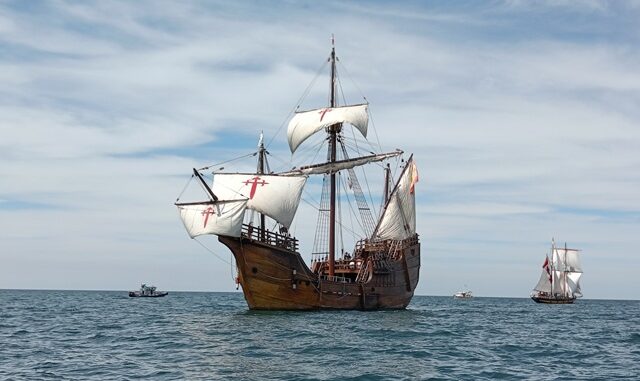
A replica of one of the ships that was part of the Chistopher Columbus discovery of America fleet is heading to Ramsgate next month.
The Nao Santa Maria will be docked at the Royal Harbour in July.
The Nao Santa Maria set sail from the port of Palos de la Frontera (Huelva) as the leading ship, together with the caravels Pinta and Niña, the so-called Three Caravels or Columbus fleet, on August 3rd 1492.
In Columbus’ references to the Santa María in his famous Journal, the Admiral constantly named it “nao” (ship), and this appears 81 times in the text, in the same way as other chroniclers of the time.
It was acquired by the Spanish Crown in order to form part of the Columbus expedition from Juan de la Cosa, a navigator and cartographer from Cantabria, a resident at the time in Puerto de Santa María.
Interestingly, Columbus never called it Santa María, it was his son Hernando who did so for the first time in his father’s biography.
Columbus’ fleet set sail from the port at Palos de la Frontera (Huelva, Spain), with a crew of about 90 men. The majority were sailors from Palos de la Frontera, Moguer and Huelva, 70% Andalusian, 10 from the Basque Country and Galicia, 2 Portuguese, 1 from Genova, 1 from Calabria and 1 from Venice.
After stopping off at the island of La Gomera (Canary Islands) and after 33 days of sailing, on October 12th 1492, the Santa María, managed by 40 men under Christopher Columbus, reached America, one of the most transcendental meetings in history. Alonso Niño was the pilot and Juan de la Cosa was the captain.
While on La Española island on Christmas Day, 1492, the ship ran aground due to an oversight by the cabin boy that was at the wheel, and it sank. In the place where it sank, known as Baie de Caracol on the island of Haiti, its ruins were used to create the first Spanish settlement in America, Fuerte Navidad.
The replica build
This full-scale replica of the nao Santa María was built by the Nao Victoria Foundation in Punta Umbría (Huelva, Spain), with the support of the Provincial Council of Huelva and the Cajasol Foundation, during 14 months of work, which began in January 2017 and ended in March 2018.
The construction took place at the Varaderos Palmás shipyards in Punta Umbría (Huelva, Spain), and involved nearly a hundred professionals from various disciplines: shipbuilders, rope makers, sailors, and other maritime craftsmen, along with historians and engineers who worked on the planning of the initial blueprints for the replica and the design of the ship’s shapes and measurements.
The Santa María was launched on March 16th 2018. It is a 200 tonne ship, with 28.30m maximum length, 7.96 m beam and 3.49 m height. Like the original, the replica has three masts, the main mast, mainsail mizzen and a bowsprit, with the height of the main mast being almost 25 metres from the waterline to the highest point.
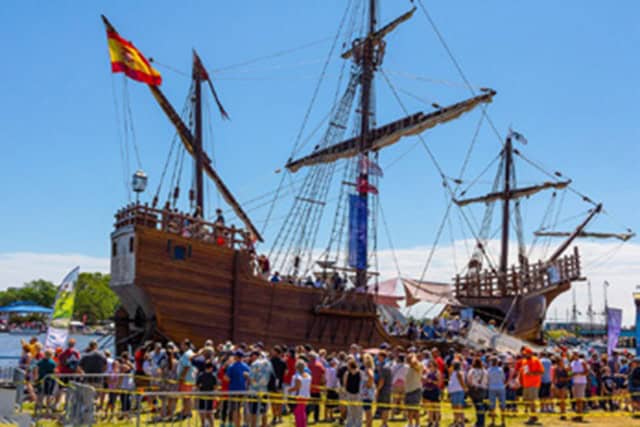
It carries five sails with a surface of 303 m² and the standing and running rigging consists of approximately three kilometres of rope.
It has a crew of 20 men. The replica combines historic rigour with sailing requirements in the 21st century and current legislation, and includes modern elements such as engines and machine rooms, GPS system, radio, radar, fuel tanks, water tanks, gas cooker, showers and sinks, among others.
The lower part of the vessel is an exhibition area for visitors to discover its history.
Visiting Ramsgate
Ramsgate will be one of the English ports to welcome the Nao Santa María after more than three years in the United States, opening its decks to the public in cities such as New York, Miami or Puerto Rico.
People will be able to get on board and see how the adventurers of yesteryear sailed and lived.
The ship will be open to visitors from July 23 -27, 10am to 8pm each day.
It is advised to buy tickets in advance at https://tickets.naosantamaria.org/content
Associations should arrange to visit the following e-mail address: [email protected]
Tickets
Regular: £10 / child (5- 10 years): £5 / £25 Family (2 regular + up to 3 children between 5- 10 years). Free for children under 5 years old, who must be accompanied by an adult.
Guided group visits, arrange through: [email protected]
Points of sale: on the ship or on the website: https://tickets.naosantamaria.org/content

To all on the Nao Santa Maria: A warm welcome to proper Europe 👋
The term Nao is known elsewhere as a Carrack.These were vessels with tall structures fore and aft,and developed into enormous (for their time) vessels such as the Henri grace a dies or Great Harry and the Mary Rose.They were also the transition between clinker built(overlapping planks of wood) and carvel built where wooden planks were fitted around an internal wooden frame or skeleton with caulking between the joints to reduce leakage.
The Nina and Pinta were smaller caravel ships with triangular lateen sail rigs.