

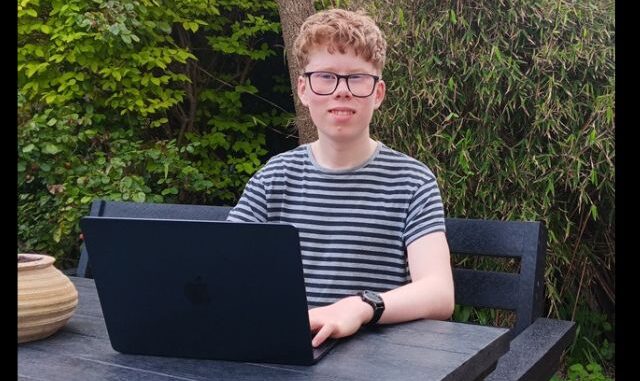
Max Vigar is a home-educated 14-year-old writer. He is based in Margate and writes articles, poetry, and stories on a variety of themes, including themes like AI and honesty.
As AI evolves, will there still be room for human creativity in our iridescent community?
Thanet is home to an impressive creative community – from painters to poets to performers. It’s thriving and it feels more powerful than ever. However, can that continue with one technological development looming?
We already use AI in countless ways – collating information, enhancing our lives, and boosting efficiency. It’s a powerful tool, and it’s only getting better.
I’m a 14-year-old writer. I pen articles, poems, and stories, and my dream career is to write for a living alongside the many other writers, poets, and artists who call Thanet home. But what happens to those creatives if AI starts to become the default – if the copy for websites and the content for magazines starts coming from chatbots rather than real writers, where do Thanet’s creatives – young and old – go? My fear is that bots will replace writers, and all the literature that we read – that we use to communicate and connect **with each other – will be generated by a computer, not a person, in the near future.
If AI took over journalism and creative writing, it would crush the dreams of Thanet’s young writers. Working creatives would lose the income they rely on, and the chance to share their passion with the world. And what would replace them? Software. Code. Lines of logic without heart or empathy. How could it truly replicate human expression?
Why replace aspiring and established creatives at all? While it would be cheaper and more straightforward, creativity isn’t about mechanical efficiency. It’s an opportunity for us to explore ourselves, talk to each other, contemplate the world, and form the human-to-human connections that we all rely on. Since birth, I’ve been surrounded by Thanet’s creative projects, from youth workshops to film clubs, and people involved in local creative communities like Marine Studios and Kent Film Foundation will face an uphill battle just to stay heard – or even to stay employed – if AI takes over.
I don’t believe that my fear is irrational – take a look at ChatGPT or Google Gemini. These apps can generate an article – on any topic you request – in under a minute. Want a poem? Just type ‘write a poem’ – and thirty seconds later, one appears. For free. LLMs (Large Language Models) are a force to be reckoned with – all working at breakneck speed, right in a browser tab. Anyone could have competent material in seconds.
Obviously, AI comes with its fair share of benefits for writers. I use it myself. It’s very helpful for research, so long as you do a quick fact check on what the bot tells you, and it can suggest tweaks that could be made to your work, which is very handy in the editing stage of penning a piece. It can also re-order parts of an article to improve structure – I have found ChatGPT surprisingly good at this. So chatbots aren’t all bad news for us creatives; they can help us develop our work.
There would also, of course, still be avenues that writers and other creatives could take. Performance poets that tour and share their work live will likely avoid being overshadowed by chatbots because they can captivate the audience in a way that a computer program can’t. These platforms can’t – and probably won’t anytime soon – perform live like a human can. AI simply lacks the charisma, personality and physicality that make us human. Songwriters that perform their work may be in demand more than ever, as live events could become a sought-after way to creatively connect with other humans – stand-up comedy may thrive. LLMs may not be bringers of doomsday for Thanet’s artists, but they could still deliver a near-fatal blow for many.
I don’t mean to blindly criticise these tools; my qualms lie with just how involved they will become in the world of writing. One of the reasons we don’t see many teenage writers in our widely read magazines and journals may be that adults are more experienced, capable competitors to them. This advantage means under 18s’ submissions are often declined in favour of over 18s’ work. Now imagine AI as the adults – quicker, more efficient, better at research, and never needing a break. But even seasoned writers won’t be able to outmatch bots in the future. We’ll all be children, and AI will be the more capable one.
This is my fear: if AI spreads too far into literature, it could overtake all of us wordsmiths – whatever our age – and leave us unable to fulfil our dreams and our lives, and we may lose the human connections that creativity builds – connections so integral to our community. On the other hand, if we value and support our true writers and artists – which our area has in abundance – then the local creative scene could flourish in a way no bot could ever imitate. So this is the question: will Thanet keep the ink flowing – or will it turn the page on its creatives in favour of AI? The future is ours to write.

I suggest he trains for a proper job if he’s correctly worried there’ll be no money in writing poetry.
Max, you have a world of opportunities ahead of you still. Generative AI is an average of everything put into it, so if you are above average you can beat it. People crave human connection, not machined sludge, even if they indulge in it sometimes. You can write, and write well, so write, and keep writing. Don’t be afraid of AI. Get angry. Destroy it with art.
As a writer myself, I welcome AI. NOT because I use it (I don’t!), but because everything “it” writes is in the same over-wordy and humourless (and often inaccurate) fashion. So Max, just continue to develop your own individual style, and you’ll be just fine.
Wouldn’t worry about it-by the time you are 25 there will be virtually no job that AI or AGI hasn’t taken over from humans.
Really, it’s called progress, been happening since the dawn of time in all arenas. If it’s popular and consumer buys into it, AI wins. There will always be a place for truly independent creative thinking, so as in many things the best will always flourish. You’re insular situation ( being home schooled, for whatever reasons, with all the arguments for/against), detaches you to a degree from the world at large and so colours your thinking. AI will never replace true genius and freethinking at the top of the scale but will most certainly do away with the bottom rungs of many activities. So as ever someones outcome in life is defined by the mix of talent , drive , aspiration .
Other than delicate surgical work there is no job that cannot be replaced by AI/AGI in a decade or so. We have already seen in warehousing how they have mostly replaced people & do everything way faster.
The top pilots in thw world do simulations with AI & lose every time-wars will be fault with robots, not humans & whoever has the most money/technology will win a lot faster. In 10 years time if Russia/Ukraine happened then with China joining in on Russia’s side, Ukraine would have been under Russian control within months, probably a month or less.
Why are super rich employers who care less about their employees already going to hire people to stack shelves, serve on tills, do manual labour jobs, answer phones, arrange meetings, take notes etc-which is most UK jobs, when robots can do it far quicker, without errors, without wanting holidays, toilet breaks, cigarette breaks, never get ill, to leave early to pick the kids up from school/nursery etc, when they have a fleet of robots to do it for free-after they buy them as a one off payment?
Afraid that man has invented his doom, his first step was touching the Moon. Now who is going to take away their licence to kill?
Robots are used for the most delicate surgery.
Yes, but only under human supervision. They lack one important thing in surgery & that is making decisions when things change based on the view & a new course of direction has to be agreed upon quickly.
Not really thought is it? Progress for the super rich, but not the masses. Of course as we have seen with recent banking/shop software crashes & airline software crashes-whether through hacks or updates wiping out the systems etc, the old/dinosaur ways of keeping written records & paying in cash do have advantages.
LLMs are very good at remixing the material they have been trained on, but when it comes to using on for research they are fraught with difficulties, as they will broadly return an answer based on the most common results. If those are wrong, the bot doesn’t care, it will incorporate that into a competently-worded response. The fact-checking required negates the usefulness of the tool, much of the time.
The source of LLMs model training material is contentious, because most simply scrape content from the net, without reimbursing or acknowledging the writers whose work they are using. When the recent consultation regarding options on licensing materials came out, the tech firms were fully in favour of being able to continue using whatever they found for free. Shocker.
As it is, the favoured model is an opt-out system, which would still require creatives to actively remove their material and deny access. At best that’s an immense pain, requiring ongoing vigilance and follow-ups, at worst it could mean removing material from search engine results, limiting their ability to monetise their work.
1. AI is here to steal your spreadsheets so you can finally write that novel about a time-traveling platypus.
2. While robots handle your emails, you can get serious about finger painting or interpretive dance.
3. Thanks to AI, your job can now be outsourced to a silicon brain while you become the world’s first professional cloud-watcher.
(according to AI)
Good jounalists will always be needed, not just in print, but braodcasting too! I sketched out 80 pages of notes about my career in the nuclear power industry in 1985, intending to turn it into a book. Then I had to redraft it after the Chenobyl nuclear power station accident in 1986. I still have the manuscripts, as it was unprintable, because few people understood nuclear engineering, Duurh! Anyone want a copy?