

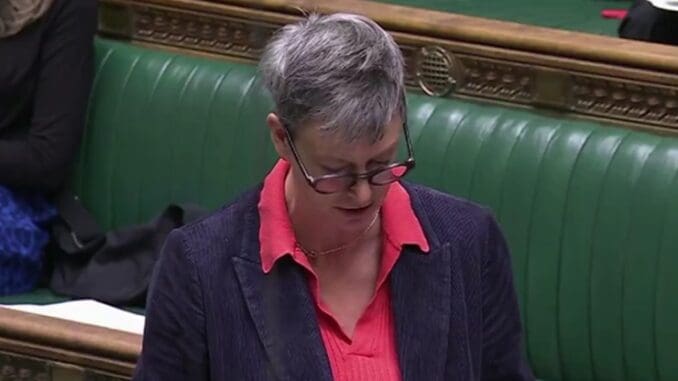
East Thanet MP Polly Billington has tabled a bill in parliament calling on the government to introduce a ‘social tariff’ on energy bills.
Ms Billington’s suggestion of a social tariff aims to force energy companies to provide a discount on bills for those struggling to pay, protecting them from the impact of rising prices.
The rising cost of gas, which sets national energy prices, has caused household bills to increase dramatically, causing significant hardship for millions of households.
Ms Billington says that while the long-term solution is making the switch to cheaper, homegrown renewable energy, she wants to see more done to support the most vulnerable households during a particularly difficult time.
Fuel poverty
Putting forward the Bill in Parliament, Ms Billington said: “As an MP, the reality of fuel poverty is frequently rammed home to me on the doorstep, where concerns are raised about the rising costs of energy and the pressure that they put on household budgets, especially among those on low incomes.
“East Thanet is not a leafy, affluent community of the kind that many people associate with the south-east. It is a coastal community with high levels of deprivation, much low-paid and insecure work, many elderly residents, many families with a disabled member, and many cold, old and draughty homes.
“In Thanet, a quarter of all working-age adults claim universal credit, and over 40% of people claim at least one form of benefit from the Department for Work and Pensions. These are the people who suffer most from increasing energy bills, and who often have to choose between heating and eating.
“A social tariff that supports the most vulnerable with their energy bills and prevents them from falling into fuel poverty would protect them from some of the failures of the current energy market, and shield them as that market is reformed to make the most of leaving fossil fuels behind.”
The ‘Ten Minute Rule Bill’ tabled by Ms Billington is a type of legislation backbench MPs use to lobby government. Social tariffs already exist in a number of countries, such as Spain, where vulnerable customers receive a 35% discount, while severely vulnerable customers get 50% of their bills.
According to research by the House of Commons Library, 13% of households – 3.1 million households – in England are classed as ‘fuel poor’ and Kent County Council statistics (June 2024) show that Thanet had the highest fuel poverty rate in Kent at 15.8%, compared to the county average of 11.4%.
Bills ‘skyrocket’
Ms Billington said: “Over the past few years energy bills have continued to skyrocket because the UK’s energy system remains hooked up to volatile international gas markets controlled by dictators like Vladimir Putin.
“In a place like East Thanet with old, poorly-insulated homes and above-average deprivation that’s a particularly big challenge. It’s shocking that 15.8% of Thanet households are living in fuel poverty, significantly above the Kent average.
“While the government works hard to make the switch to clean, homegrown renewables that will permanently bring bills down, I want to see more done to support the most vulnerable customers through these tough times.
“That’s why I’m campaigning for the introduction of an energy social tariff that would force energy companies to give discounts to their most deprived customers.”
Energy cap
From 1 April to 30 June 2025 the price for energy for a typical household which uses electricity and gas and pays by Direct Debit will go up by 6% to £1,849 per year. For a typical household, this will add £9.25 a month to their energy bills.
This is 9% (£159) per year higher than the price cap set by Ofgem for the same period last year, from 1 April to 30 June 2024 (£1,690).
Energy bill debt
In Parliament, Ms Billington said people owe more than £2 billion in energy bill debt, and that figure has doubled in the past three years alone.
She added: “Those in debt then become stuck in a cycle where they face an increase in energy bills while also trying to pay off the debt they have built up. That is not sustainable for those consumers or even the energy retailers, which have to deal with the fallout from fuel poverty debt.”
The Bill is at the second reading stage in the House of Commons with a date yet to be set. It has to pass through several stages at the Commons and then the House of Lords before reaching consideration of amendments and then Royal Assent.
