


Green Councillor Kevin Pressland is a passionate campaigner for nature and the natural environment. His understanding of the threats faced by the natural world is based on expertise gained from a 40-year career in horticulture, garden design and sustainable land management:
As Thanet residents may be aware, Australia’s legislators have had the courage to ban children 16 and under from social media. One hopes sense will prevail and that other countries including the UK will follow suit.
I am encouraged to hear the London Borough of Barnet schools have started to go smart phone free since September 2025, making it the first borough in the country to do so, with all 103 primary schools signed up and secondary schools beginning to follow suit.
I applaud the schools, parents and teachers and the local MP there for pushing for this and I hope our local Labour MP Polly Billington in East Thanet will encourage this approach and I hope Roger Gale MP (West Thanet) will also urge schools in his constituency to do the same?
It’s about time action was taken as children’s mental health and wellbeing wherever they are they must come first before the interests of tech companies’ profits. Will our MP’s urge our government to act and not push the can down the road?
Nature for mental wellbeing
We also have an epidemic of anxiety in the UK, with nearly a fifth of people experiencing it over the course of a year in varying degrees, including young people.
Although anxiety is often treated through medication, there are many alternative ways which are proving to be very effective for some people. The series ‘An Almanac for Anxiety/In Search of a Calmer Mind’ on Radio 4 sounds https://www.bbc.co.uk/sounds/play/m001p6vt explores how connecting with the elemental forces of nature helps people with a range of mental illnesses to feel better. It also pinpoints current academic research behind these methods.
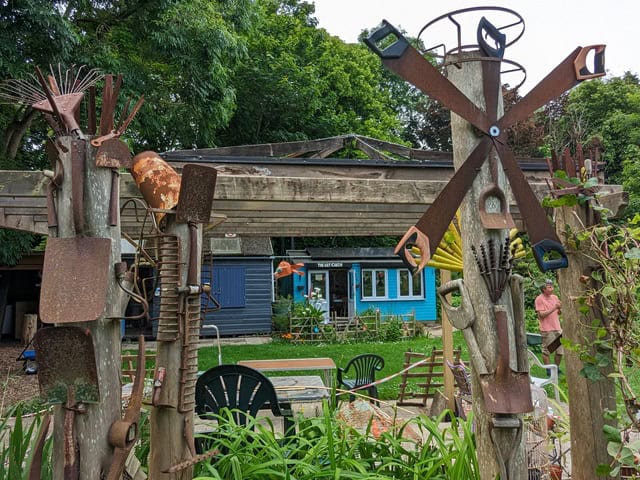
In Episode 5 – Earth – they visit the Horticultural Therapy Trust allotment in Plymouth and discover how gardening can be soothing for people with severe mental illnesses. We are privileged to have the ‘The Garden Gate Project’ at Northdown Park, a place of healing and community spirit, we also have the ‘Windmill Garden Trust’ another fantastic initiative. We need more of these initiatives in Thanet and beyond. I hope you agree?
If so, please tell your TDC and KCC councillors.
This BBC 4 programme also talks about how putting our hands in the earth can be good for our gut microbiome and potentially our mental health. It has been shown to reduce inflammation which is a real issue in many societies that have limited interaction with soil etc
I, and I know others, would like to see education in Thanet and beyond expand opportunities for pupils to interact with natural surroundings, enabling interaction with soil, animals, plants and as the programme touches on, all these improve people’s social interaction and joy too. I hope more schools in Thanet will take up this challenge.
It also encompasses many subjects on the curriculum in subtle ways maths, English, geography other natural sciences, wider science etc
People may not be aware on 30th October 2025, the country of Colombia’s Congress approved the so-called Empathy Law, a measure that will make education on animal protection compulsory in every school in the country, both public and private, by embedding concern for other animals and nature in the national curriculum.
The initiative, known as ‘Law 010 of 2024’ and authored by Green Alliance senator and animal advocate Andrea Padilla, is framed as a cultural and educational shift to raise new generations of empathetic citizens who respect all forms of life.
This is clearly needed in the UK as the animal abuse figures outlined by the RSPCA show. The welfare charity revealed it dealt with 129 abuse reports for Kent last Summer, a rise or 101% since 2020. Also, in East Sussex there was a 76% rise, West Sussex a 52% rise, Surrey an 80% rise.
Ian Briggs, head of the RSPCA’s special operations unit, called the figures “really distressing and stark”. He added that England and Wales had an overall rise of 105% in reports of beatings over the last 4 years: 1,613 for July to August 2020 to 3,304 in July to August 2024 alone.
These figures clearly indicate our society needs to address this lack of empathy with other creatures and the wider creatures of the farming and the natural world of which we share this beautiful planet.
I ask all of us to encourage our MPs to urge the government to pass an Empathy Law, a measure that will make education on animal protection compulsory in every school in the country, both public and private, by embedding concern for other animals and nature in the national curriculum in the UK.

Until Forster’s 1870 Education Act there was no compulsory schooling within the U.K. Compulsory primary education was not introduced to socially enlighten children. It was introduced to ensure an educated workforce for the future of the country’s increasingly technologically advanced industries. Forty years later, compulsory secondary education was introduced for the same reasons.
Why should the wealth generated within the Primary and Secondary Sectors of the economy be allowed to be squandered by those who are tasked with creating the future workforce?
Policing every aspect of a child’s conduct and activity, moral guidance, nutrition, etc. is the parent or guardian’s responsibility. It is the British way.
A valid article, although many in the political world wouldn’t have a clue about empathy judging by the current attack on farmers (still), small businesses, pubs, free speech etc. etc. And the state over reach is evident. The BBC also plays its own part in causing anxiety across the nation with its willingness to carry out the state’s various fear messages and undertaking seriously misleading edits and reports to skew opinion. But more time in nature is undoubtedly good for children and adults, away from the addictive smart phone scrolling (designed as such).
I like the BBC. No adverts, and plenty of interesting classical and modern music on Radio 3. I’ve never noticed any “fear messages”, whatever they are.