

Kent’s councils have finally submitted their views to ministers on how they think they should be abolished – and what should replace them.
With several competing visions now in Whitehall’s hands, Local Democracy Reporter Dan Esson examines what the shake-up could mean for the county…
Why the reforms?
Earlier this year, every council in Kent began drawing up its preferred blueprint for how the county should look after Local Government Reorganisation (LGR). The Labour government is embarking on the biggest overhaul of England’s local authority structures since the 1970s.
Since 1974, Kent has operated a two-tier system: Kent County Council (KCC) sits above 12 district and borough councils, with responsibilities split between them. Districts run services such as bin collections, while KCC operates the household waste sites where that rubbish ends up. KCC also maintains roads and oversees areas such as education and social care.
Under the reforms, all councils in England are expected to become unitary authorities – like Medway – bringing all powers under a single roof. A unitary council would be responsible for everything from waste and roads to schools and social care.
The Ministry of Housing, Communities and Local Government (MHCLG), which is steering the reforms, says the changes will produce more efficient services and stronger local democracy.
“Reorganisation will improve public services in Kent and ensure every penny of taxpayers’ money is well spent,” a spokesperson said.
“Our plans will unlock growth and speed up building, and ensure local people get better support when they need it most.”
The popular choice: Option 3a
With 14 authorities set to be scrapped, reorganisation in Kent was never likely to be simple. As of today, all have declared their preferences. Perhaps unsurprisingly, there is little agreement.
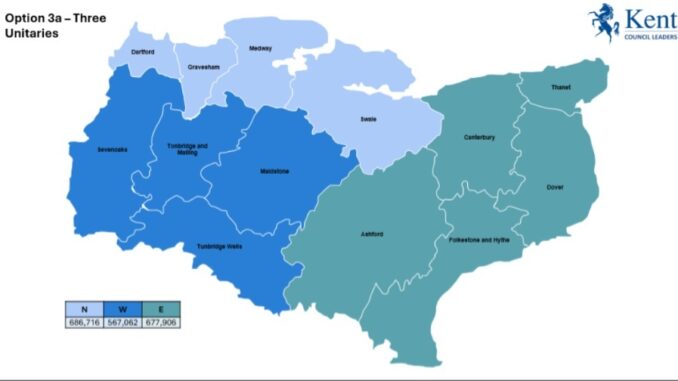
The most popular proposal, endorsed by five councils, is Option 3a. It would create three unitaries: East, West and North Kent. Crucially, it keeps all current district boundaries intact.
Cllr Kevin Maskell (Con), Sevenoaks District Council’s Leader, says: “We have carefully considered the issues, and we firmly believe three new unitary councils would best serve our residents and Kent as a whole.
“In our opinion, the three-unitary model is the best option to manage future financial and service pressures and therefore, to meet Kent residents’ needs.”
Splitting it four ways
Two separate proposals for four unitaries have emerged – both centred on East, West, North and Mid Kent, but with different borders.
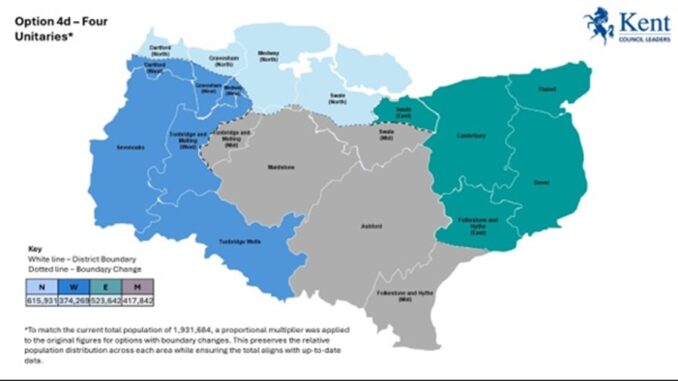
Option 4d is the preferred option of Medway Council, Canterbury and Ashford – splitting the county into four, and breaking up some existing boundaries.
This would see Faversham and its environs leave Swale for East Kent. Folkestone would join East Kent, while Romney Marsh would become part of Mid Kent.
West Malling would join Mid Kent, while Tonbridge would become part of the West. The less-populated parts of Dartford, Gravesham and Medway would join with West Kent too, while the larger towns remain part of the north.
Cllr Alan Baldock (Lab), Canterbury council leader, said: “This is the start of a new era and the creation of new opportunities to work smarter and to allow people to walk through one door to seek help with life’s challenges, reassured the public services they desperately need and deserve will be there.”
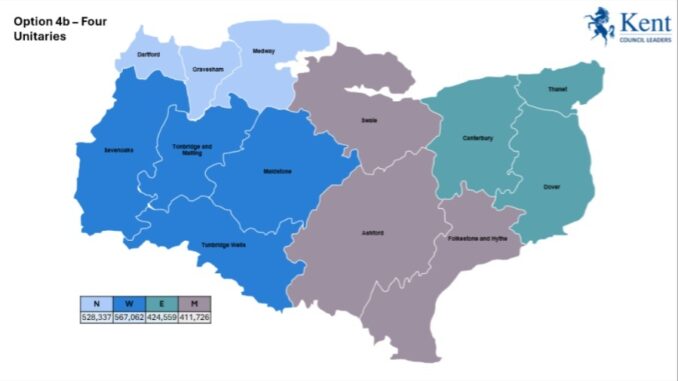
Dover, Swale and Thanet, however, have opted for four councils with a different split – known as Option 4b.
This would see four councils without breaking up any existing boundaries – but unusually with one Mid Kent authority stretching from Folkestone and Romney Marsh in the south to Sheppey in the north.

Dartford and Gravesham councils are the only two to support option 5a – for five smaller councils.
Their proposal mainly uses existing boundaries, though with some changes. Most of what is currently Sevenoaks district would be in West Kent, but Swanley would become part of North Kent.
The part of Medway north and west of the river would become part of North Kent, whereas the parts south and east of the river would join with Swale to form Mid Kent, excluding Faversham, which would become part of East Kent.
Going it alone
KCC is the only authority advocating the creation of a single, countywide authority – supported by three area assemblies for East, West and North Kent.
Next the Government will carry out a consultation process with stakeholders and the public, scheduled to begin in the new year.
The final decision from government on a selected option and geography is expected in Summer 2026.
As things stand, the new system is due to come into force in April 2028, with elections beforehand and the new bodies operating as “shadow authorities” until the old councils formally shut down.
Criticism
Not everyone is enthusiastic about the plans.
Local government expert Professor Colin Copus of De Montfort and Gent universities, has branded the reorganisation “an unprecedented act of municipal vandalism.”
“This reorganisation is totally unnecessary; it’s based on a flawed assessment that somehow bigger local gov is always better and more effective and cheaper,” he said.
“But we’ve known from research over the past 50 years that isn’t always the case and if it does turn out they’re cheaper, it’s often to do with other factors.
“Its very unlikely that these massive savings quoted with one proposal or the other are ever going to be met.
“The bigger local government gets, the less people care about it, the less they’re likely to engage and the less it means, and services are highly unlikely to improve anyway.”
What will the reforms achieve?
Reform-led KCC’s single mega-council with three area assemblies below it, would make Kent the biggest unit of local government in Europe, taking the record from the current holder, Birmingham City Council.
Dartford and Gravesham’s brainchild, Option 5a, coincidentally includes a small, densely populated northwestern authority, comprised largely of the area currently covered by both of them, plus Swanley and part of Medway. It’s safe to assume MHCLG will dismiss these out of hand.
Three or four councils will probably be the final result – but whatever model is chosen, the crisis of British local government is likely to outlive its current structures.
The new authorities will hopefully have more money to spend than the existing ones. But they will nonetheless be met at the gates with colossal commitments to pay for. Social care – which consumes most of KCC’s budget – will be divided up between the councils unless they devise some alternative means of providing it.
Demand for that service is only growing, and costs along with it; all the while it remains the legal responsibility of local government, it will be ruinous to their finances. Similar applies to SEN transport – an ever-ballooning expense which will likely be passed onto the new authorities.
The long-term spending commitments of the existing councils, including debt, will need to be redistributed between the new bodies. The dissolution of Northamptonshire County Council in recent years offers an example of what this looks like – a drawn-out court battle of many years.
Many of the structural problems squeezing councils – high borrowing costs, inflated service prices for the public sector and ever-increasing demand – cannot be solved by drawing new borders.
These are large-scale economic and political problems that could only be counteracted by much more wide-ranging reforms to the British state. Kent’s new councils may help streamline the management of our problems, but they will not solve them.
